

Branding and positioning: the ecommerce retention edge
TL;DR:
- Many ecommerce marketers mistakenly treat branding and positioning as interchangeable, leading to ineffective email flows.
- Understanding and integrating distinct brand positioning ensures more relevant messaging, boosting customer loyalty and retention.
Most ecommerce marketing managers treat branding and positioning as interchangeable terms, then wonder why their Klaviyo flows feel flat or fail to build genuine customer loyalty. They’re not the same thing, and conflating them is quietly killing retention performance across thousands of stores. Branding and positioning are two distinct strategic tools, each doing a different job, and when you understand the difference, your email automation starts doing work that paid ads simply cannot replicate. This guide breaks down both concepts clearly and shows you exactly how to wire them into your Klaviyo retention strategy.
Table of Contents
- Understanding branding versus positioning in ecommerce
- Why a clear brand positioning statement powers consistent retention messaging
- Integrating brand positioning with Klaviyo’s retention email automation
- Optimizing timing and message quality with Klaviyo’s AI-driven personalized send time
- Avoiding common pitfalls: maintaining brand voice and strategic oversight in AI-powered email marketing
- Our take: positioning is not a branding deliverable, it is a revenue decision
- Ready to connect your brand positioning to email revenue?
- Frequently asked questions
Understanding branding versus positioning in ecommerce
Most confusion between these two concepts comes from the fact that they live close together in marketing discussions. But their jobs are fundamentally different.
Branding versus positioning works like this: branding is the set of identity signals your brand outputs, while positioning is the mental slot your brand earns inside your customer’s head relative to every other option they have. Branding is what you say and show. Positioning is what customers believe and remember.
In ecommerce, this distinction has real operational weight. If your brand uses a warm, conversational tone and earthy visual palette, that is branding. If customers instinctively think of you as “the sustainable skincare brand for women over 40 who don’t want to compromise on performance,” that is positioning. One is an output. The other is an outcome.
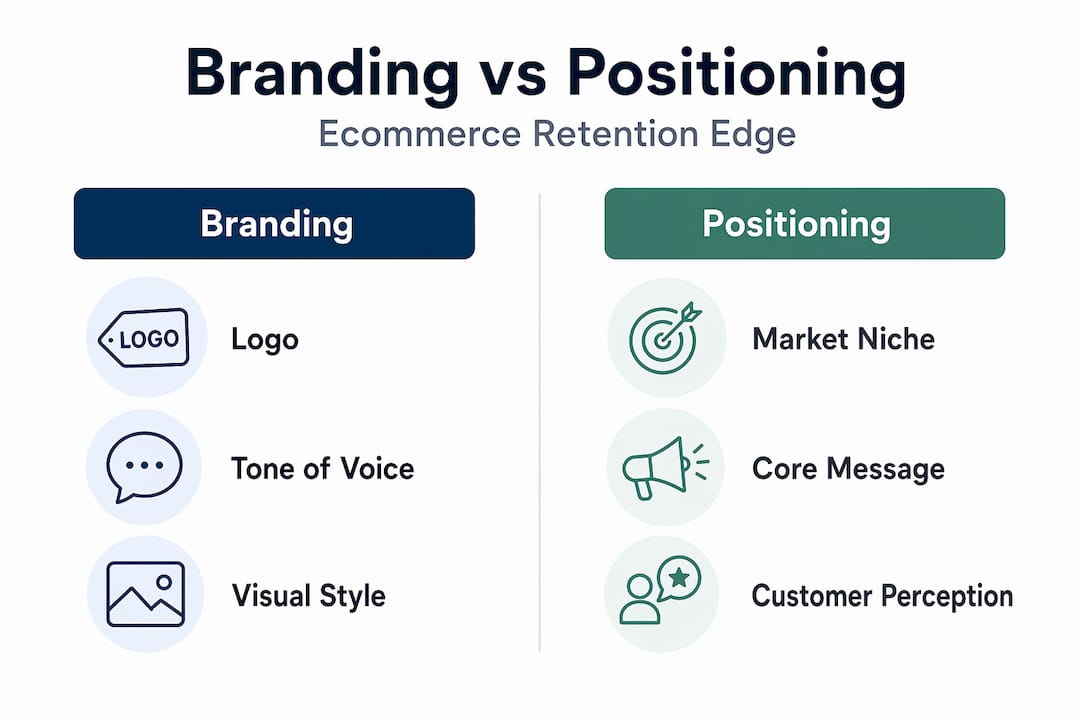
Here is how the two categories break down in practice:
Branding elements (what you control and express):
- Logo, color palette, and typography
- Email design templates and visual style
- Brand voice, tone, and word choices
- Photography style and content aesthetic
- Taglines and campaign copy
Positioning elements (the mental real estate you compete for):
- Target customer definition (who specifically you serve)
- Category frame (which problem you solve, and how you name it)
- Differentiation claim (why you over everyone else)
- Emotional and functional benefit ladder
- Competitive context (who you are implicitly not)
When you think about personal branding in email marketing, both layers matter. But positioning is the layer that determines whether your emails feel relevant, not just recognizable. An email that looks on-brand but fails to reinforce your differentiated position is just pretty noise.
Why a clear brand positioning statement powers consistent retention messaging
A positioning statement is not your tagline. It is not your mission statement. It is an internal strategic document that tells every person on your team what your brand stands for, who it serves, and why customers should choose you. When it is written well, it makes campaign decisions obvious and prevents the slow drift that turns email programs into generic discount machines.
A strong positioning statement has five non-negotiable qualities that keep it useful in day-to-day decisions. Here is what each looks like in an ecommerce context:
- Clear. Jargon-free and specific enough that a new hire understands your brand’s purpose in one read. Example: “We make chef-quality knives accessible to home cooks who take weeknight dinner seriously.”
- Relevant. Rooted in what your target customer actually cares about, not what sounds impressive internally. If your buyers prioritize speed, your positioning should reflect urgency and efficiency.
- Differentiated. It must put space between you and the next-best option. “Quality products at fair prices” is not a position. “The only meal kit service designed specifically for two-person households” is.
- Credible. You need to be able to back it up with product reality, reviews, or a demonstrable process. Positioning that outruns your product creates churn, not loyalty.
- Actionable. The real test: can your email team use this statement to approve or reject a subject line? If yes, it works. If it is too abstract to guide real decisions, rewrite it.
Understanding the customer retention importance in ecommerce becomes clearer once your positioning statement is tight. Every post-purchase email, every winback flow, every loyalty nudge should echo the same core promise your positioning defines.
Pro Tip: Before you launch any new email campaign or update a flow’s messaging, run it through your positioning statement like a checklist. Does this email reinforce our differentiation? Does it speak to our specific target customer? Does it stay credible? If any answer is no, rewrite before you send.

Integrating brand positioning with Klaviyo’s retention email automation
Here is where strategy meets execution. Your positioning statement is not just a document that sits in a Google Drive folder. It should be the filter every Klaviyo flow runs through before it reaches a customer’s inbox.
Retentive email flows should start with high-intent triggers like abandoned checkout and use customer profile data to personalize experiences, not just insert a first name. Personalization guided by positioning means your abandoned cart flow for a premium skincare buyer sounds nothing like one for a budget fitness supplement buyer, even if both came from the same template. The trigger might be identical. The message should feel worlds apart.
Here are the core Klaviyo retention flows and how your positioning shapes each one:
- Abandoned cart flow. Your highest-intent automation. Use positioning to address the exact hesitation your target customer has. A brand positioned on sustainability reinforces ethical sourcing here. A brand positioned on performance shows proof.
- Post-purchase flow. This is where you deepen the relationship. Your positioning defines what “customer success” looks like for your buyer and how you communicate it in onboarding emails.
- Winback flow. Timing is everything here. Customer repurchase likelihood drops significantly in the 30 to 60 day window after a purchase. Your winback message should restate your differentiated promise, not just offer a discount.
- Browse abandonment flow. Lighter-touch but still on-brand. Use your tone and positioning to add context to what the customer browsed, not just remind them it exists.
- VIP and loyalty flow. Your positioning elevates this beyond points and perks. It tells loyal customers why they specifically belong in your brand’s inner circle.
You can build far more precise flows by combining this with personalization strategies in Klaviyo that segment by purchase behavior, product category, and predicted lifetime value. And when choosing your tech stack, an email automation tools comparison can clarify where Klaviyo’s segmentation depth gives it a real structural advantage over simpler platforms.
| Retention flow | Trigger event | Personalization method | Core positioning message type |
|---|---|---|---|
| Abandoned cart | Cart not completed after X hours | Product category + customer tier | Reinforce brand promise and overcome hesitation |
| Post-purchase | Order confirmed | Purchase history + onboarding stage | Welcome to the brand world; define customer success |
| Winback | No purchase in 60 to 90 days | RFM score + last category browsed | Restate differentiation; remind why you exist |
| Browse abandonment | Product viewed, no add to cart | Browsed category + session frequency | Add context and brand value, not just urgency |
| VIP loyalty | Loyalty threshold crossed | Spend tier + lifetime purchase count | Celebrate belonging; deepen brand identity |
Optimizing timing and message quality with Klaviyo’s AI-driven personalized send time
You can write the most on-brand email in your company’s history and still lose because it lands in the inbox at 11:47 PM on a Tuesday. Timing is not a minor detail. It is a core element of how your positioned brand promise gets experienced.
Personalized send time in Klaviyo uses AI models to predict the optimal open and conversion windows for each individual subscriber, based on their historical engagement patterns. It includes a control group by default, so you are always running a real performance comparison. Critically, it optimizes for revenue outcomes, not just open rates, which means the AI is aligned with the same metric you care about.
Here is how to implement it effectively:
- Enable personalized send time at the campaign level inside your Klaviyo send settings.
- Set quiet hours to match your audience’s time zone distribution, so the model respects reasonable sending windows.
- Allow the AI at least four to six weeks of data before drawing conclusions. It learns continuously.
- Use the revenue-per-recipient metric, not just open rate, to evaluate whether timing changes are driving real results.
- For flow emails, review send-time data quarterly and adjust manual delays when you see consistent drop-off patterns.
“Personalized send time is not just an open rate tactic. When you optimize for revenue at the individual level, you are building the habit of engagement, not just catching someone in a lucky moment.” This is how positioning gets delivered consistently: the right message, in the right voice, at the moment each subscriber is most ready to receive it.
The customer retention importance point here is underrated. Retention is not just about what you say. It is about when your brand shows up in someone’s routine. Timing shapes that habit.
Avoiding common pitfalls: maintaining brand voice and strategic oversight in AI-powered email marketing
AI tools can accelerate your email program significantly. They can also quietly flatten everything that makes your brand worth remembering. The risk is not that AI writes poorly. The risk is that it writes competently but generically, producing emails that are grammatically clean and completely forgettable.
Without explicit brand guardrails, AI can cause brand voice to become generic, and recovering from that kind of brand drift is harder than preventing it. You will not notice it happening email by email. You will notice it when your open rates are fine but your revenue per email is sliding, and your customers have stopped talking about you the way they used to.
Common brand voice mistakes in AI-assisted email programs:
- No documented voice guide. AI generates based on inputs. If your team has not written down tone, vocabulary preferences, phrases to avoid, and examples of on-brand copy, you are handing a blank canvas to a tool with no taste.
- Treating AI output as final. AI is a first draft engine. Every email still needs a human to read it through the lens of your positioning statement before it sends.
- Over-indexing on performance metrics and ignoring brand health. Click rates measure today. Brand voice affects whether customers come back next year.
- Using AI for subject lines without testing brand consistency. Subject lines are the first positioning signal in the inbox. Generic curiosity-gap subjects erode differentiation over time.
- Skipping brand audits of automated flows. Set-it-and-forget-it flows become tone-deaf over months. Schedule quarterly reviews.
Personal branding in email is what separates a customer’s inbox relationship with your brand from their inbox relationship with every other store they bought from once. Protect it like the revenue driver it is.
Pro Tip: Build a short “brand voice checklist” of five questions and require every AI-assisted email to pass it before sending. Questions like “Does this sound like a person or a press release?” and “Would our target customer feel like this was written for them specifically?” catch drift before it compounds.
Our take: positioning is not a branding deliverable, it is a revenue decision
Here is the uncomfortable truth that most branding conversations miss: positioning is not a creative exercise. It is a business decision that determines who you will win with and who you will lose to. It sets the filter for every email you send, every customer you retain, and every dollar you recover from abandoned carts.
We see ecommerce brands treat positioning as a one-time deliverable, something you set during a rebrand and then file away. Then they wonder why their Klaviyo flows feel disconnected, their winback rates are mediocre, and their VIP segment keeps shrinking. The positioning was fine. The execution was never connected to it.
The brands that build durable retention programs are the ones that treat positioning as a living operating system. Every time they write a new email sequence, they run it through the positioning filter. Every time they test a new subject line angle, they check whether it reinforces their differentiated claim. They do not confuse more emails with better email. They know that a single well-positioned message at the right moment is worth more than seven generic campaigns in the same week.
If your email program feels like it is performing but not compounding, the answer is almost never a new template or a better send time. It is almost always a positioning problem masquerading as a technical one. Fix the foundation, then let the automation amplify it.
Ready to connect your brand positioning to email revenue?
Your brand has a position worth fighting for. But without the right automation infrastructure, that position never fully reaches your customers’ inboxes. At Take Action, we build Klaviyo retention programs that are built around your specific brand positioning, not generic templates. From abandoned cart flows rooted in your differentiated promise to AI-optimized send times that respect your customer’s patterns, everything we build is designed to make your brand memorable and your revenue predictable.
If you are ready to stop leaving retention revenue on the table, explore how our Klaviyo email marketing services translate your brand strategy into automated, measurable growth. We work with ecommerce brands who know their product is worth returning for and need an email program that proves it.
Frequently asked questions
What is the difference between branding and positioning?
Branding is the process of creating your company’s identity signals like logos and tone, while positioning is the mental space your brand occupies relative to competitors in the customer’s mind.
How does a brand positioning statement help ecommerce marketing?
It provides an internal guide ensuring all messaging and product decisions align and differentiate your brand, which is why strong positioning statements guide product decisions, marketing, and customer experience with both clarity and actionability.
Why is timing important in retention email flows using Klaviyo?
Because the second-purchase likelihood drops within a 30 to 60 day window, sending timely and personalized messages before that momentum fades directly protects retention rates and revenue.
Can AI replace human strategy in email marketing?
No. AI should act as a collaborator that enhances your existing strategy but cannot define your goals, brand voice, or positioning; human oversight is what keeps automated messaging effective and on-brand.
How can I prevent AI-generated emails from sounding generic?
Provide clear brand guardrails, a documented voice guide, and story foundations, then regularly audit AI content against your positioning statement to catch drift before it compounds across your flows.