

Blog writing for business: frameworks for ecommerce growth
TL;DR:
- Ecommerce blogs need a strategic system linking content to specific business outcomes.
- Creating buyer-focused content around the buyer journey and SEO pillars boosts conversions and traffic.
- Integrating blogs with email marketing and repurposing content drives long-term growth and customer engagement.
Most ecommerce blogs publish consistently and still see almost no return. Traffic arrives, bounces, and disappears without converting to subscribers, customers, or repeat buyers. The problem is rarely effort — it’s the absence of a system that connects content to actual business outcomes. When blog writing is treated as a strategic channel rather than a checkbox, it becomes one of the most scalable tools you have for growing your email list, building brand authority, and fueling long-term revenue. This article gives you the frameworks, processes, and integration strategies to make that shift happen.
Table of Contents
- Understand your goals and audience
- Prepare your content strategy and structure
- Write, optimize, and format for results
- Integrate your blog with email marketing
- Why most business blogs underperform — and how to break the mold
- Take action: expert support for ecommerce blog and email growth
- Frequently asked questions
Key Takeaways
| Point | Details |
|---|---|
| Target buyer journeys | Plan your blog topics to address discovery, evaluation, and decision-making stages for maximum impact. |
| Structure for SEO and conversions | Use a pillar-cluster model and optimize post formatting to boost search rankings and guide readers to purchase. |
| Integrate with email marketing | Cross-link blog and email channels to steadily grow your list and nurture leads into customers. |
| Measure and refine strategy | Regularly review publishing cadence and results to sharpen focus and accelerate business growth. |
Understand your goals and audience
Having introduced the big-picture opportunity, let’s get clear on what your blog should accomplish and who it’s for. Without this foundation, even well-written posts drift without direction, attracting the wrong readers or failing to move the right ones toward a purchase.
Start with your primary blog objectives. Most ecommerce blogs serve one of three core outcomes:
- Traffic growth: Ranking for keywords your target customers are already searching
- List growth: Converting readers into email subscribers using CTAs and lead magnets
- Revenue support: Educating buyers, reducing purchase hesitation, and linking to products
You don’t have to pick just one, but you do need to rank them. If list growth is your top priority, every post should include a contextual email signup opportunity. If traffic is primary, keyword research drives your editorial calendar. Mixing these without a ranking order produces content that tries to do everything and achieves nothing measurably.
Map your buyer journey stages. Every reader who lands on your blog is at a different point in the decision process. The three stages to plan around are discovery (they have a problem and are searching for answers), evaluation (they’re comparing options and gathering information), and decision (they’re close to buying and need final reassurance). Content marketing for ecommerce works best when you deliberately create posts for each stage rather than publishing only awareness-level content. A common mistake is filling a blog with top-of-funnel posts that educate but never convert.
Build simple buyer personas. You don’t need a 20-page document. A useful persona answers four questions: What problem does this person have? What words do they use to describe it? Where are they in their purchase journey? And what would make them trust your brand enough to subscribe or buy? Two or three sharp personas are more useful than ten vague ones.
Use the pillar-cluster content model. As an SEO Content Workflow for Ecommerce Brands explains, planning content around buyer stages and building topic clusters with pillar pages gives your blog structural authority in search engines while guiding readers through a logical progression. A pillar page covers a broad topic in depth (think 3,000+ words), and cluster posts tackle narrower subtopics that link back to it. This model, when combined with using content pillars, creates compounding SEO value over time.
Here’s a simple benchmark table to calibrate your expectations:
| Metric | Early stage (0-6 months) | Growth stage (6-18 months) |
|---|---|---|
| Posts published per month | 2 to 4 | 3 to 6 |
| Average time on page | 1.5 to 2 minutes | 2.5 to 4 minutes |
| Email CTR from blog | 0.5% to 1.5% | 2% to 5% |
| Organic traffic growth | Slow and gradual | Accelerating month over month |
Setting realistic expectations by stage prevents the common trap of abandoning a blog strategy right before it starts compounding.
Prepare your content strategy and structure
With your goals and audience defined, now you’ll need to choose the right topics and structure posts for growth. Topic selection and post architecture are where most brands leave the most SEO value on the table.
Research keywords with low competition in mind. Blog writing mechanics for ecommerce include targeting low-competition long-tail keywords with 10 to 150 monthly searches, proper H2/H3 structure, and on-page SEO optimization. New and mid-size ecommerce blogs cannot compete for high-volume, short-tail keywords like “running shoes” or “protein powder.” Instead, target phrases like “best running shoes for flat feet under $100” or “protein powder without artificial sweetener for sensitive stomachs.” These convert better because they reflect specific buyer intent.

Here’s a comparison of pillar posts versus cluster posts to help you plan your publishing mix:
| Feature | Pillar post | Cluster post |
|---|---|---|
| Word count | 2,500 to 4,000+ words | 1,200 to 2,000 words |
| Keyword target | Broad, competitive keyword | Specific, long-tail keyword |
| Purpose | Anchor and authority | Depth and topical relevance |
| Internal linking | Links out to clusters | Links back to pillar |
| Publishing frequency | 1 per topic theme | Multiple per pillar |
Follow a numbered process for building your content calendar:
- Identify your top five to seven product or service themes
- Create one pillar topic per theme
- Generate five to ten cluster topics per pillar using keyword tools or customer questions
- Assign buyer journey stages to each topic (discovery, evaluation, or decision)
- Schedule posts at a rate of two to four per month across pillar and cluster types
- Review and refresh older posts every six months
Reviewing top blog post formats gives you additional structural options beyond the standard listicle or how-to post, including comparison posts, roundups, and case study formats that drive high engagement.
When planning your calendar, study what discount monitoring strategies and seasonal shifts look like in your market so your editorial calendar stays aligned with buying behavior. If your audience shops heavily in Q4, your evaluation and decision-stage posts should be published in September and October to rank in time.
Pro Tip: Templatize your post outlines so every writer or collaborator starts from the same skeleton. A standard template with placeholder sections for intro hook, problem statement, H2 sections with 200 to 300 word targets, internal link slots, and a CTA block saves significant time and keeps quality consistent across your catalog. Pair this with content planning for ecommerce to create a system that scales without breaking.
Write, optimize, and format for results
With a plan in place, it’s time to move from strategy to action: writing and publishing your posts for maximum impact. A well-structured strategy is worthless without posts that actually hold reader attention and move them toward a decision.
Follow this writing process step by step:
- Open with a hook that names the reader’s problem or stakes a counterintuitive claim. Never open with a generic overview sentence. The first two sentences determine whether the reader stays.
- Establish WIIFM (what’s in it for me) within the first paragraph. Readers need to know exactly what they’ll learn and why it matters to their situation before they scroll.
- Write in short paragraphs of three to four sentences maximum. Long blocks of text increase bounce rate, particularly on mobile.
- Use visuals strategically. Images, comparison tables, and infographics break up text and reinforce key points. Every visual should add meaning, not decoration.
- Add three to five internal links per post, pointing to related products, category pages, or complementary blog content. This keeps readers on your site longer and supports your site architecture.
- Close with a clear CTA matched to the buyer stage of the post. A discovery post might end with a soft CTA to subscribe for a free guide. A decision-stage post should link directly to a product page or offer.
Engaging intros with hooks and WIIFM, combined with short paragraphs, visuals, internal links to products, and proper SEO practices, are foundational for business blogs that convert.
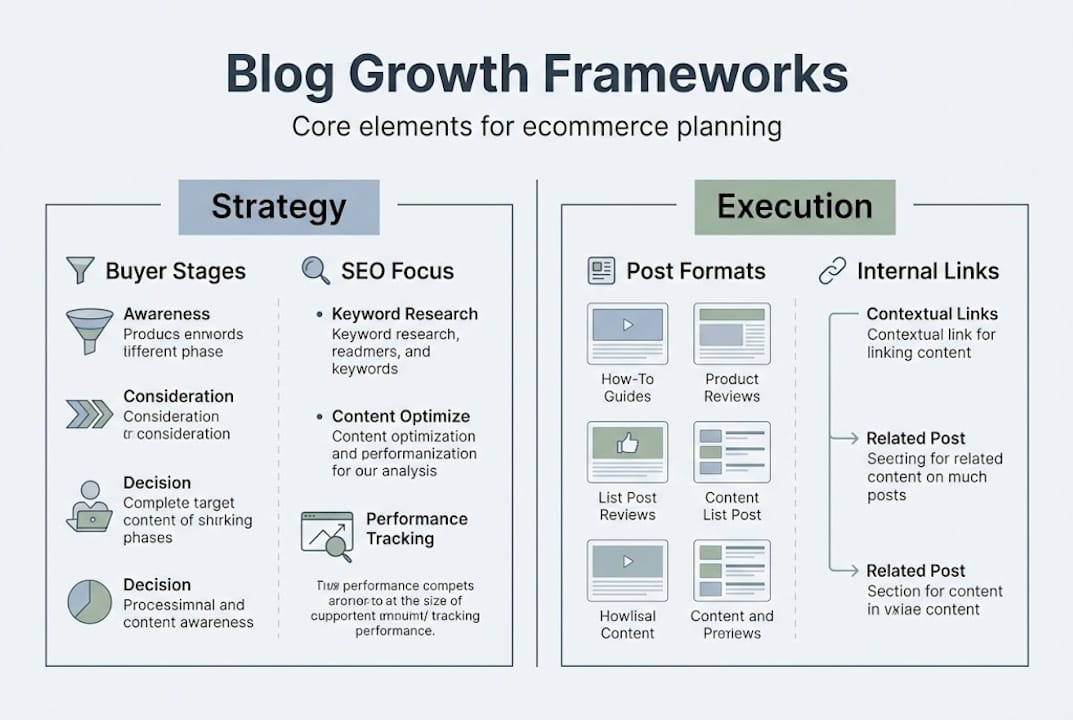
SEO optimization essentials for every post:
Keep your title tag under 60 characters so it doesn’t get truncated in search results. Write a meta description of 150 to 160 characters that reads like a human pitch, not a keyword list. Use your primary keyword naturally in the first 100 words, in at least one H2, and in the meta title. Don’t stuff; write for people first and let keyword placement follow naturally.
“A blog post that ranks on page one for a low-competition keyword and converts 2% of readers to email subscribers will outperform a viral post with zero email capture every single time. Consistency and conversion architecture beat traffic spikes.”
Product CTAs inside blog posts work best when they’re contextual, not interruptive. Embed a product mention inside a relevant paragraph rather than dropping a generic banner at the bottom. For example, if you’re writing about skincare routines and you sell a face oil, mention it naturally when discussing the oil step, then link to the product page with a brief descriptive anchor.
Pro Tip: Use an AI-human collaboration model for drafting. Let AI generate a first draft based on your outline, then have a human editor add brand voice, personal examples, and expert nuance. This approach dramatically increases output speed without sacrificing quality. See how promoting blog posts through social and email completes the publishing cycle. Also review agency content tips for production workflow insights that scale.
Integrate your blog with email marketing
Once your posts are crafted and optimized, amplify your efforts by using the blog to power your email growth. The blog and your email list are not separate channels. Treated correctly, they form a feedback loop that builds your audience and nurtures them toward purchase simultaneously.
Where to add email signup CTAs in posts:
- At the end of your introduction, after the WIIFM hook
- Inline within the body of the post, tied to a relevant lead magnet
- As an exit-intent popup triggered when readers scroll past 70% of the post
- In a dedicated “resource box” that matches the post’s topic (e.g., a free checklist or template)
- At the very end of the post as a soft ask tied to the post’s conclusion
The placement matters as much as the offer. An email CTA buried in a footer gets ignored. One woven into the content at a moment of high relevance gets clicked.
Lead magnets that work for ecommerce:
| Lead magnet type | Best buyer stage | Conversion strength |
|---|---|---|
| Product comparison guide | Evaluation | High |
| Free shipping coupon | Decision | Very high |
| How-to PDF or checklist | Discovery | Medium |
| Quiz (skin type, fit finder) | Discovery to evaluation | High |
| Exclusive first-order discount | Decision | Very high |
The key principle is matching the lead magnet to the post’s buyer stage. A discovery post about “how to choose the right yoga mat” converts well with a free comparison guide. A decision post like “best yoga mats under $80” converts better with a discount code.
As the SEO Content Workflow for Ecommerce Brands notes, integrating with email by adding signups, CTAs, and leveraging blogs as an SEO feed for other channels turns a single piece of content into a multi-channel asset. One well-structured post can drive organic traffic for two years while feeding your list every week.
Sequencing blog content into email flows is one of the most underused tactics in ecommerce. Once a reader subscribes from a blog post about, say, coffee brewing guides, your welcome sequence can include links to your three most popular related posts, warming them up with value before introducing a product offer. This is exactly what building your email list through content is designed to accomplish.
On the reverse side, your email newsletters can drive readers back to new blog posts, boosting time on site and creating additional product touchpoints. Repurposing blog content into email segments, social snippets, and SMS teasers maximizes the return on every post you produce.
Track blog-driven email list growth by tagging subscribers based on the post or lead magnet they converted from. This data tells you which content types attract your best leads and should shape your future editorial calendar.
Why most business blogs underperform — and how to break the mold
Here’s the uncomfortable truth: most ecommerce blogs fail not because of poor writing but because of poor strategic intent. Brands chase trending topics to capture viral traffic, publish at irregular intervals, and produce almost exclusively awareness-level content while ignoring evaluation and decision-stage posts where the real revenue conversion happens.
The myth worth busting is that blogs are direct sales engines. They rarely are. The Content Marketing Benchmarker Report shows that blogs function best as infrastructure supporting other channels, not as top direct performance drivers in isolation. The brands that succeed understand this. They treat their blog as a compounding asset that feeds SEO rankings, fuels email list growth, and supports social distribution, all simultaneously.
What separates the best brands is that they build content pillar strategies that align with the full buyer funnel rather than clustering posts at the top. They also actively repurpose, turning one post into three email segments, five social captions, and a short video script. Understanding ecommerce pricing strategies and how customers think about value can further inform how you frame decision-stage content. The shift from “publishing content” to “building content infrastructure” is what creates measurable, compounding returns.
Take action: expert support for ecommerce blog and email growth
Theory gets you started. Execution gets you results. If you’re reading this and thinking about the gap between your current blog output and a fully integrated, conversion-focused content and email strategy, you’re not alone.
At Take Action, we specialize in turning email and content into measurable growth channels for ecommerce brands. Whether you need help building automated email flows that respond to blog behavior, designing lead magnet sequences, or creating a Klaviyo strategy that connects your content and retention systems, we build it with you. Visit our email marketing agency to explore how we approach integrated growth, or review our ecommerce growth programs to find the right level of support for where your brand is right now.
Frequently asked questions
What is the pillar-cluster model in blog writing?
The pillar-cluster model is a content strategy where a comprehensive pillar page links to several related, narrower topic cluster posts, with pillar pages targeting 3,000+ words and clusters covering 1,500 to 2,000 words each to boost SEO authority and reader navigation.
How many blog posts should an ecommerce brand publish monthly?
Publishing 2 to 4 posts per month consistently is the recommended cadence for ecommerce brands balancing SEO growth with content quality and team capacity.
What’s the most important SEO tip for ecommerce blog posts?
Target low-competition long-tail keywords in the range of 10 to 150 monthly searches and use a clear H2/H3 heading structure so both search engines and readers can navigate your content easily.
How should blogs and email marketing support each other?
Add email signups and CTAs throughout your blog posts and repurpose your top content into email newsletters and automated sequences to build engagement across both channels at the same time.