

What Is a Brand Loyalty Email, and Why Does It Drive Repeat Sales?
A brand loyalty email is an owned message designed to deepen trust and repeat-purchase intent through consistent, personalized, value-first content rather than a one-off discount push. The payoff shows up as higher customer lifetime value, more repeat orders, and unprompted advocacy. Personalization and trust are the mechanisms doing most of the work, not the discount code.
TL;DR:
- Personalization should be layered and based on customer lifecycle, behavior, and product preferences to effectively turn subscribers into loyal buyers.
- Trust, built through consistent, value-driven communication and alignment with brand values, is the core factor that sustains long-term loyalty.
- Measurement of loyalty relies on repeat purchase rate, retention, and customer lifetime value, rather than open or click metrics alone.
- Fixing data hygiene and establishing clear flow objectives are critical before implementing personalization and segmentation strategies.
- Over-mailing or inconsistent brand voices are common pitfalls that reduce effectiveness; testing cadence and maintaining a unified tone improve results.
Table of Contents
- What Counts as a Brand Loyalty Email (and What Doesn’t)
- How Email Actually Builds Loyalty
- Core Tactics That Turn Subscribers Into Repeat Buyers
- Measuring Whether Your Emails Are Actually Building Loyalty
- Your Quarter-One Checklist for Building Loyalty Through Email
- Where Most Loyalty Email Programs Actually Break
- How Take-action Builds Loyalty Programs That Actually Convert
- Sources
What Counts as a Brand Loyalty Email (and What Doesn’t)
Brand loyalty email targets attitudinal loyalty (how a customer feels about you) and behavioral loyalty (whether they keep buying) at the same time. A shipping confirmation is not one of these emails. Neither is a generic “20% off everything” blast with no context behind it.
Loyalty-focused content looks different: a VIP early-access drop, a personalized restock alert based on past purchases, a “you’ve been with us a year” note, or a curated guide built around what someone actually bought. Investopedia draws a useful line here: true brand loyalty means a customer sticks with you regardless of price, while discount-driven customer loyalty evaporates the moment a competitor undercuts you. A good test for any send: would this email still make sense if you removed the discount? If yes, it’s a loyalty touch. If the discount is the entire message, it’s promotional.
How Email Actually Builds Loyalty
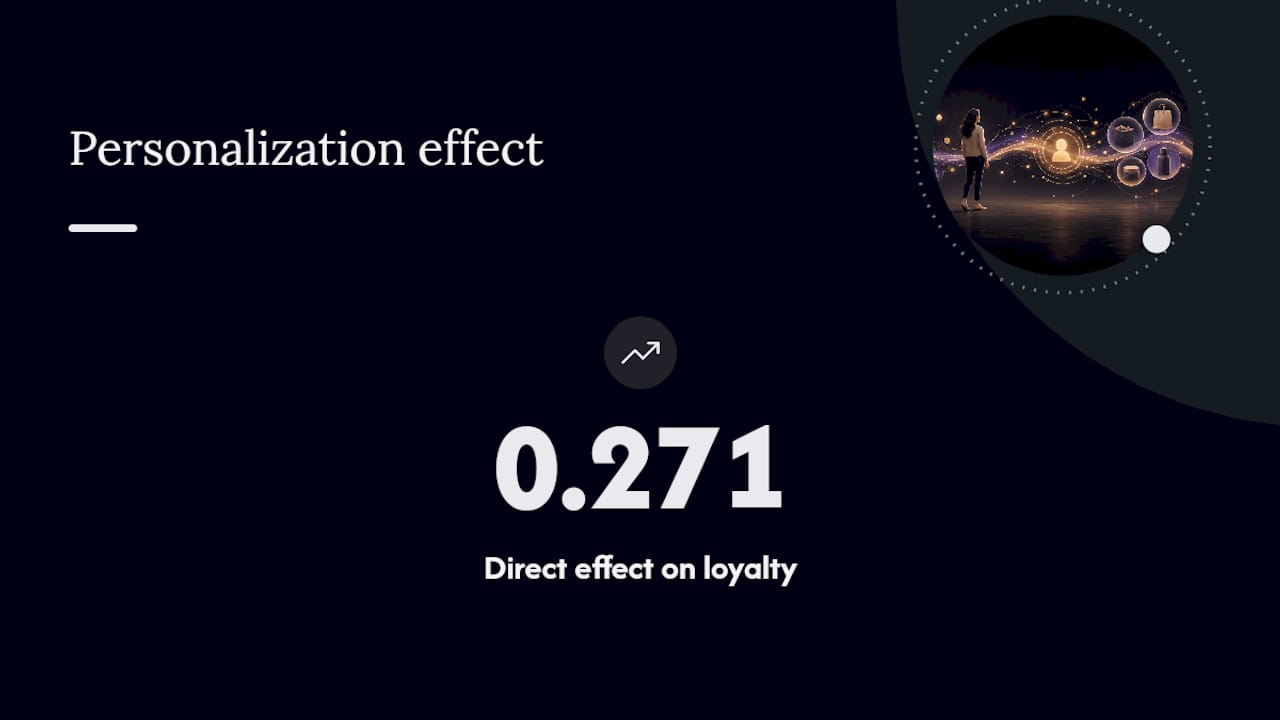
Trust is the hinge. A 2025 study on email marketing and consumer loyalty found that personalization significantly predicts loyalty (β = 0.271, p < 0.001), and that trust mediates how content, frequency, and personalization translate into loyalty at all. In plain terms: personalized emails don’t move the needle because they feel clever. They move it because they make the sender feel more trustworthy, and trust is what actually keeps someone buying.
Statistic to remember: Research summarized on ResearchGate puts personalization’s effect on trust at β = 0.040 and on loyalty at β = 0.271, both statistically significant. That gap matters: personalization’s direct hit on loyalty is far larger than its hit on trust alone, meaning relevance itself has weight beyond the trust it builds.
Consistency reinforces this. A subscriber who recognizes your voice, your layout, and your tone within two seconds of opening an email is building brand salience without even reading the copy. PwC’s research on customer loyalty backs this at the program level: executives are raising loyalty budgets because proactive, experience-driven programs, not passive discounting, drive the repeat behavior that actually shows up in revenue. Brand values matter too. Analysis of eco-branding and loyalty shows that when a brand’s stated values show up consistently in its communications, customers form the kind of emotional attachment that survives a price increase.
Core Tactics That Turn Subscribers Into Repeat Buyers
Personalization isn’t one setting you switch on. It comes in layers, and stacking them is what separates a loyalty program from a glorified newsletter.
- Lifecycle personalization — messaging that shifts based on where someone sits in the customer journey (new subscriber, first-time buyer, repeat customer, lapsing).
- Behavior-based personalization — triggers tied to browsing, cart activity, or engagement history.
- Product affinity personalization — recommendations built from what someone has already bought or viewed, not generic bestsellers.
- Predictive insertion — dynamic content blocks that adjust based on predicted next purchase or churn risk.
Segmentation decides who gets which message. At minimum, split your list into VIPs (top spenders or highest frequency), at-risk customers showing declining engagement, repeat buyers who haven’t been rewarded for it, and new customers still forming their first impression. Segmentation strategies built for ecommerce growth can multiply the effect of every other tactic on this list, because a personalized message sent to the wrong cohort still misses.
Cadence is where a lot of loyalty programs quietly fail. Frequency strongly affects trust, but the right cadence varies by segment, so testing by cohort beats applying one blanket rule to your entire list. A VIP segment might welcome three emails a week; a re-engagement segment might need silence for two weeks before a single, well-timed nudge.

Priority flows worth building first: a welcome series that sets tone, a post-purchase experience flow that nurtures rather than upsells, a VIP rewards flow, and a re-engagement flow for lapsing subscribers. Content mix matters as much as targeting: rotate utility content (how-to guidance, care instructions), exclusive offers, user-generated content, and social proof so the inbox doesn’t read as one long sales pitch. Personalized email examples that drive real retention show this mix in practice.
A post-purchase nurture email should skip the sales pitch entirely for the first send and instead answer the question the customer is most likely asking right after checkout.*
- VIP reward micro-template: Subject: “You’ve earned something most customers never see.” Body: acknowledge status, reveal the perk, no expiration pressure.
- Post-purchase nurture micro-template: Subject: “Here’s how to get the most out of [product].” Body: usage tips, community link, soft mention of related items.
Measuring Whether Your Emails Are Actually Building Loyalty
Open rates tell you almost nothing about loyalty on their own. The KPIs that matter are repeat purchase rate, retention rate, and customer lifetime value, tracked over rolling quarters rather than single campaigns.
- Repeat purchase rate: the share of customers buying a second time within a defined window.
- Retention rate: how many customers from a given cohort are still active after 90, 180, or 365 days.
- Customer lifetime value (CLV): total expected revenue per customer over the relationship.
- Supporting email metrics: open rate, click rate, conversion rate, revenue per recipient, and unsubscribe rate, read together rather than in isolation.
Statistic to remember: the same 2025 study found personalization’s effect on loyalty was statistically significant at p < 0.001, a strong enough signal that marketers can treat personalization depth as a lever worth testing deliberately, not a nice-to-have.
For attribution, run cohort analysis comparing subscribers who received a loyalty flow against those who didn’t, or use holdout groups where a portion of a segment is excluded from a flow to measure incremental lift. A/B testing individual elements, subject lines, send times, personalization depth, tells you what to optimize next. Treat any repeat purchase rate lift above single digits from a new loyalty flow as a meaningful result worth scaling.
Your Quarter-One Checklist for Building Loyalty Through Email
Most brands don’t need a bigger list. They need cleaner data and a shorter list of priorities executed well.
- Audit data and tagging so personalization has something real to pull from (purchase history, product category, engagement recency).
- Rank your flows: welcome, post-purchase, VIP rewards, re-engagement, and decide what each one measures for success.
- Build a testing roadmap covering subject lines, cadence by segment, and personalization depth over a set number of weeks.
- Set governance: a brand voice guide, approved templates, and a QA step before every send.
- Decide build versus buy: in-house works if you have someone who owns Klaviyo segmentation and flow logic full time; bring in an agency when you need flow setup and ongoing optimization without hiring a full team.
Pro Tip: Fix data hygiene before you touch copy. The sharpest personalization in the world fails if your segmentation is built on stale purchase tags.
Where Most Loyalty Email Programs Actually Break
Three failure modes show up again and again: messy data that makes personalization impossible, inconsistent brand voice across flows and campaigns, and over-mailing segments that should have been left alone for a week.
The fix for each is specific. Clean your tagging before you build a single new flow. Write one voice guide and hold every template to it. Test cadence per segment instead of applying one send frequency to the whole list. Brands that fix data hygiene first typically see personalization actually start working within a quarter, not because the tactics changed, but because the inputs finally support them.
— Take
How Take-action Builds Loyalty Programs That Actually Convert
Take-action is the alternative to guessing your way through email: instead of another generic campaign calendar, you get flow setup, segmentation, and AI-assisted personalization built specifically around your customer data in Klaviyo.
The work centers on the flows that carry the most loyalty weight: welcome series, post-purchase nurture, VIP rewards, and re-engagement, each built with the segmentation and cadence testing this article just walked through. Take-action pairs that setup with ongoing optimization, so personalization depth improves as more purchase and engagement data comes in, rather than staying frozen at launch settings. If your current program relies mostly on discount blasts and a single welcome email, an audit will show you exactly where trust and repeat purchase rate are leaking. Start with a pilot audit through Take-action to see which flows are costing you the most in unrealized customer lifetime value.
Sources
- EMAIL MARKETING AND CONSUMER LOYALTY: THE ROLE OF FREQUENCY, CONTENT AND PERSONALISATION
- Customer loyalty and business growth: PwC
- Understanding Brand Loyalty: A Key to Business Success | Investopedia