

What Is Brand Awareness in Digital Marketing?
TL;DR:
- Brand awareness refers to how easily consumers recall and recognize your brand from memory, not just visibility. Building awareness requires consistent storytelling, multi-channel presence, and emotional engagement to strengthen mental associations over time. It is a strategic asset that reduces customer acquisition costs and enhances pricing power, making ongoing measurement essential for growth.
Most marketing professionals know brand awareness matters. Far fewer can define it precisely enough to measure it, build it deliberately, or defend budget for it in a boardroom. Understanding what is brand awareness in digital marketing goes well beyond recognizing a logo. It’s the degree to which your audience carries a mental representation of your brand, one strong enough to surface without prompting. That cognitive footprint determines whether customers choose you, recommend you, or scroll right past you. This guide breaks down the concept, the measurement, and the strategy with the specificity your marketing decisions actually deserve.
Table of Contents
- Key Takeaways
- What is brand awareness in digital marketing, defined precisely
- Measuring brand awareness online
- Why brand awareness is a strategic asset
- How to raise brand awareness in digital marketing
- My take on what most marketers get wrong
- Ready to turn awareness into retention?
- FAQ
Key Takeaways
| Point | Details |
|---|---|
| Awareness has two levels | Brand recognition (aided) is easier to achieve; brand recall (unaided) is the real indicator of brand health. |
| Share of voice drives growth | Brands with SOV above their market share consistently grow; target 5-10 points above your current share. |
| Visibility and awareness differ | Visibility produces immediate clicks; awareness builds the mental associations that drive long-term loyalty. |
| AI visibility is now a metric | Monitoring citation frequency in AI-generated answers is a critical brand awareness task in 2026. |
| Consistency compounds | Awareness built through repeated, consistent storytelling across channels accumulates into lasting brand equity. |
What is brand awareness in digital marketing, defined precisely
To define brand awareness properly, start by separating it from two things it is often confused with: visibility and brand identity. Your logo is brand identity. A display ad impression is visibility. Neither one is awareness. Awareness happens inside the consumer’s mind.
Brand awareness reflects how easily and accurately a consumer can retrieve your brand from memory, either when prompted by a cue or entirely on their own. Digital marketing affects this retrieval process at every stage of the customer journey. Every touchpoint either strengthens or weakens that mental association.
There are four cognitive levels worth understanding:
- Brand recognition (aided awareness): The consumer identifies your brand when shown a cue, such as a logo or tagline. This is the most basic level and the easiest to achieve through paid media exposure.
- Brand recall (unaided awareness): The consumer names your brand without any prompt, typically in response to a category cue like “which email marketing tools do you know?” Recall is harder to achieve and a stronger indicator of brand health than recognition.
- Top-of-mind awareness: Your brand is the first one recalled in a category. This is the seat at the table every brand wants.
- Brand dominance: Your brand is the only one recalled. Think of how some brands have become synonymous with entire product categories.
In digital channels, these levels manifest differently than in traditional media. Recognition gets built through retargeting ads, consistent visual design across platforms, and branded search results. Recall gets built through content depth, emotional storytelling, and consistent presence over time. The key distinction is that visibility drives immediate conversions; awareness builds the lasting mental associations that make those future conversions cost less to earn.
Measuring brand awareness online
Most marketers default to reach and impressions as proxies for awareness. Those metrics measure exposure, not memory. Here is how to measure the thing itself, along with the channels through which it travels.
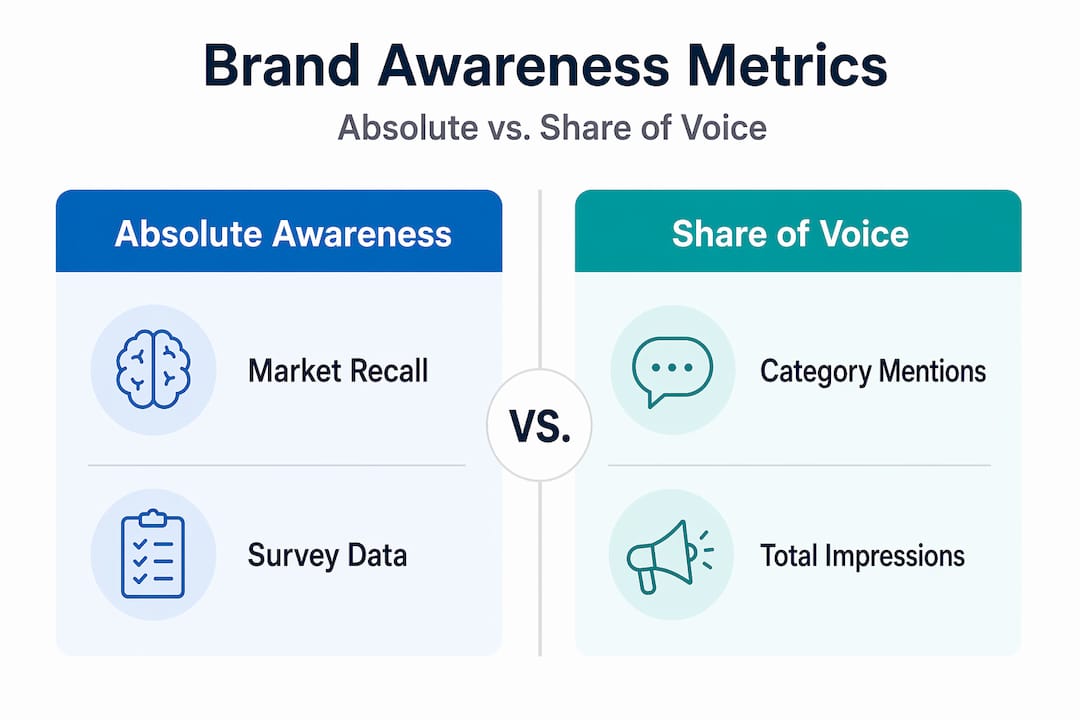
Absolute awareness vs. share of voice
Absolute brand awareness answers “what percentage of your market knows you exist?” You measure it through brand surveys, branded search volume in Google Search Console, and direct traffic trends. These numbers tell you where you stand but not whether you’re growing relative to competitors.
Share of voice (SOV) answers the more strategic question. SOV measures what percentage of total category visibility your brand owns across paid, organic, and earned channels. The formula is straightforward:
SOV = Your brand mentions or impressions ÷ Total category mentions or impressions × 100
The reason SOV matters is competitive. Brands with SOV exceeding their market share tend to grow, and the rule of thumb is to target SOV 5-10 points above your current market share. Maintaining what researchers call Excess Share of Voice (eSOV) is one of the most evidence-backed ways to invest in sustainable growth. Each 10 points of eSOV correlates to roughly 0.5% annual market share growth. That may sound modest, but compounded over three to five years, it defines category leaders.
| Metric | What it measures | Best tool |
|---|---|---|
| Branded search volume | Unaided recall proxy | Google Search Console |
| Direct traffic | Top-of-mind awareness proxy | Google Analytics |
| Share of voice | Relative competitive visibility | Social listening tools |
| AI citation frequency | Brand presence in AI answers | Manual tracking or Amplitude |
| Brand survey recall | True unaided awareness | Survey platforms |
Measuring AI visibility in 2026
The most significant shift in measuring brand awareness online right now is the rise of generative AI platforms as discovery channels. When someone asks ChatGPT, Gemini, or Perplexity about your product category, your brand either gets cited or it doesn’t. That citation is a new form of top-of-mind awareness you cannot afford to ignore.

Large language models form persistent brand associations based on how often and authoritatively a brand appears in training data and indexed content. Track 20-50 relevant queries monthly across AI platforms to monitor how frequently your brand surfaces. Generative Engine Optimization (GEO) is the practice of creating content specifically structured to earn those citations. It is not optional anymore.
Pro Tip: For mid-size brands, combine biannual direct awareness surveys with continuous proxy monitoring of branded search trends and direct traffic. You get meaningful data without the cost of quarterly research panels.
Why brand awareness is a strategic asset
Brand awareness is not a vanity metric. It is the prerequisite for every other marketing outcome you care about: consideration, preference, purchase, and retention. You cannot be chosen by someone who does not know you exist.
The strategic mechanics are straightforward but underappreciated. Without awareness, higher levels of brand loyalty and resonance cannot be achieved. This is the central argument in Keller’s Brand Equity model, which positions awareness as the foundation of the entire pyramid. Every dollar you spend on conversion optimization, loyalty programs, or customer retention produces better returns when awareness is strong, because the audience arriving at those programs already trusts your brand before the first interaction.
“Awareness is not the top of the funnel. It is the floor beneath every part of the funnel.”
The financial implications are real. High brand awareness reduces customer acquisition costs because consumers in familiar-brand categories spend less time researching and switch less often. It also supports pricing power. A consumer who recalls your brand unprompted, who associates it with a consistent identity and story, is more willing to pay a premium than someone who found you through a discounted ad.
For ecommerce businesses specifically, digital branding tips grounded in consistent visual and messaging identity compound in value over time. The brand that shows up in the same voice across Instagram, email, and search is the one that earns recall.
Visibility alone is insufficient. A brand can generate millions of impressions and still fail to build the memory structures that produce recall. That only happens through repeated, relevant, emotionally resonant exposure, not through volume alone.
How to raise brand awareness in digital marketing
Raising awareness is not a single campaign. It is an operating principle. Here is how to build it deliberately.
1. Establish a distinct, consistent brand identity. Before any channel strategy, define what your brand sounds like, looks like, and stands for. Consistency across every touchpoint is how the brain builds and strengthens memory structures. Color palettes, typography, tone of voice, and core messages should be codified and applied everywhere without exception.
2. Build multi-channel presence with purpose. No single channel builds recall on its own. Use social media marketing for cultural relevance and audience reach, SEO for long-term organic visibility in branded and category searches, paid advertising for targeted exposure in high-intent moments, and content marketing to build the authoritative footprint that both humans and AI models associate with your category.
3. Lead with story, not product. The brands that achieve top-of-mind recall are almost never the ones who led with features. They led with a point of view, a customer story, or a problem they uniquely understand. Emotional connection is what converts recognition into recall. Consistent storytelling across touchpoints builds cumulative awareness far faster than rotating campaign themes.
4. Balance paid and organic investment. Paid media builds recognition quickly. Organic content, earned media, and community build recall over time. The most effective awareness strategies use paid channels to introduce and organic channels to deepen. Neither replaces the other.
5. Measure, track trends, and adjust. Trend analysis is more valuable than any single data point. Set up tracking for branded search volume, direct traffic, and AI citation frequency. Review them on a consistent schedule and treat changes in trend lines as your leading signal.
Pro Tip: When creating brand awareness content, check whether your brand surfaces in AI-generated answers for 20-30 category queries. If competitors appear and you don’t, that’s a GEO gap and a specific content opportunity you can fill.
You can explore proven ecommerce awareness strategies to go deeper on channel-specific tactics that work for online brands.
My take on what most marketers get wrong
I’ve worked with enough ecommerce brands to notice the same pattern playing out repeatedly. A team invests in paid social, watches their reach numbers climb, and reports it as awareness growth. Then six months later, they wonder why branded search volume hasn’t moved and why their email list is full of one-time buyers who don’t recognize them in the inbox.
The problem is confusing visibility with awareness. Visibility is an input. A real person seeing your ad is not the same as that person carrying your brand in memory. The mental association only forms through repetition, relevance, and consistency. That takes months, not a single campaign flight.
The second mistake I see constantly is treating awareness as a phase rather than a permanent operating layer. Brands “do awareness” for a quarter, then pivot to conversion, then wonder why their cost per acquisition keeps climbing. Awareness is not a campaign. It is the ambient presence your brand maintains in its market at all times.
What I’ve learned is that the brands who build real recall invest in one thing above everything else: a consistent story told across every channel, every season, every year. Their email voice matches their Instagram voice matches their ad copy. That coherence is what the brain stores. Everything else is just traffic.
— Take
Ready to turn awareness into retention?
Building brand awareness gets people to your door. What happens after they arrive determines whether they stay. At Take-action, we specialize in the next chapter: turning that initial recognition into repeat buyers through email marketing built around your brand’s identity, voice, and customer journey.
From automated welcome flows that introduce new subscribers to your brand story, to post-purchase sequences that reinforce why they chose you, Take-action’s Klaviyo-powered campaigns are designed to deepen the awareness you’ve worked to build. If you want email that feels like a natural extension of your brand, not just another promotional send, explore our services to see how we approach retention as a brand-building channel.
FAQ
What is brand awareness in simple terms?
Brand awareness is how well consumers know and remember your brand without being prompted. It ranges from basic recognition when shown a logo to unaided recall when asked about a product category.
How does brand awareness differ from brand visibility?
Visibility is real-time presence, such as an ad impression or search result. Awareness lives in memory and reflects how strongly a brand has formed lasting mental associations through repeated exposure over time.
What metrics measure brand awareness online?
Key metrics include branded search volume, direct website traffic, share of voice across paid and organic channels, and citation frequency in AI-generated search answers. Combining these gives a more complete picture than any single metric alone.
How often should brands measure brand awareness?
Quarterly tracking suits large brands; mid-market brands should conduct biannual surveys and monitor proxy metrics like branded search and direct traffic continuously throughout the year.
Why is share of voice important for brand awareness?
SOV measures your brand’s competitive visibility relative to the entire category. Brands that maintain SOV above their market share consistently grow, making it one of the most reliable leading indicators of long-term brand health.