

What Comes Under Content Marketing: a 2026 Guide
TL;DR:
- Content marketing is a strategic discipline encompassing content creation, distribution planning, audience journey management, and long-term brand building, beyond mere posting. It employs diverse formats aligned with specific audience stages to generate sustainable ROI, emphasizing patience and intentionality over short-term results, while integrating owned media and measurement for growth. Effectively executing content marketing involves precise audience targeting, format selection, consistent quality, data-driven iteration, and leveraging owned channels like email to maximize long-term impact.
Most marketing professionals assume content marketing means keeping a blog updated or posting on Instagram three times a week. That assumption costs real money. What comes under content marketing is far broader: it’s a strategic discipline covering content creation, distribution planning, audience journey management, measurement frameworks, and long-term brand authority building. This guide breaks down every element so you can stop treating content as a checkbox and start treating it as a system that compounds in value over time.
Table of Contents
- Key takeaways
- What comes under content marketing: the full scope
- Content types and formats: what each one does
- Strategy, planning, and the audience journey
- Measuring content marketing ROI
- Putting it all together: practical integration
- My take on what content marketing actually requires
- How Take-action helps you turn content into revenue
- FAQ
Key takeaways
| Point | Details |
|---|---|
| Content marketing is strategic | It covers planning, creation, distribution, and measurement, not just publishing posts. |
| Format diversity matters | Blogs, videos, podcasts, interactive tools, and email all serve distinct roles in a content program. |
| Audience journey mapping is non-negotiable | Different content types must align with attract, engage, nurture, and convert stages. |
| ROI requires multi-touch thinking | Last-click attribution undervalues content. Use assisted conversions and pipeline influence metrics. |
| Repurposing multiplies returns | One strong asset can feed multiple formats and channels without proportional additional effort. |
What comes under content marketing: the full scope
Content marketing is the strategic creation and distribution of useful, relevant content designed to attract and engage a clearly defined audience. That definition carries more weight than it first appears. The word strategic is doing real work here. Without strategy, you just have publishing.
The core principles that separate content marketing from random content production are:
- Audience focus. Every asset is built around a specific person’s needs, questions, or problems, not around what a brand wants to say.
- Relevance and value. Content must answer something real. A how-to guide, a data analysis, or a product comparison all qualify. A thinly veiled sales pitch does not.
- Consistency. Trust compounds through repeated exposure to useful content. Sporadic publishing breaks that compounding effect.
- Goal alignment. Content must connect to a business outcome, whether that’s generating leads, reducing churn, or building search authority.
Content builds trust before any commercial ask, which is precisely what separates it from advertising. Ads interrupt. Content earns attention. That distinction shapes every format and channel decision you make inside a content program.
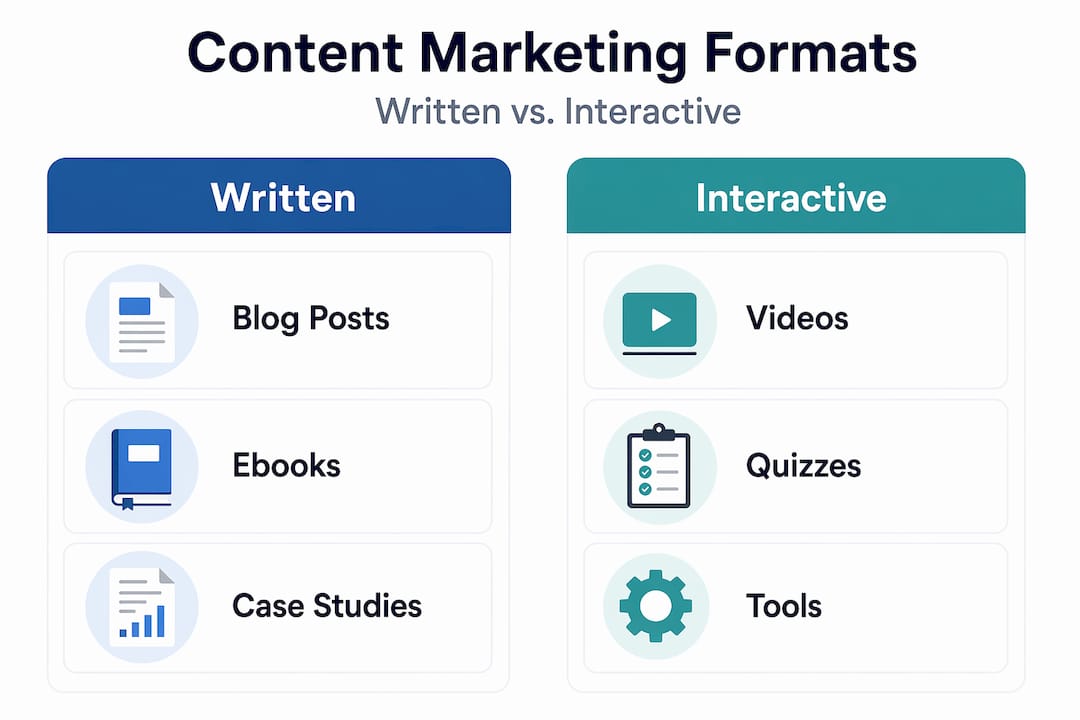
The formats that fall under content marketing include blog posts, long-form guides, ebooks, whitepapers, case studies, videos, podcasts, infographics, email newsletters, webinars, social media posts, templates, courses, and interactive tools like quizzes and calculators. Each format serves a different preference, context, and stage in the buyer’s journey.
Content types and formats: what each one does
Understanding what is included in content marketing requires looking at each format category with purpose, not just as a menu to pick from.
Long-form written content is the backbone of most programs. Blog posts drive organic search traffic. Ebooks and whitepapers capture leads at the research stage. Case studies close skeptical buyers by proving results with specificity. Whitepapers position a brand as a credible voice in a specialized field.
Visual content earns attention in compressed environments. Infographics condense complex data into scannable formats. Custom data visualizations and original research graphics earn backlinks at a disproportionate rate compared to standard text content, making them high-value assets for authority building.
Audio and video meet audiences where they are:
- Explainer videos reduce friction for complex products or services by showing rather than telling.
- Customer testimonials on video carry social proof that written reviews rarely match.
- Podcasts build loyal niche followings because they reach people during commutes, workouts, and other multitasking moments where no other format competes.
Interactive content is worth its own category. Quizzes, calculators, and tools generate significantly higher engagement and time-on-page than passive formats. A mortgage calculator on a financial brand’s site or a skincare quiz on a DTC brand’s product page keeps users engaged while collecting first-party data. That combination is hard to replicate with a static blog post.
Here is how these content types compare across key strategic dimensions:
| Format | Primary stage | Strength | Weakness |
|---|---|---|---|
| Blog post | Attract | Organic search traffic | Slow to build authority |
| Ebook / whitepaper | Engage | Lead generation | High production effort |
| Case study | Convert | Proof and credibility | Requires client cooperation |
| Video | All stages | Emotional resonance | High production cost |
| Podcast | Engage / Nurture | Deep audience loyalty | Slow audience growth |
| Interactive tool | Engage | First-party data, session time | Technical development required |
| Email newsletter | Nurture / Convert | Direct owned channel access | Requires list building |
Pro Tip: Don’t try to produce every format at launch. Pick two or three based on your audience’s actual consumption habits and your team’s genuine capacity. Depth in a few formats beats mediocrity across all of them.
Strategy, planning, and the audience journey
This is where most content efforts fall apart. Brands invest in content creation and assume the rest will follow. It won’t.

A content strategy covers brand positioning, value proposition, ROI measurement, and detailed planning before a single asset gets produced. That planning layer answers the questions that make or break execution: Who exactly are you creating for? What do they need at each stage of their decision process? Which channels own which roles? How do you know if anything is working?
The audience journey moves through four stages:
- Attract. The goal here is visibility. Blog posts optimized for search, short-form video, and social media content draw people in who don’t yet know your brand exists.
- Engage. Once someone is aware, you deepen their interest. Long-form guides, webinars, and comparison content work at this stage because they reward attention with substance.
- Nurture. This is where email becomes central. Sequences that educate, address objections, and reinforce value move an interested reader toward a decision. For ecommerce email content, this is the stage where retention and repeat purchase behavior is shaped.
- Convert. Case studies, testimonials, free trials, and offer-specific landing pages do the heavy lifting when someone is ready to decide.
Effective content marketing maps different assets to specific journey stages rather than producing content without a funnel function. A brand that publishes only awareness content never converts. A brand that publishes only bottom-funnel content never attracts new audiences. The mix matters.
One of the most persistent misconceptions in this space is treating social media as content marketing. Social media is primarily a distribution channel, not the content strategy itself. The post that drives traffic to a guide, the tweet that promotes a podcast episode, the Instagram story that links to a product page — those are distribution mechanics. The guide, the podcast, and the product page are the content.
Pro Tip: Map your existing content assets against the four journey stages before creating anything new. Most brands discover they’re heavily weighted toward one stage and have almost nothing at the others.
Measuring content marketing ROI
Content marketing ROI is genuinely difficult to measure using standard last-click attribution models because content typically assists rather than closes. A buyer might read five blog posts, download a whitepaper, attend a webinar, and then convert through a paid ad. Last-click attribution credits the ad. Multi-touch attribution credits the entire journey.
Here’s how attribution models differ in practice:
| Attribution model | How it works | Best use case |
|---|---|---|
| Last-click | 100% credit to final touchpoint | Direct response campaigns |
| First-click | 100% credit to first touchpoint | Measuring awareness content |
| Linear | Equal credit to all touchpoints | Balanced channel evaluation |
| Time-decay | More credit to recent touchpoints | Short consideration cycles |
| Position-based | 40% to first and last, 20% to middle | Blended awareness and conversion |
Beyond attribution, the metrics worth tracking in a content program include:
- Assisted conversions. These show how often a content asset appeared in a conversion path even if it wasn’t the final click.
- Engagement rate. Time on page, scroll depth, and return visits signal whether content is actually being consumed.
- Pipeline influence. In B2B contexts, tracking which accounts interacted with content before entering a sales pipeline quantifies content’s commercial contribution.
- Content scoring. Assign performance scores to assets based on traffic, leads generated, and engagement to prioritize which topics deserve more investment.
Pro Tip: Updating high-performing older content consistently outperforms publishing new content at high volume. A refreshed post that recovers its search ranking position compounds value without the full production cost of a new piece.
Putting it all together: practical integration
Knowing what is included in content marketing is only useful if you can connect it to execution. Here is how marketing professionals and business owners can build a working program rather than an expensive experiment:
- Define your audience precisely. Not “small business owners” but “ecommerce founders with $500K to $5M in annual revenue who have tried paid ads and want to reduce ad spend dependency.” Specificity determines whether your content resonates or disappears.
- Choose formats based on stage and capacity. If you don’t have video production resources, don’t start with video. If your audience researches extensively before buying, start with long-form written content.
- Integrate owned media with distribution. Your content marketing channels should work together. A blog post gets promoted through email, shared on social, and referenced in a podcast episode. Each channel amplifies the others.
- Prioritize quality and consistency over volume. Publishing two well-researched pieces per month outperforms publishing daily posts that offer nothing new. Audiences remember whether they learned something, not how frequently you posted.
- Repurpose systematically. A single comprehensive guide can become a blog series, a podcast discussion, an infographic, and a social media series. That multiplies reach without multiplying effort proportionally.
- Review analytics monthly. Traffic sources, engagement patterns, and conversion paths tell you which content is pulling weight. Cut formats that don’t perform, double down on the ones that do.
My take on what content marketing actually requires
In my experience working with ecommerce brands and online businesses, the biggest mistake I see is treating content marketing as a production problem rather than a strategy problem. Teams hire writers, fill a content calendar, and then wonder why nothing moves the needle after six months.
What I’ve found is that the brands getting real ROI from content have one thing in common: patience combined with intentionality. They understand that content marketing compounds over time in a way paid ads simply don’t. A blog post that ranks can drive qualified traffic for years. A podcast episode that answers a specific question can build loyalty that no ad spend replicates.
I’ve also seen teams over-invest in a single format, usually video, because it feels impressive, while ignoring email entirely. Email is one of the highest-converting content formats available, and it’s an owned channel. Social platforms change their algorithms. Search rankings fluctuate. Your email list is yours. Treating it as an afterthought is one of the more expensive mistakes I’ve watched brands make.
The uncomfortable truth is that most content marketing underperforms because brands want short-term results from a long-term discipline. If you’re willing to commit to 12 months of strategic, audience-focused content with consistent measurement and iteration, the returns are durable and they grow.
— Take
How Take-action helps you turn content into revenue
Content marketing explained on paper is one thing. Executing the email and retention layer that makes content actually convert is where most brands stall. At Take-action, we specialize in building the automated email infrastructure that transforms content engagement into measurable revenue. From welcome and post-purchase flows to segmented campaign strategies built inside Klaviyo, we connect the audience trust your content builds to the conversion sequences that close sales. If you’re serious about making content work as a revenue channel rather than a traffic source, we’d like to show you exactly how the system fits together.
FAQ
What does content marketing include?
Content marketing includes blog posts, videos, podcasts, infographics, email newsletters, webinars, ebooks, case studies, interactive tools, and social media content, all guided by a documented strategy that maps assets to audience journey stages and business goals.
Is email marketing part of content marketing?
Yes. Email is one of the most direct and high-converting content formats available. It serves the nurture and convert stages of the audience journey and operates as a critical owned media channel alongside other content types.
What is a content marketing agency and what does it do?
A content marketing agency plans, creates, distributes, and measures content on behalf of a brand. What a content marketing agency does typically includes developing strategy, producing assets across formats, managing distribution channels, and reporting on performance metrics that connect content to business outcomes.
How is content marketing different from social media marketing?
Social media is primarily a distribution mechanism. Content marketing refers to the strategic assets being distributed, such as articles, videos, and guides, while social media platforms are simply one channel through which those assets reach an audience.
How long does content marketing take to show results?
Most content marketing programs require six to twelve months before compounding effects become visible in search traffic, lead generation, and audience trust. Unlike paid advertising, content investments grow in value over time rather than stopping when the budget stops.