

Welcome Email Best Practices for E-Commerce Brands
TL;DR:
- A well-designed welcome email series significantly boosts engagement and conversions by capturing subscriber intent immediately after signup.
- Using behavioral triggers, timing emails within the first five minutes, and focusing on one goal per message improve overall performance.
A welcome email sequence is the highest-performing automation in e-commerce email marketing. Welcome series generate open rates 4–5x higher than standard campaigns, making them the single best opportunity to convert a new subscriber into a paying customer. The window is short: send within 0–5 minutes of signup, and you catch someone at peak intent. Wait longer, and that intent evaporates. Following welcome email best practices means building a 3–4 email series over 7–14 days, each email focused on one goal, delivered at the right moment, and written like a human being sent it.
What timing and frequency optimize welcome email effectiveness?
Timing is the single biggest variable in welcome email performance. The first email must arrive within 0–5 minutes of signup. That is when the subscriber remembers why they signed up, what they were promised, and who you are. A delay of even 30 minutes cuts through that intent sharply.

After the first email, space subsequent messages 2–5 days apart. A 3–4 email structure over 7–14 days gives you enough time to build a relationship without overwhelming a new subscriber. Flooding someone’s inbox in the first 48 hours is one of the fastest ways to earn an unsubscribe.
The most effective sequences use behavioral triggers rather than fixed time delays. Behavioral triggers create responsive flows that adapt to what each subscriber actually does. If someone clicks your first email and visits your product page, they are ready for a different message than someone who never opened. Sending the same email to both groups wastes the opportunity.
Here is how to structure timing across a standard four-email welcome series:
- Email 1: Send within 5 minutes of signup. Deliver the promised incentive (discount code, lead magnet, or free resource) immediately.
- Email 2: Send 2 days later. Focus on brand story and trust signals. Trigger earlier if the subscriber clicked Email 1.
- Email 3: Send 4–5 days after signup. Deliver educational content tied to the subscriber’s likely needs or interests.
- Email 4: Send 7–10 days after signup. Introduce a product offer. Trigger only if the subscriber has not yet purchased.
Exit rules are non-negotiable. Remove purchasers from the welcome series the moment they convert. Sending a “here’s 10% off your first order” email to someone who already bought at full price damages trust and looks careless.
Pro Tip: Set up a separate post-purchase flow in Klaviyo so converted subscribers move directly into a thank-you and onboarding sequence rather than falling into a gap with no communication.
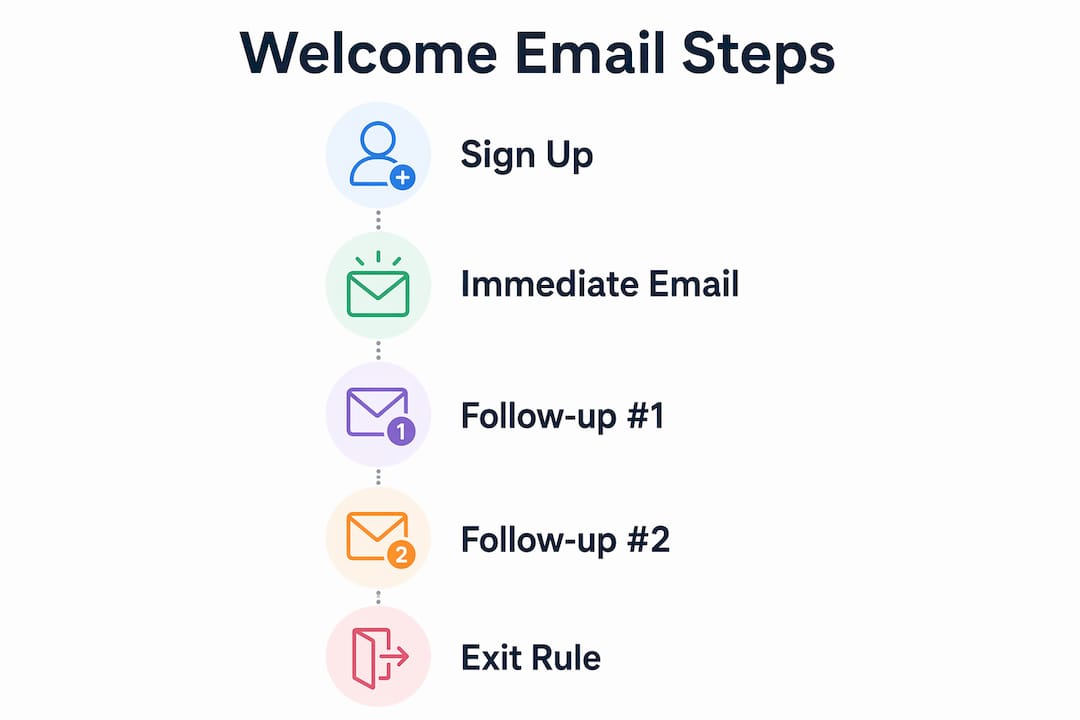
How to structure content in a welcome email series for maximum engagement
Each email in a welcome series has a specific job. Mixing those jobs in one message dilutes focus and drops click rates. The one goal, one CTA principle is the clearest rule in email marketing, and it applies most strictly to welcome sequences.
A well-built four-email series looks like this:
-
Email 1: Deliver the value. Send the discount code, the free guide, or whatever you promised at signup. Keep the copy short. Confirm the subscription, set expectations for what comes next, and make the CTA obvious. Nothing else belongs in this email.
-
Email 2: Build trust. Share your brand’s origin story, a founder message, or a strong set of customer testimonials. New subscribers do not know you yet. This email answers the question “why should I care about this brand?” without pushing a sale. Social proof from real customers works better than any marketing claim you write yourself.
-
Email 3: Educate. Give the subscriber something genuinely useful. A buying guide, a how-to, a product comparison, or a curated list of your best content. This email positions your brand as a resource, not just a store. Subscribers who find your emails useful stay subscribed and buy more over time.
-
Email 4: Make the offer. Now you can introduce a product or collection with a soft pitch. Focus on benefits, not features. If you have a discount, use it here as a final nudge. Keep the CTA singular: one button, one destination.
Copy style matters as much as structure. Plain-text style emails with minimal graphics outperform banner-heavy designs during the welcome phase. A wall of branded imagery signals “marketing email.” A clean, readable message signals “a person wrote this.” Subscribers respond to the latter.
Pro Tip: Write Email 2 as if it were a personal note from the founder. First-person voice, short paragraphs, no stock photography. That format consistently outperforms polished brand templates in welcome sequences.
What are common mistakes to avoid in welcome email campaigns?
The most expensive mistake in a welcome series is a delayed first email. Losing customer intent by waiting more than 5 minutes on the first send is a structural failure, not a content problem. Fix it at the automation level before you touch copy or design.
The second most common mistake is making the sequence too promotional too soon. Avoid business-centered copy that talks about your brand’s achievements before the subscriber has any reason to care. New subscribers are asking “what’s in this for me?” Answer that question first.
Other frequent pitfalls include:
- Multiple CTAs in one email. Every extra link you add splits the subscriber’s attention. One clear CTA per email produces better click rates than three competing options.
- Broken personalization tokens. If your first name merge tag has no fallback value, subscribers see “Hi ,” instead of “Hi Sarah,” or “Hi there.” That kills the personal feel instantly. Always set a fallback like “Hi there” or “Hi friend.”
- Ignoring mobile layout. Mobile devices account for over 60% of welcome email opens. A design that looks clean on desktop but breaks on a phone loses more than half your audience before they read a word.
- Treating the series as permanent. Welcome sequences need regular review. Offers go stale, brand messaging evolves, and subscriber behavior changes. Audit your series at least once per quarter.
“The welcome series is not a set-it-and-forget-it automation. It is a living conversation with your newest and most curious subscribers. Treat it accordingly.”
Avoiding these common email marketing mistakes is not about perfection on the first build. It is about building a feedback loop that catches problems before they compound across thousands of new subscribers.
What tools and strategies optimize welcome email automation and measurement?
Automation setup determines whether your welcome series works at scale or breaks under volume. The trigger must fire from the signup event itself, not from a manual import or a delayed batch job. Klaviyo’s flow builder handles this with event-based triggers that fire in real time, which is why it is the platform of choice for most serious e-commerce email programs.
Segmentation at the point of signup improves every email that follows. A subscriber who joined through a Facebook ad for running shoes has different needs than one who signed up after reading a blog post about marathon training. Segment subscribers based on sign-up source or stated preferences, and route them into tailored versions of your welcome series. Even two or three variants outperform a single generic sequence.
The metrics that matter most at each stage of the series are different:
| Email stage | Primary metric | What it tells you |
|---|---|---|
| Email 1 | Open rate | Subject line and send timing performance |
| Email 2 | Click rate | Brand story resonance and CTA clarity |
| Email 3 | Click rate + time on site | Educational content relevance |
| Email 4 | Conversion rate | Offer strength and subscriber readiness |
A/B testing subject lines and CTAs is the fastest way to improve performance. Subject line testing can increase open rates by 10% with no changes to the email body. Test one variable at a time, run each test until you have a statistically meaningful sample, and apply the winner before moving to the next variable.
Automated workflows for e-commerce brands also benefit from layered behavioral triggers. If a subscriber clicks the product link in Email 3 but does not buy, trigger a follow-up 24 hours later with a specific product recommendation or a low-friction offer. That kind of responsiveness is what separates a basic drip sequence from a genuinely effective welcome program.
Pro Tip: Build your welcome flow with a “purchased” exit condition from day one. Klaviyo makes this straightforward with flow filters. Without it, you will eventually send a discount offer to a customer who just paid full price, and that is a trust problem that is hard to walk back.
For deeper ideas on keeping subscribers engaged after the welcome series ends, the ecommerce newsletter strategies at Take-action cover retention-focused campaign structures that pick up where onboarding leaves off.
Key Takeaways
A welcome email series built on immediate delivery, single-goal emails, and behavioral triggers consistently outperforms generic drip sequences in both open rates and revenue per subscriber.
| Point | Details |
|---|---|
| Send within 5 minutes | The first email must arrive while signup intent is at its peak. |
| One goal per email | Each message in the series should have a single CTA to protect click rates. |
| Use behavioral triggers | Adapt timing and content based on subscriber actions, not fixed delays. |
| Apply exit rules | Remove purchasers from the welcome series the moment they convert. |
| Test and iterate | Audit subject lines, CTAs, and send times at least once per quarter. |
What I have learned from building welcome sequences that actually work
The conventional wisdom says welcome emails are about making a good first impression. That framing is too passive. A welcome series is your best chance to shape how a subscriber thinks about your brand before they have any purchase history with you. Most brands waste it by talking about themselves.
Treating email addresses as high-value assets is not a metaphor. Every address in your list represents a person who raised their hand and said “I am interested.” The brands that win long-term are the ones that respond to that signal with something genuinely worth reading, not a logo-heavy template and a discount code buried at the bottom.
The design instinct to make welcome emails look polished works against you. Subscribers are conditioned to ignore anything that looks like an ad. A plain, direct email that reads like it came from a real person gets opened, read, and clicked. I have seen brands cut their graphic design budget for welcome emails and watch click rates go up.
The hardest thing to convince marketers of is that the welcome series is not the place to sell hard. Build the relationship first. Focusing on subscriber needs before pitching is not a soft strategy. It is the fastest path to a subscriber who buys repeatedly and refers others. The brands that treat new subscribers like prospects to convert immediately are the ones with high unsubscribe rates and low lifetime value.
— Take
How Take-action builds welcome sequences that drive real revenue
E-commerce brands that work with Take-action get welcome email series built from the ground up: proper Klaviyo flow architecture, behavioral triggers, exit rules, and copy that sounds like a person wrote it.
Take-action handles the full setup, from segmentation strategy to subject line testing, so your welcome series works from day one and keeps improving over time. The goal is not just better open rates. It is turning new subscribers into repeat buyers who generate revenue without requiring more ad spend. If your current welcome flow is a single automated email with a discount code, there is a significant amount of revenue sitting uncaptured. See what Take-action builds for e-commerce brands ready to make email a primary growth channel.
FAQ
What is the ideal timing for a welcome email?
Send the first welcome email within 0–5 minutes of signup. That window captures peak subscriber intent and sets the tone for the relationship.
How many emails should a welcome series include?
A 3–4 email series over 7–14 days is the standard for effective e-commerce welcome sequences. Each email should focus on a single objective.
Why do welcome emails outperform regular campaigns?
Welcome emails arrive when subscriber interest is highest, which is immediately after signup. That timing produces open rates 4–5x higher than standard broadcast campaigns.
What is an exit rule in a welcome sequence?
An exit rule automatically removes a subscriber from the welcome series when they complete a target action, such as making a purchase. This prevents sending irrelevant promotional emails to customers who have already converted.
How do I improve low click rates in my welcome series?
Apply the one CTA per email rule and run A/B tests on subject lines and button copy. Multiple competing links split attention and reduce overall click rates.