

The Role of Seasonal Email Campaigns in E-Commerce
TL;DR:
- Seasonal email campaigns are timed to coincide with holidays and shopping peaks to boost engagement and sales. They outperform generic emails by targeting customers when their buying intent is high, especially during the critical Q4 season. Proper planning, segmentation, and combining channels like SMS can significantly increase revenue during peak periods.
Seasonal email campaigns are marketing messages timed to align with holidays, cultural events, and key shopping periods to drive higher engagement and sales. The role of seasonal email campaigns goes far beyond sending a festive graphic in december. These campaigns tap into customers’ natural buying mindset at the exact moment they are ready to spend, making email the highest-converting channel during peak periods. Platforms like Klaviyo and Mailchimp give e-commerce brands the segmentation and automation tools to execute these campaigns with precision, turning seasonal moments into measurable revenue.
How do seasonal email campaigns enhance e-commerce revenue?
Seasonal campaigns outperform generic email blasts because they meet customers when buying intent is already high. Seasonal marketing aligns with the customer’s natural mindset, producing higher open and click-through rates than non-seasonal messages. That alignment is not accidental. It is the result of timing your message to a moment when your customer is already searching for a solution.

The revenue numbers behind this are hard to ignore. The Q4 holiday season accounts for 25–40% of total annual revenue for most e-commerce stores. Email drives approximately 20% of all holiday e-commerce revenue in 2026. That means a brand doing $5 million a year could attribute $250,000 or more directly to email during the holiday window alone.
Segmentation is what separates good seasonal campaigns from great ones. Segmented seasonal campaigns can increase email marketing revenue by up to 760% compared to generic blasts during peak seasons. That figure reflects the difference between sending one message to your entire list versus sending targeted messages based on purchase history, browsing behavior, and customer value. A first-time buyer gets a gift guide. A loyal customer gets early access. Both convert at a higher rate than a one-size-fits-all send.
The most effective seasonal campaign types include:
- Gift guides segmented by price point or recipient type, which reduce decision fatigue and increase average order value
- Shipping deadline reminders that create urgency without discounting, protecting margin while driving conversions
- Early access campaigns for VIP customers that reward loyalty and generate revenue before the peak rush
- Post-holiday clearance emails that extend the revenue window into january and february
- Re-engagement sequences timed to back-to-school, Valentine’s Day, or Mother’s Day for brands with relevant product lines
Nearly 40% of holiday shoppers begin browsing before november. That statistic means brands that wait until Black Friday to launch their first holiday email are already behind. The brands winning Q4 start warming up their lists in september.
What are the best practices for planning seasonal email campaigns?
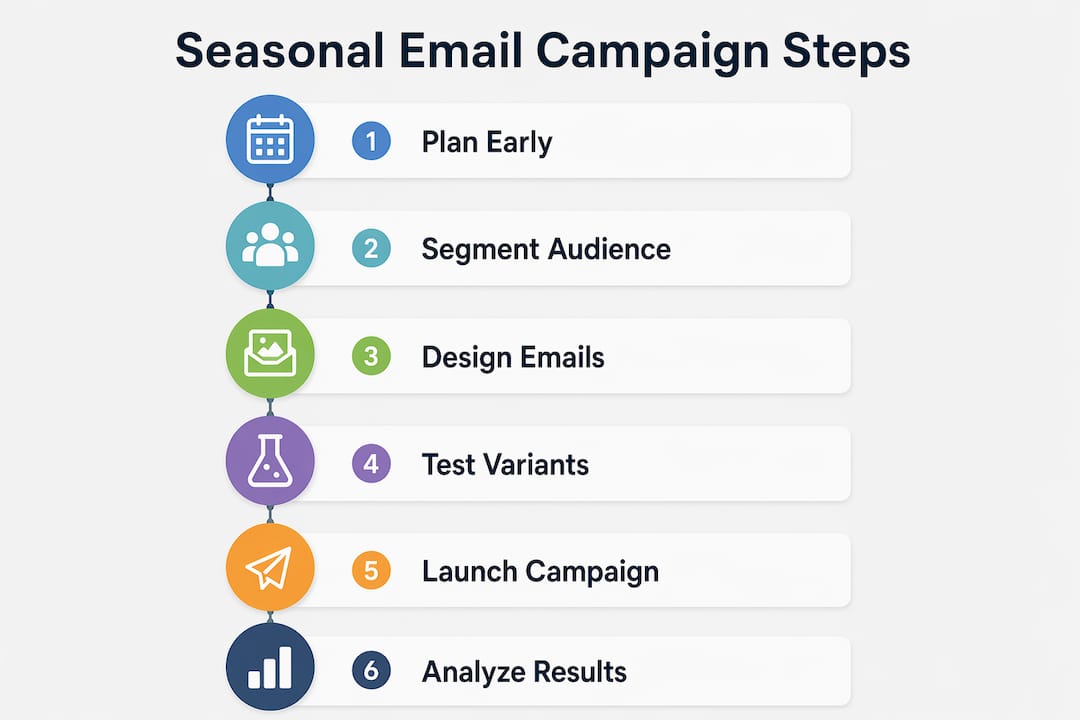
Planning is the single biggest differentiator between brands that crush seasonal revenue targets and those that scramble. A 12-month seasonal email calendar eliminates last-minute scrambles and ensures every seasonal moment gets the attention it deserves. Build your calendar in Q1 for the full year, mapping every major holiday, cultural event, and shopping period relevant to your audience.
Here is a practical framework for building your seasonal email strategy:
- Map your key dates. List every holiday and shopping event relevant to your customer base, from Valentine’s Day through the winter holidays. Include brand-specific moments like anniversaries or product launch anniversaries.
- Segment your list before each peak. Divide your audience by purchase history, engagement level, and customer lifetime value. Email segmentation strategies built around behavior outperform demographic splits every time.
- Run a warm-up phase 3–4 weeks before peak. The true success of seasonal campaigns lies in this window. Re-engage lapsed subscribers, suppress unresponsive contacts, and clean your list before high-frequency sends begin.
- Coordinate across teams. Shared calendars align marketing, design, and inventory teams so emails go out on time and products are actually in stock when customers click through.
- Layer in SMS for time-sensitive messages. Combining email with SMS during holidays can increase total revenue by 25–35% compared to email alone. Use email for detailed content like gift guides and SMS for flash sale alerts and shipping cutoffs.
- Review and suppress unengaged contacts. Sending to a cold list during peak periods tanks your deliverability. Remove contacts who have not opened in 90 days before your biggest sends.
Pro Tip: Build your Black Friday and Cyber Monday sequence in august, not october. That gives your design team time to produce quality creative and your copy team time to test subject lines before the inbox gets crowded.
How do seasonal email campaigns differ from generic email marketing?
Generic email marketing sends the same message to the same list on a regular schedule. Seasonal email marketing sends the right message to the right segment at the moment when that message has the most emotional and commercial relevance. The difference shows up directly in revenue.
| Factor | Generic email blasts | Seasonal email campaigns |
|---|---|---|
| Timing | Fixed schedule, no event alignment | Tied to holidays, cultural moments, shopping peaks |
| Segmentation | Minimal, often full-list sends | Behavior, purchase history, and value-based segments |
| Emotional relevance | Low, transactional tone | High, taps into seasonal mindset and gift-giving intent |
| Open rate | Baseline performance | Elevated due to subject line relevance and timing |
| Revenue per send | Lower, undifferentiated | Significantly higher with proper segmentation |
| List health | Often ignored | Actively managed with warm-up and suppression phases |
The emotional dimension of seasonal campaigns is what most brands underestimate. A shipping deadline reminder sent on december 18 is not just a logistical message. It is a message that speaks directly to a customer’s anxiety about getting a gift delivered on time. That emotional hook drives clicks in a way that a generic “shop our collection” email never will.
Building brand affinity year-round through relationship-based content outperforms maintaining a large, disengaged list. Brands that send value-driven content during quieter months, think how-to guides in january or style tips in march, arrive at peak season with a warmer, more responsive audience.
What content and design tactics make seasonal emails perform?
Subject lines carry more weight during peak seasons than at any other time of year. Inboxes are crowded in november and december, and a weak subject line means your email never gets opened regardless of what is inside. The best seasonal subject lines combine urgency, specificity, and emotional relevance. “Last chance: free shipping ends tonight” outperforms “Holiday sale now on” every time.
Strong seasonal email content relies on these elements:
- Personalized product recommendations based on past purchases, not generic bestseller lists. A customer who bought a coffee maker last year should see coffee accessories, not your full catalog.
- Visually themed templates that match the season without overwhelming the product. Holiday templates should frame the product, not compete with it.
- Limited-time offers with clear deadlines. Countdown timers in email bodies increase urgency and have a measurable impact on click-through rates.
- Mobile-first design. The majority of holiday emails are opened on mobile devices. A layout that breaks on a phone screen loses the sale regardless of how good the offer is.
- User-generated content (UGC). Customer photos and reviews embedded in seasonal emails build trust and social proof at the moment of highest purchase intent. The UGC campaign ideas that work best in seasonal sends are real customer photos paired with a short testimonial.
Pro Tip: Test two subject line variants on 20% of your list before sending to the remaining 80%. Even a small lift in open rate compounds significantly when you are sending to tens of thousands of subscribers during peak season.
Gift guides deserve special attention as a content format. They reduce the cognitive load of gift shopping, which is the primary friction point for holiday buyers. A well-structured gift guide segmented by price point, “under $50,” “under $100,” “splurge-worthy,” converts at a higher rate than a standard promotional email because it does the customer’s thinking for them.
Key Takeaways
Seasonal email campaigns are the highest-return channel in e-commerce when built on segmentation, early planning, and emotionally relevant content timed to natural buying cycles.
| Point | Details |
|---|---|
| Revenue concentration | Q4 accounts for 25–40% of annual revenue; email drives roughly 20% of holiday e-commerce sales. |
| Segmentation multiplier | Segmented seasonal sends can generate up to 760% more revenue than generic full-list blasts. |
| Early planning wins | Start warm-up phases 3–4 weeks before peak and build your full calendar in Q1. |
| Channel pairing | Adding SMS to holiday email campaigns can lift total revenue by 25–35% over email alone. |
| Year-round list health | Nurturing subscribers during off-peak months produces a warmer, more responsive list at peak. |
What I have learned about seasonal email strategy after years of execution
Most brands treat seasonal campaigns as a sprint. They ignore their list for months, then send five emails in one week during Black Friday and wonder why open rates collapse. That is not a seasonal strategy. That is inbox spam with a holiday theme.
The brands that consistently win peak seasons treat email as a year-round relationship. They send value in july. They re-engage lapsed customers in september. By the time november arrives, their list is warm, their deliverability is strong, and their subscribers actually want to hear from them. The warm-up period is not optional. It is the foundation everything else is built on.
The other mistake I see constantly is treating segmentation as a checkbox rather than a strategy. Splitting your list into “buyers” and “non-buyers” is not segmentation. Real segmentation means knowing which customers bought in Q4 last year, which ones browsed but did not convert, and which ones have not opened an email in six months. Each of those groups needs a different message, a different offer, and a different send cadence. The benefits of list segmentation are not theoretical. They show up in your revenue report every single peak season.
The trend I am watching closely in 2026 is the integration of behavioral data from platforms like Klaviyo into seasonal send logic. Brands that trigger seasonal emails based on real-time browse behavior, not just a calendar date, are seeing meaningfully better conversion rates. The calendar tells you when to send. The data tells you who to send to and what to say.
— Take
How Take-action helps brands maximize seasonal email revenue
Seasonal email success requires planning, segmentation, and execution working together at the right time. Take-action specializes in exactly that combination, building seasonal campaign strategies for e-commerce brands that turn peak periods into their highest-revenue months of the year.
Take-action works with brands on Klaviyo to build full seasonal campaign calendars, segment lists by behavior and purchase history, and execute high-converting email sequences from warm-up through post-peak. The agency’s clients see measurable lifts in open rates, click-through rates, and revenue per send during every major shopping period. If you want a seasonal email strategy built and executed by a team that does this every day, Take-action’s email services are the place to start.
FAQ
What is the role of seasonal email campaigns in e-commerce?
Seasonal email campaigns align marketing messages with key shopping periods to capture customers when buying intent is highest. They consistently outperform generic email blasts in open rates, click-through rates, and revenue per send.
How much revenue can seasonal email campaigns generate?
Email drives approximately 20% of all holiday e-commerce revenue, and the Q4 season alone accounts for 25–40% of annual store revenue for most brands. Segmented seasonal campaigns can increase email revenue by up to 760% compared to non-segmented sends.
When should I start planning seasonal email campaigns?
Start planning your full-year email calendar in Q1 and begin your warm-up phase 3–4 weeks before each peak period. Brands that plan months in advance consistently outperform those that send high-frequency emails at the last minute.
How does segmentation improve seasonal email performance?
Segmentation targets each subscriber with a message relevant to their behavior and purchase history, which increases open rates and conversions. Suppressing unengaged contacts before peak sends also protects deliverability so your emails actually reach the inbox.
Should I combine email with SMS for seasonal campaigns?
Combining email with SMS during holidays can increase total revenue by 25–35% compared to email alone. Use email for detailed content like gift guides and SMS for time-sensitive alerts like shipping deadlines and flash sales.