

The Role of Email in Customer Retention for Ecommerce
TL;DR:
- Email retention marketing uses targeted, behavior-driven messages to build loyalty and generate high ROI by engaging customers throughout their lifecycle. Automated, personalized workflows based on real-time signals outperform generic broadcasts, increasing repeat purchases and reducing churn. Focusing on lifecycle mapping, list hygiene, and timely win-back campaigns enables brands to maximize customer lifetime value effectively.
Retention email marketing is defined as the practice of sending targeted, behavior-driven communications to existing customers to sustain loyalty and drive repeat purchases. The role of email in customer retention is more direct than any other digital channel: it reaches customers in a personal space, at a moment you control, with a message you tailor. Ecommerce brands using platforms like Klaviyo, Omnisend, and Mailchimp report that email returns up to $45 for every $1 spent, making it the highest-ROI retention lever available. No paid ad channel comes close to that math.
How email drives customer retention and repeat revenue
Email’s retention function works because it operates across the full customer lifecycle, not just at the point of acquisition. A first-time buyer who receives a well-timed post-purchase sequence, a replenishment reminder, and a loyalty reward email is far more likely to return than one who hears nothing after checkout. That ongoing contact builds familiarity, and familiarity builds trust.
The industry term for this practice is “lifecycle email marketing,” and it covers every touchpoint from welcome through win-back. Where retention email differs from promotional blasting is intent: the goal is not to push a sale on every send, but to deliver value that keeps the customer engaged with your brand between purchases. This distinction matters because customers who feel marketed at unsubscribe. Customers who feel helped stay.
Ecommerce brands that treat email purely as a promotional channel leave significant revenue on the table. Email marketing ROI at the ecommerce level is built on retention, not acquisition. The brands winning on email in 2026 are the ones using it to serve customers first and sell second.
Why automated lifecycle flows outperform broadcast emails
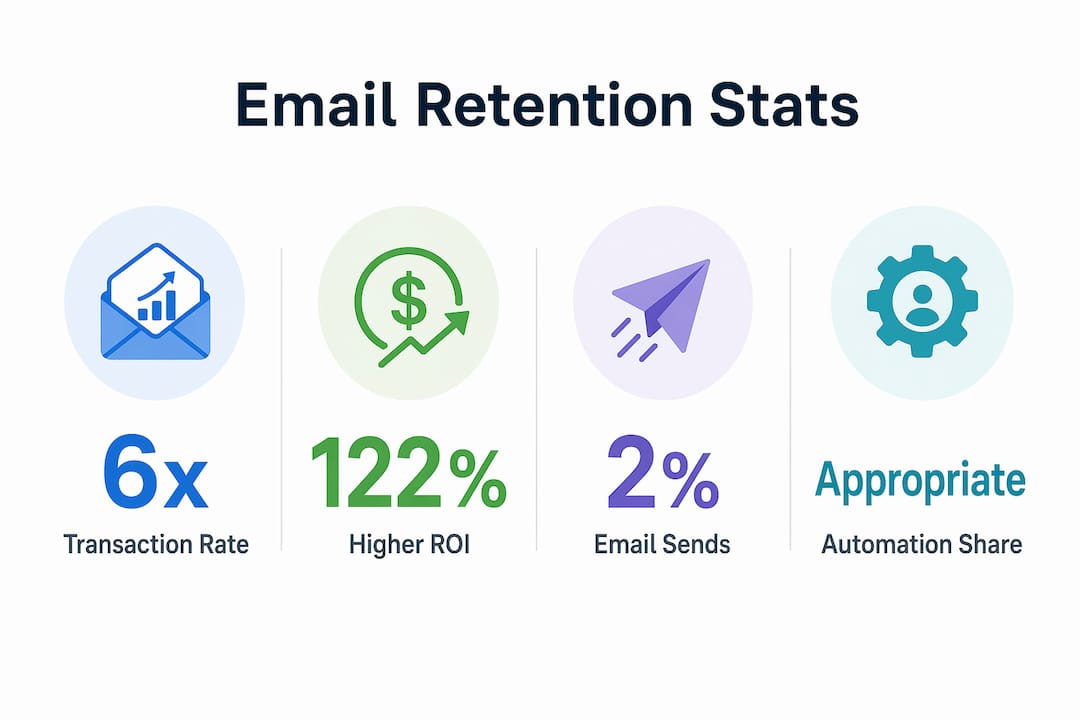
The data on automation is striking. Automated lifecycle emails represent roughly 2% of total email sends but drive approximately 37 to 41% of all email-generated sales. That ratio tells you everything about where retention value actually lives.
Broadcast emails, the weekly newsletter or the sitewide sale announcement, have their place. But they are not retention tools. They reach everyone on your list with the same message regardless of where each customer sits in their relationship with your brand. Automated flows, by contrast, fire based on specific customer behaviors: a completed purchase, a lapsed replenishment window, a second browse without a buy.
| Flow type | Trigger | Avg. engagement | Revenue contribution |
|---|---|---|---|
| Welcome series | New subscriber or first purchase | High open rates (40%+) | Strong first-purchase conversion |
| Post-purchase | Order confirmed | Very high (transactional) | Repeat purchase setup |
| Replenishment | Days since last purchase of consumable | High relevance-driven opens | Predictable recurring revenue |
| Win-back | 60 to 90 days of inactivity | Lower but high-value segment | Recovered lapsed customers |
| Broadcast email | Scheduled send | Average (15 to 25% open) | Promotional spikes only |
The most effective automated ecommerce workflows are built around dynamic triggers tied to customer behavior, not fixed calendar dates. A replenishment email sent 28 days after a skincare purchase converts far better than a generic “we miss you” sent to everyone who hasn’t bought in a month.
Pro Tip: Build your lifecycle triggers around product-specific timelines. A 30-day consumable and a 12-month appliance need completely different re-engagement windows. Map your product catalog to realistic repurchase cycles before you build a single flow.
What personalization actually means for retention emails
Personalized email campaigns deliver around 6x the transaction rate of non-personalized ones and yield 122% higher ROI. That gap exists because most brands still treat “personalization” as inserting a first name into a subject line. Real personalization is built on three data layers: who the customer is, what they have done, and what they need right now.

Behavioral data is the most powerful layer. A customer who bought twice in 90 days and opened your last three emails is in a completely different retention state than someone who bought once six months ago and has not engaged since. Sending both the same message is not personalization. It is list management disguised as marketing.
Dynamic lifecycle segmentation based on real-time engagement signals, recency, frequency, and purchase value, consistently outperforms static segments built on demographics or acquisition source. Klaviyo’s predictive analytics layer makes this segmentation accessible without a data science team, which is why it has become the platform of choice for serious ecommerce retention programs.
Practical examples of personalized retention email content include:
- Product-specific reorder reminders tied to the exact SKU a customer purchased
- Browse abandonment emails referencing the specific category or product viewed
- Loyalty tier updates showing a customer how close they are to their next reward
- Post-purchase education matched to the product category (setup guides, care instructions, usage tips)
- Anniversary or milestone emails triggered by the customer’s first purchase date
Pro Tip: Use real-time engagement signals to build dynamic segments that update automatically. A customer who re-engages after six months of silence should immediately exit your win-back flow and enter an active-customer nurture sequence, not continue receiving reactivation messaging.
Key types of retention emails and how to use them
The most effective retention email programs combine transactional utility with relationship-building content. Neither alone is sufficient. Transactional emails, order confirmations, shipping updates, and delivery notifications, earn the highest open rates of any email type because customers actively want that information. That attention is an opportunity most brands waste by sending plain, template-driven confirmations with no retention value built in.
Post-purchase emails that match customer context improve confidence and protect retention far better than generic upsell blasts sent immediately after checkout. A customer who just spent $150 on a skincare set does not want a 10% discount on their next order within 24 hours. They want reassurance that their order is on its way, guidance on how to use what they bought, and a reason to trust the brand they just chose.
A practical post-purchase email flow for ecommerce brands looks like this:
- Order confirmation (immediate): Confirm details, set delivery expectations, and include one piece of product-relevant content.
- Shipping notification (on dispatch): Provide tracking and a brief “what to expect” note.
- Delivery confirmation (on arrival): Acknowledge receipt and offer a usage tip or setup guide.
- Product education email (3 to 5 days post-delivery): Send utility-focused content that builds product confidence and increases satisfaction.
- Review request (7 to 10 days post-delivery): Ask for feedback once the customer has had time to form an opinion.
- Repeat purchase prompt (timed to product lifecycle): Introduce a complementary product or reorder prompt based on typical usage cycles.
Balancing promotional and informational content is where most ecommerce brands get the ratio wrong. A sequence that is 80% promotional trains customers to ignore your emails or unsubscribe. A sequence that is 80% informational builds loyalty but leaves revenue unrealized. The sweet spot for most categories is roughly 60% informational and 40% promotional across a full post-purchase flow.
Common challenges in email retention and how to fix them
Even a well-designed retention email program fails if the technical foundation is broken. The four most common failure points are deliverability, list decay, message saturation, and poor win-back timing.
Deliverability is the prerequisite everything else depends on. List hygiene and deliverability are prerequisites for retention email success because poor inbox placement kills engagement before the subject line even gets a chance. Sending to unengaged contacts damages your sender reputation, which reduces deliverability for your entire list, including your best customers.
List decay is faster than most brands expect. Email lists decay at roughly 22% per year through unsubscribes, address changes, and abandoned inboxes. Without active suppression and re-engagement protocols, your retention program is gradually sending to a ghost audience.
Message saturation is the most common self-inflicted wound in ecommerce email. Sending too frequently to unresponsive contacts does not convert them. It accelerates unsubscribes and spam complaints.
Win-back timing requires discipline. Win-back campaigns generate strong ROI but only when paired with suppression strategies that protect deliverability. A customer who has not opened an email in 120 days should receive a short, high-value win-back sequence of two to three emails, and then be suppressed if they remain unresponsive.
- Suppress contacts who have not engaged in 90 to 120 days before running win-back flows
- Set a sunset policy: after a defined win-back window, move unresponsive contacts to a suppressed list
- Monitor spam complaint rates weekly; anything above 0.1% requires immediate list review
- Use ecommerce automation tools to automate suppression and re-engagement triggers rather than managing them manually
Pro Tip: Never send a win-back campaign to your full lapsed segment at once. Warm up the send by starting with your most recently lapsed contacts (60 to 75 days inactive) before moving to longer-lapsed segments. This protects your sender score while maximizing recovery rates.
Key takeaways
Email retention marketing works because it combines behavioral targeting, lifecycle automation, and personalized content to keep customers engaged and buying across their full relationship with a brand.
| Point | Details |
|---|---|
| Automation drives disproportionate revenue | Automated flows make up 2% of sends but generate 37 to 41% of email sales. |
| Personalization multiplies transaction rates | Personalized campaigns deliver 6x the transaction rate of generic emails. |
| Post-purchase sequencing protects retention | Context-matched post-purchase emails build confidence and reduce churn more than upsell blasts. |
| List hygiene is non-negotiable | Suppressing unengaged contacts protects deliverability for your entire active list. |
| Win-back requires timing discipline | Segment lapsed contacts by recency and suppress non-responders after a defined window. |
What I’ve learned about email retention after working with ecommerce brands
Most brands come to Take-action with the same problem: they have an email list, they send campaigns, and they wonder why retention numbers are not moving. The diagnosis is almost always the same. They are treating email as a broadcast channel instead of a relationship channel.
The brands that see the biggest retention lifts are the ones willing to slow down and map their customer lifecycle before building a single flow. That means connecting Klaviyo to their product catalog, their customer service data, and their purchase history, not just their signup forms. When you know that a customer bought a product that typically runs out in 45 days, and you know they opened your last two emails, you have everything you need to send a message that feels genuinely useful rather than opportunistic.
I have also seen brands over-invest in acquisition email (welcome flows, cart abandonment) and under-invest in the middle of the lifecycle. The post-purchase period, from delivery through the 90-day mark, is where retention is actually won or lost. Customers who receive relevant, helpful communication during that window have measurably higher lifetime value than those who do not.
The KPIs that matter most for retention email are not open rates. They are repeat purchase rate, time between purchases, and revenue per recipient over a 90-day window. If those numbers are not in your weekly reporting, you are optimizing for the wrong thing.
AI-driven personalization is making dynamic segmentation more accessible in 2026, but the brands using it most effectively are the ones who started with clean data and clear lifecycle definitions. Technology amplifies what you already have. It does not fix a broken foundation.
— Take
How Take-action helps ecommerce brands build retention email programs that scale
Take-action specializes in building email retention systems for ecommerce brands using Klaviyo, from lifecycle flow architecture to campaign strategy and ongoing optimization. The agency combines behavioral segmentation, automated trigger design, and brand-aligned messaging to turn email into a predictable revenue channel rather than a periodic promotional tool. If your retention metrics are flat despite an active email program, the issue is almost always structural, and that is exactly the kind of problem Take-action is built to solve. Work with Take-action to audit your current flows, identify the gaps in your lifecycle coverage, and build a retention program that compounds over time.
FAQ
What is the role of email in customer retention?
Email retains customers by delivering timely, relevant communications across the full purchase lifecycle, from post-purchase education through win-back campaigns. It is the highest-ROI retention channel available to ecommerce brands, returning up to $45 for every $1 spent.
How do automated email flows reduce customer churn?
Automated flows trigger based on specific customer behaviors, such as purchase completion or inactivity, ensuring customers receive relevant messages at the right moment rather than generic blasts. This behavioral relevance is why automated emails drive 37 to 41% of email-generated sales despite representing only 2% of total sends.
Why does personalization matter for retention emails?
Personalized email campaigns deliver around 6x the transaction rate of non-personalized ones because they address the customer’s actual behavior and current needs rather than broadcasting a one-size-fits-all message. Segmenting by recency, purchase history, and engagement level produces the strongest retention outcomes.
How often should ecommerce brands send retention emails?
Send frequency should match customer engagement level and lifecycle stage, not a fixed calendar schedule. Active customers can receive two to four emails per month without fatigue, while lapsed contacts should receive a short win-back sequence and then be suppressed if they remain unresponsive.
What metrics should I track for retention email performance?
Track repeat purchase rate, revenue per recipient over 90 days, and time between purchases as your primary retention KPIs. Open and click rates are useful diagnostic signals, but they do not directly measure whether email is keeping customers loyal and buying.