

Setting Marketing Goals for Ecomm Brands: Step-by-Step Guide
Over 60 percent of ecommerce brands identify unclear goals and scattered analytics as major barriers to growth. Knowing where your business stands today is the first step to unlocking steady expansion. By assessing your current performance, setting measurable targets, and connecting marketing efforts with your overall strategy, you can transform scattered data into real progress. This guide walks you through building a foundation for smarter, more effective ecommerce growth by tackling each step with clarity and purpose.
Table of Contents
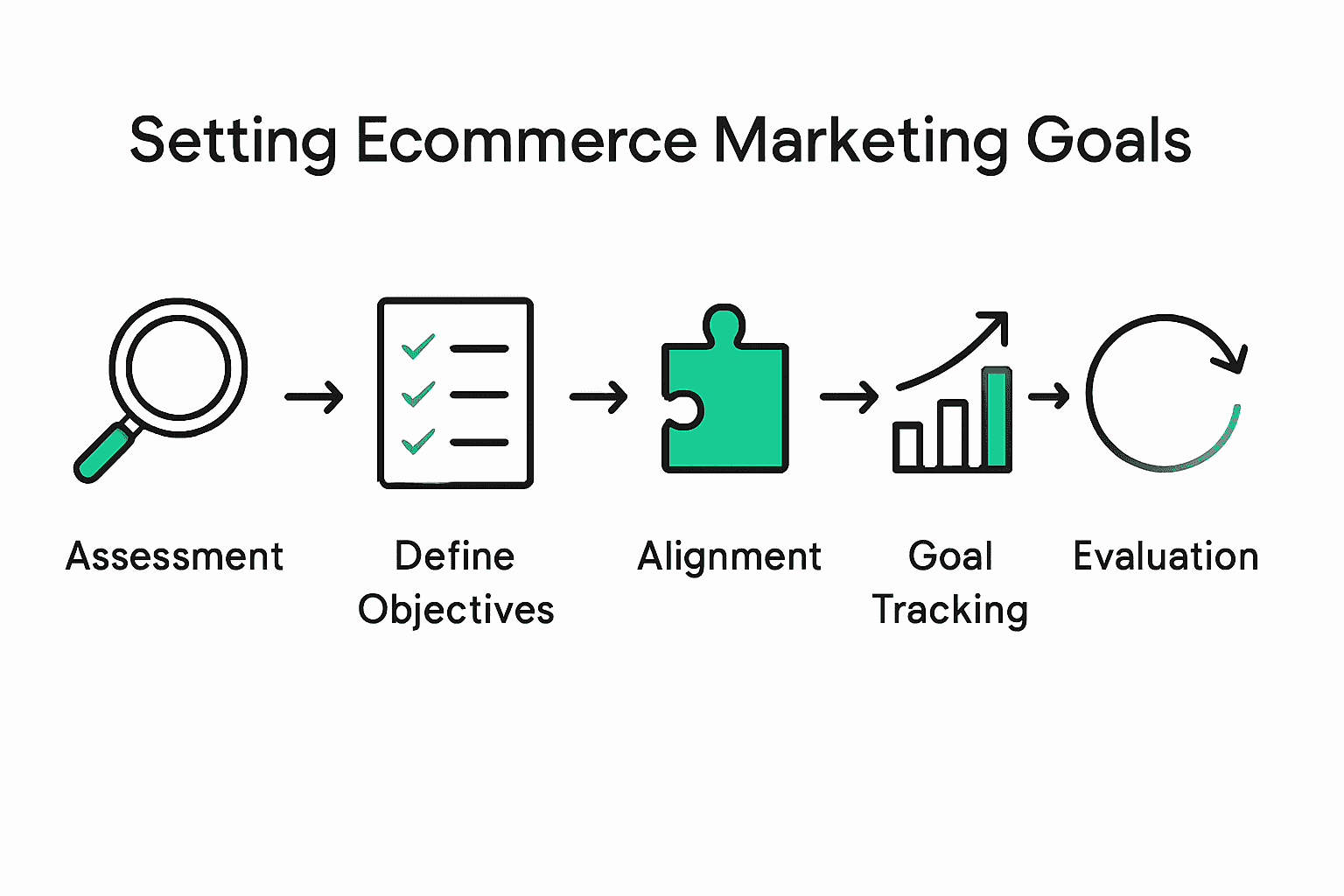
- Step 1: Assess Current Performance And Benchmarks
- Step 2: Define Measurable Marketing Objectives
- Step 3: Align Goals With Business Growth Strategy
- Step 4: Integrate Goal Tracking With Klaviyo And Analytics
- Step 5: Evaluate Results And Refine Future Goals
Quick Summary
| Key Point | Explanation |
|---|---|
| 1. Assess Current Performance Thoroughly | Understand all aspects of your ecommerce metrics, not just revenue. Focus on traffic, conversion, and customer engagement. |
| 2. Set SMART Marketing Objectives | Create specific, measurable, achievable, relevant, and time-bound goals to direct your marketing efforts effectively. |
| 3. Align Marketing with Business Strategy | Integrate marketing objectives with business growth indicators to ensure a cohesive strategic direction. |
| 4. Utilize Klaviyo for Goal Tracking | Leverage advanced analytics tools like Klaviyo to monitor performance and refine your marketing strategies in real time. |
| 5. Evaluate and Adapt Strategy Regularly | Critically assess results and refine future goals to continuously improve and adapt your marketing efforts. |
Step 1: Assess current performance and benchmarks
In this crucial step, you’ll develop a comprehensive understanding of your ecommerce brand’s current performance by establishing meaningful benchmarks and analyzing key metrics. Think of this process as taking your brand’s digital temperature to identify strengths, weaknesses, and opportunities for growth.
According to research from Aisel, evaluating ecommerce website performance requires examining multiple dimensions beyond simple revenue numbers. This means diving deep into metrics like customer usage patterns, financial returns, and overall owner satisfaction. Start by gathering data across several critical areas:
- Website traffic and conversion rates
- Average order value
- Customer acquisition cost
- Retention and repeat purchase rates
- Email marketing engagement metrics
Research published in Clutejournals suggests applying a balanced scorecard approach to comprehensively assess performance. This means looking beyond pure financial metrics and considering operational efficiency, customer experience, and long term growth potential.
Pro Tip: Don’t just collect numbers. Understand the story behind the data.
Once you’ve compiled your initial performance snapshot, you’ll be ready to set strategic goals that transform these insights into actionable growth strategies. The next step will help you translate these benchmarks into specific, measurable objectives that can propel your ecommerce brand forward.
Step 2: Define measurable marketing objectives
In this step, you’ll transform your performance assessment into crystal clear marketing objectives that drive real business growth. Your goal is to create specific targets that are not just numbers on a page but actionable strategies that will propel your ecommerce brand forward.
According to research from Thejoas, digital marketing strategies must include clear and measurable objectives that directly influence consumer purchase behavior. This means moving beyond generic goals like “increase sales” to precise targets such as “boost conversion rates by 15% through personalized email marketing campaigns”.
Start by establishing SMART objectives:
- Specific: Clearly define what you want to achieve
- Measurable: Attach concrete numbers or percentages
- Achievable: Set realistic targets based on your current performance
- Relevant: Align objectives with overall business strategy
- Time-bound: Set specific timeframes for achieving these goals
Research from Sciencepubco emphasizes the importance of defining measurable objectives across multiple digital marketing channels including SEO, social media engagement, and content marketing. For an ecommerce brand, this might translate to objectives like:
- Increase organic search traffic by 25% within 6 months
- Improve social media engagement rate from 2% to 5% in Q3
- Reduce customer acquisition cost by 10% through targeted email campaigns
Pro Tip: Ensure your objectives are interconnected and support your overall marketing strategy.
By creating precise and strategic marketing objectives, you are setting the foundation for targeted, effective growth.
 Understanding how to measure marketing ROI will be crucial in tracking your progress and making data-driven adjustments.
Step 3: Align goals with business growth strategy
In this critical step, you’ll transform your marketing objectives into a comprehensive strategy that propels your entire business forward. Your mission is to create a holistic approach where marketing efforts directly support and accelerate your broader business growth ambitions.
Research from Arxiv highlights the importance of integrating marketing initiatives with overall business objectives. This means looking beyond isolated marketing tactics and understanding how each strategy contributes to your larger business vision. Think of it like assembling a puzzle where every marketing effort is a piece that fits perfectly into your growth landscape.
Start by mapping your marketing goals against key business growth indicators:
- Revenue expansion targets
- Market share growth
- Customer acquisition and retention rates
- Product development roadmaps
- Operational efficiency improvements
A fascinating case study from Arxiv demonstrates how proactively aligning operational goals with business strategies can dramatically enhance performance and scalability. For ecommerce brands, this translates to creating marketing objectives that are nimble and responsive to changing business needs.
Pro Tip: Treat your marketing strategy as a living document that evolves with your business.
Sustainable Business Growth: Complete Guide for Brands can provide additional insights into creating a comprehensive approach that connects your marketing efforts with long term business success. As you align your goals, remember that consistency and adaptability are your greatest assets.
Step 4: Integrate goal tracking with Klaviyo and analytics
In this crucial step, you will transform raw data into actionable insights by strategically integrating goal tracking across your marketing analytics platforms. Your objective is to create a comprehensive system that provides real time visibility into your marketing performance and helps you make informed decisions.
Research from Sciencepubco emphasizes the critical importance of integrating digital marketing strategies with advanced analytics tools. Klaviyo stands out as a powerful platform that allows ecommerce brands to track and measure marketing goals with unprecedented precision.
Start by setting up these key tracking mechanisms:
- Connect Klaviyo with your website analytics
- Configure custom events and conversion tracking
- Create segmented performance dashboards
- Set up automated reporting workflows
- Map customer journey touchpoints
According to research from Thejoas, analytics play a crucial role in monitoring the impact of digital marketing strategies on consumer behavior. By leveraging Klaviyo’s advanced tracking capabilities, you can gain deep insights into how your marketing initiatives directly influence customer actions.
Pro Tip: Regularly review and recalibrate your tracking setup to ensure data accuracy.
Understanding the Importance of Marketing Analytics will provide additional context for developing a robust tracking infrastructure. Remember that effective goal tracking is an ongoing process of refinement and strategic optimization.
Step 5: Evaluate results and refine future goals
In this final strategic phase, you will transform your marketing data into a powerful roadmap for continuous improvement. Your goal is to critically analyze performance metrics and develop an adaptive approach that turns insights into actionable growth strategies.
Research from Aisel provides a comprehensive model for measuring ecommerce website performance that goes beyond surface level metrics. This approach requires a holistic evaluation of your marketing efforts across multiple dimensions including quantitative results and qualitative impact.
Implement a structured evaluation process:
- Compare actual results against initial objectives
- Identify overperforming and underperforming strategies
- Analyze conversion rates and customer engagement metrics
- Understand the root causes behind performance variations
- Document key learnings and insights
According to research from Clutejournals, applying a Balanced Scorecard framework allows ecommerce brands to assess performance comprehensively. This means looking beyond just revenue numbers and considering factors like customer satisfaction, operational efficiency, and long term growth potential.
Pro Tip: Treat each marketing cycle as a learning opportunity rather than a success or failure scenario.
What Is Growth Hacking? Complete Guide for Brands can provide additional strategies for turning your evaluation insights into future growth initiatives. Remember that successful marketing is an iterative process of continuous learning and strategic refinement.
Drive Ecommerce Growth by Setting Strong, Measurable Marketing Goals
The article highlights key challenges ecommerce brands face in defining and tracking precise marketing objectives that align with overall business growth. You might be struggling to transform data into actionable strategies or to integrate goal tracking seamlessly across platforms like Klaviyo. These challenges can hold back your ability to increase customer retention, optimize email campaigns, or scale your brand effectively.
Take Action specializes in helping ecommerce businesses overcome these exact hurdles by turning your email marketing into a powerful growth engine. Our expertise in automation, segmentation, and strategic campaign design ensures your goals are not just set but achieved through data-driven approaches tailored to your brand voice. We help you increase open rates, recover abandoned carts, and diversify revenue streams beyond paid ads while maintaining a consistent, optimized customer journey.
Elevate your marketing strategy today with targeted support designed around your unique objectives.
Ready to set measurable marketing goals that fuel real growth and see them through with expert guidance?

Explore our proven strategies and automation expertise at Take Action and learn how to integrate Klaviyo goal tracking and analytics with ease. Don’t wait to turn your marketing data into lasting revenue—start your journey with us now.
Frequently Asked Questions
How can I assess my current ecommerce brand performance?
To assess your current ecommerce brand performance, analyze key metrics such as website traffic, conversion rates, and customer acquisition costs. Gather data over a specific period and look for trends or patterns to identify strengths and weaknesses.
What are SMART objectives, and how do I define them for my marketing strategy?
SMART objectives are Specific, Measurable, Achievable, Relevant, and Time-bound goals that guide your marketing efforts. To define them, start by determining what you want to achieve and attach concrete numbers, such as aiming to increase organic search traffic by 25% within 6 months.
How do I align my marketing goals with my overall business growth strategy?
Align your marketing goals by mapping them against your key business objectives, like revenue growth and customer retention. Create a holistic approach where each marketing effort directly contributes to your larger business vision, ensuring that they support each other effectively.
What key metrics should I track to evaluate my marketing efforts in ecommerce?
To evaluate your marketing efforts, track key metrics such as conversion rates, customer engagement metrics, and average order values. Regularly review these metrics to identify which strategies are effective and which need refinement for improvement.
How often should I review and refine my marketing goals?
You should review and refine your marketing goals regularly, ideally at the end of each marketing cycle or campaign. Establish a routine review process to assess performance against your objectives and make adjustments as needed for continued growth.
What role does Klaviyo play in tracking ecommerce marketing goals?
Klaviyo helps track and measure marketing goals by integrating with your website analytics and enabling you to set up custom events and conversion tracking. Utilize its features to create segmented performance dashboards and automate reporting, ensuring real-time insights into your marketing effectiveness.
Recommended
- Complete Guide to SEO for Ecommerce Stores | Take Action Blog | Take Action
- Building Brand Awareness for Ecommerce Success: Step by Step | Take Action Blog | Take Action
- 7 Essential Ecommerce Marketing Strategies for Growth | Take Action Blog | Take Action
- Mastering Brand Positioning Strategies for Ecommerce Success | Take Action Blog | Take Action
- Optimizing Product Listings for Increased Sales Success | Prodcast