

Personalization Is the Retention Lever Most Brands Waste
Personalization is now the single biggest lever separating brands that keep customers from brands that keep acquiring them to replace the ones who left. Companies that get personalization right see double-digit revenue growth and materially better retention, and over 70% of customers now treat personalized experiences as the baseline, not the bonus. A study of 420 retail consumers found AI-driven personalization significantly increases loyalty by building trust and perceived value. The catch: that same study found privacy concerns cancel out the benefit when personalization feels invasive rather than helpful.
TL;DR:
- Cohort segmentation is a cost-effective starting point for personalization programs and can significantly boost loyalty without requiring real-time machine learning.
- Timing, such as sending a cart abandonment email within two hours rather than days, has a measurable impact on retention and customer engagement.
- Personalization efforts should focus on behavioral signals like purchase history and recent activity to prevent customer perceptions of invasive or irrelevant messaging.
- Measuring effective personalization involves using holdout groups and uplift modeling to accurately track incremental retention and loyalty improvements.
- Privacy concerns can undermine personalization benefits; transparent data practices and clear opt-outs are essential to maintain customer trust.
Table of Contents
- The Role of Personalization in Retention Depends on What “Personalization” Actually Means
- How Does Personalization Actually Improve Customer Retention?
- What Do the Numbers Say About Personalization’s Impact on Loyalty?
- Which Channels Drive the Most Retention Through Personalization?
- How Do You Operationalize Personalization Without Breaking It?
- Why Does Personalization Sometimes Backfire?
- How Do You Prove Personalization Is Actually Working?
- What Does Email-First Retention Personalization Look Like in Practice?
- Key Takeaways
- Where to Read More on This Topic
- What Actually Matters When You Cut Through the Personalization Hype
- Sources
The Role of Personalization in Retention Depends on What “Personalization” Actually Means
Most teams use the word “personalization” to describe three very different levels of sophistication, and confusing them is why so many retention programs underdeliver.
- Cohort segmentation groups customers by shared traits (purchase category, geography, lifecycle stage) and sends the same message to everyone in the group. A skincare brand emailing “new moms” one flow and “acne-prone teens” another is cohort personalization. It requires basic customer data and a segmentation tool, nothing exotic.
- Behavioral personalization reacts to what an individual actually does: browsing a product three times, abandoning a cart, skipping a usual reorder window. This is where dynamic email content and on-site recommendation widgets live.
- Hyper-personalization uses machine learning to predict what a specific person wants before they’ve signaled it, adjusting content, offers, and timing in real time. Think Klaviyo predictive analytics recommending a reorder date based on someone’s actual consumption pattern rather than a generic 30-day cycle.
Each step up the spectrum costs more in data infrastructure and modeling talent. Deloitte’s research suggests cohort-based personalization remains a legitimately good starting point for teams that can’t yet justify the investment in real-time modeling. You don’t need hyper-personalization to move the retention needle. You need the right level for your data maturity.
How Does Personalization Actually Improve Customer Retention?
The mechanism isn’t magic. It’s a chain reaction, and understanding each link helps you diagnose where your own program is breaking down.
- Relevance reduces friction. When a message matches what someone actually wants, they act on it faster and ignore it less often. Engagement frequency climbs because the content stops feeling like noise.
- Relevance builds satisfaction. A post-purchase email that anticipates a real question, like sizing or care instructions, resolves the moment instead of creating another support ticket. Satisfied customers buy again sooner.
- Satisfaction compounds into trust. Trust is what lets a brand recommend a slightly more expensive product or a subscription upgrade without the customer feeling sold to.
- Trust deepens loyalty through a feedback loop. Academic research on the Algorithmic Personalization Loop describes this well: as customers respond to personalized content, systems learn more about them, personalization improves, and loyalty strengthens iteratively. Customers effectively train the system that serves them better.
The reverse is just as true. When personalization misfires, whether from stale data, tone-deaf recommendations, or repetitive messaging, that same loop runs backward into what researchers call depersonalization: the customer feels unseen, and loyalty erodes faster than it would from generic, non-personalized contact.
The operational levers that make the positive loop happen aren’t complicated in concept, even if they’re demanding to build. Timely triggers (send within the window when the message is still relevant), lifecycle flows (welcome, browse abandonment, post-purchase, win-back), and automated save flows that catch a customer before they churn rather than after.
Pro Tip: If you only have bandwidth to fix one thing this quarter, fix timing before you fix content. A perfectly written email sent four days after cart abandonment underperforms a mediocre one sent within two hours.
What Do the Numbers Say About Personalization’s Impact on Loyalty?
Executives asking for a business case need real figures, not vague enthusiasm about “customer-centricity.” Here’s where the evidence actually lands.
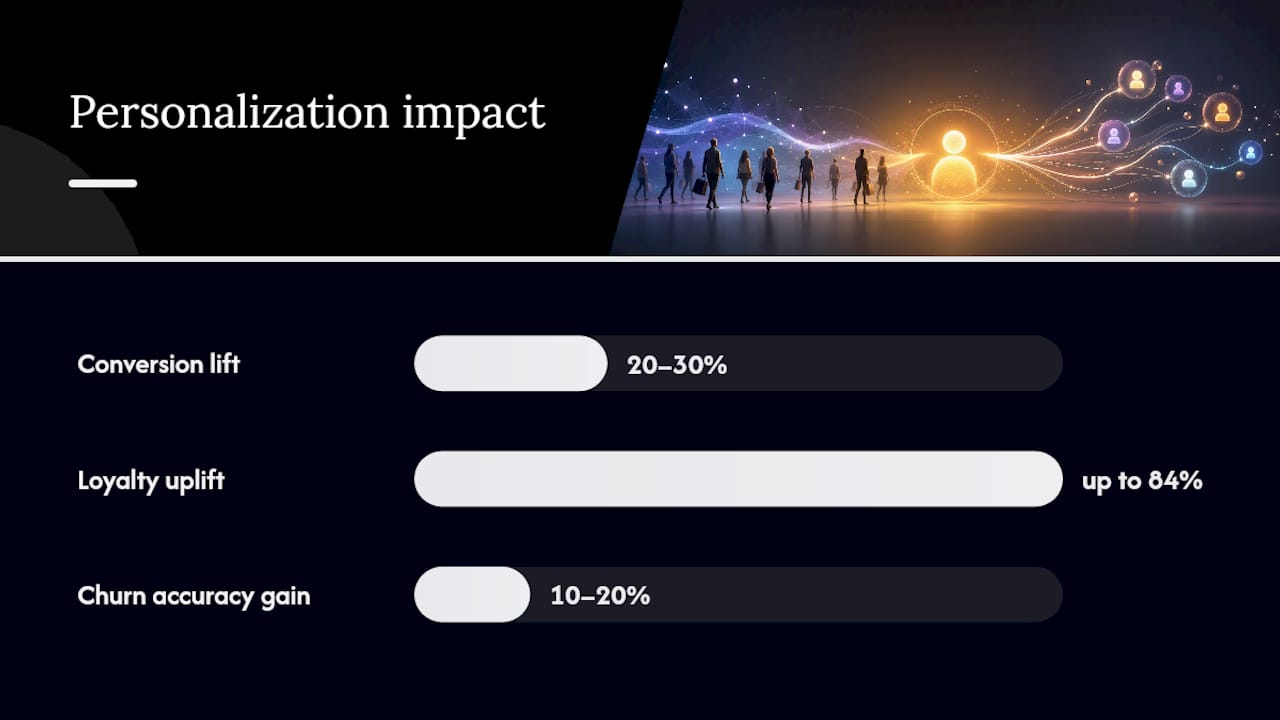
A structured review synthesizing over 50 sources found that AI-enabled hyper-personalization can lift conversions by 20% to 30% and loyalty indicators by as much as 84% in favorable conditions, with machine-learning churn models improving predictive accuracy by 10% to 20% over older rule-based methods. That accuracy gap matters more than it sounds: a model that correctly flags at-risk customers two weeks earlier gives your team two more weeks to intervene before they cancel or drift to a competitor.
McKinsey’s research points the same direction at the revenue level, tying personalization leadership to double-digit revenue growth and stronger retention outcomes across the brands it studied.
The KPIs worth tracking against these benchmarks:
- Retention rate (rolling 90-day and annual) segmented by personalization exposure versus a control group
- Churn rate, especially the delta between personalized and non-personalized cohorts
- Customer lifetime value (CLV) uplift attributable to specific personalized flows
- Repeat purchase rate, the cleanest proxy for whether relevance is translating into behavior
Deloitte’s consumer loyalty research adds an important qualifier: personalization is now the top attribute customers want from loyalty programs, yet only about 60% of consumers say they’re satisfied with the personalization they currently receive. That gap between expectation and delivery is where most of the growth is sitting unclaimed.
Which Channels Drive the Most Retention Through Personalization?
Not every channel earns its personalization investment equally. Prioritize based on where the behavioral signal is strongest and the cost to act on it is lowest.
- Email lifecycle flows remain the most dependable retention channel because they’re triggered by explicit behavior (cart abandonment, browse activity, post-purchase timing) and reach the customer directly rather than competing for attention in a feed.
- On-site and product recommendations work best for repeat purchases in categories with natural reorder cycles or logical upsell paths (consumables, apparel, subscriptions).
- Loyalty program personalization turns a generic points system into targeted rewards based on actual purchase history rather than blanket discounts. This is the tactic Deloitte’s data suggests is most underused relative to customer demand.
- Post-purchase and support messaging catches customers at their highest-trust moment. A well-timed check-in outperforms a generic review request.
- Cross-channel timing coordination matters more than any single channel. A customer who gets a cart-abandonment email, a retargeting ad, and a push notification within the same hour doesn’t feel personalized. They feel targeted, and that distinction shows up in unsubscribe rates.
An ecommerce newsletter strategy built around retention rather than one-off promotions typically outperforms campaign-style sending precisely because it respects this cadence problem instead of adding to it.
How Do You Operationalize Personalization Without Breaking It?
Personalization fails most often not because the idea is wrong but because the execution treats it as a messaging layer instead of an operational system. Building it correctly follows a fairly consistent sequence.
- Establish data foundations first. First-party data capture, identity resolution across devices, and unified event tracking are non-negotiable prerequisites. Without them, every downstream model is guessing.
- Decide segmentation versus one-to-one deliberately. Not every flow needs individual-level personalization. Reserve real-time, ML-driven personalization for high-value moments (churn risk, high-CLV segments) and use cohort logic everywhere else to control cost.
- Build automation architecture around triggers and conditional logic. A save flow should branch based on the specific signal, a payment failure gets a different message than a usage gap, rather than funneling everyone into the same generic “we miss you” template.
- Layer in predictive models where the data supports them. Churn prediction, reorder timing, and dynamic offer optimization are the three models with the clearest retention payoff, largely because they let you intervene before the customer has already decided to leave.
- Assign clear ownership and a testing cadence. Personalization programs stall when no single team owns the feedback loop between what the data shows and what the campaigns actually do differently as a result.
Practitioner guidance on retention architecture consistently makes the same point: systems built on behavioral triggers and automated recovery flows outperform one-off campaigns and, done well, reduce the discount cannibalization that comes from blasting the same coupon to everyone regardless of whether they need one to convert.
Pro Tip: Map every “save” trigger to a specific signal before you write a single email. If your only intervention is a discount, you’re not personalizing, you’re discounting with extra steps.

Why Does Personalization Sometimes Backfire?
Privacy concerns don’t just add friction to personalization. They can flip its effect entirely. The same 420-consumer study that found AI personalization drives loyalty also found that privacy concerns negatively moderate that relationship, meaning the exact same tactic can build trust with one customer and trigger reactance in another, depending on how transparent the data collection felt.
The warning signs worth watching for:
- Recommendations so precise they feel like surveillance rather than relevance
- Repetitive messaging that ignores a customer’s previous “no”
- Opaque data use with no clear opt-out or explanation
- Personalization that references information the customer didn’t knowingly share
Mitigating this isn’t complicated, but it requires discipline: build privacy-by-design into data collection from the start, keep consent language plain rather than legalistic, offer real opt-outs (not buried ones), and be able to explain in a sentence why a customer is seeing what they’re seeing. Brands that treat ethical marketing practices as core infrastructure rather than a compliance checkbox tend to sustain personalization’s retention benefits longer, because trust, once broken by a creepy recommendation, is expensive to rebuild.
How Do You Prove Personalization Is Actually Working?
Measuring personalization’s true effect on retention requires more rigor than comparing a campaign’s open rate to last quarter’s.
- Run holdout groups religiously. A subset of customers who never receive the personalized treatment is the only way to isolate lift from broader market trends or seasonality.
- Use uplift modeling over simple before/after comparisons. Uplift modeling isolates the incremental effect of the personalized treatment itself, rather than crediting personalization for behavior that would have happened anyway.
- Extend test windows for retention claims. A 30-day conversion test tells you almost nothing about 12-month retention. Cohort analysis and survival analysis are better suited to answering whether personalized customers actually stick around longer.
- Watch for two specific measurement traps. Discount cannibalization inflates apparent lift when personalized offers simply pull forward purchases that would have happened anyway. Selection bias creeps in when your “personalized” cohort is already your most engaged customers by default.
Report on a monthly cadence at minimum, with a quarterly deep dive that separates channel-level performance from true incremental retention gain.
What Does Email-First Retention Personalization Look Like in Practice?
Retention personalization gets real the moment it’s built into a Klaviyo flow rather than discussed in a strategy deck. The practical checklist we run through with ecommerce clients:
- Capture behavioral signals at the point of action: cart abandonment timestamp, browse category, reorder interval, support contact history
- Build save flows triggered by specific signals (a lapsed reorder window, a failed payment) rather than a single generic “we miss you” template
- Segment post-purchase flows by product category so care instructions and upsells actually match what was bought
- Use personalized email examples as a baseline, then adjust dynamic content blocks by purchase history
- Tie loyalty program messaging to actual tier progress instead of blanket point reminders
- Audit flows quarterly against the latest Klaviyo personalization tactics since platform capabilities shift fast
Teams that want this built and managed rather than assembled piecemeal typically bring in a dedicated email marketing and retention partner to handle the flow architecture and ongoing optimization.
Key Takeaways
Personalization drives retention when it operates as an automated, data-backed system rather than a one-off campaign tactic, and it backfires the moment customers sense it’s tracking them rather than helping them.
| Point | Details |
|---|---|
| Match sophistication to data maturity | Start with cohort segmentation before investing in hyper-personalization if your data infrastructure isn’t ready. |
| Timing beats content quality | A well-timed generic message often outperforms a perfectly written one sent too late. |
| Track retention, not just opens | Monitor retention rate, churn delta, CLV uplift, and repeat purchase rate against a holdout group. |
| Build save flows around signals | Trigger interventions from specific behaviors like payment failures or reorder gaps, not blanket discounts. |
| Privacy protects the upside | Transparent data use and real opt-outs prevent the creepiness effect from erasing personalization’s retention gains. |
Where to Read More on This Topic
For deeper reading beyond this guide, McKinsey’s personalization value research quantifies the revenue case, Deloitte’s loyalty survey covers customer expectations, and the hyper-personalization literature review breaks down the mechanics behind the effect sizes cited above.
What Actually Matters When You Cut Through the Personalization Hype
The research supports a narrower conclusion than most vendors pitch. Personalization doesn’t retain customers because it’s clever. It retains them because it removes friction and proves, repeatedly, that the brand paid attention. That’s a much lower bar than “predict everything,” and most teams overshoot it chasing hyper-personalization before they’ve nailed timing and relevance at the cohort level.
The conventional advice, buy more data, add more models, personalize more surfaces, misses the actual failure point. Most retention programs don’t fail from insufficient sophistication. They fail from misapplied sophistication: a recommendation engine with no explainability, a save flow triggered too late, a loyalty program that ignores what customers already told you they want.
Prioritize the boring fundamentals first: clean first-party data, well-timed triggers, and transparent consent. The AI layer amplifies whatever foundation you’ve already built. It doesn’t replace one.
— Take
Sources
- The value of getting personalization right—or wrong—is multiplying
- Enhancing customer retention through hyper-personalisation: Integrating artificial intelligence with marketing strategies: A decade review
- Personalization at Scale: AI’s Impact on Retail Customer Loyalty | Canadian Journal of Marketing Research
- Getting to know you: Personalization drives customer loyalty | Deloitte
- Algorithmic personalization and brand loyalty: An experiential perspective