

Overcoming Marketing Overwhelm: Streamline Email Retention
TL;DR:
- Most ecommerce revenue comes from automated flows, but they receive only a small fraction of sends.
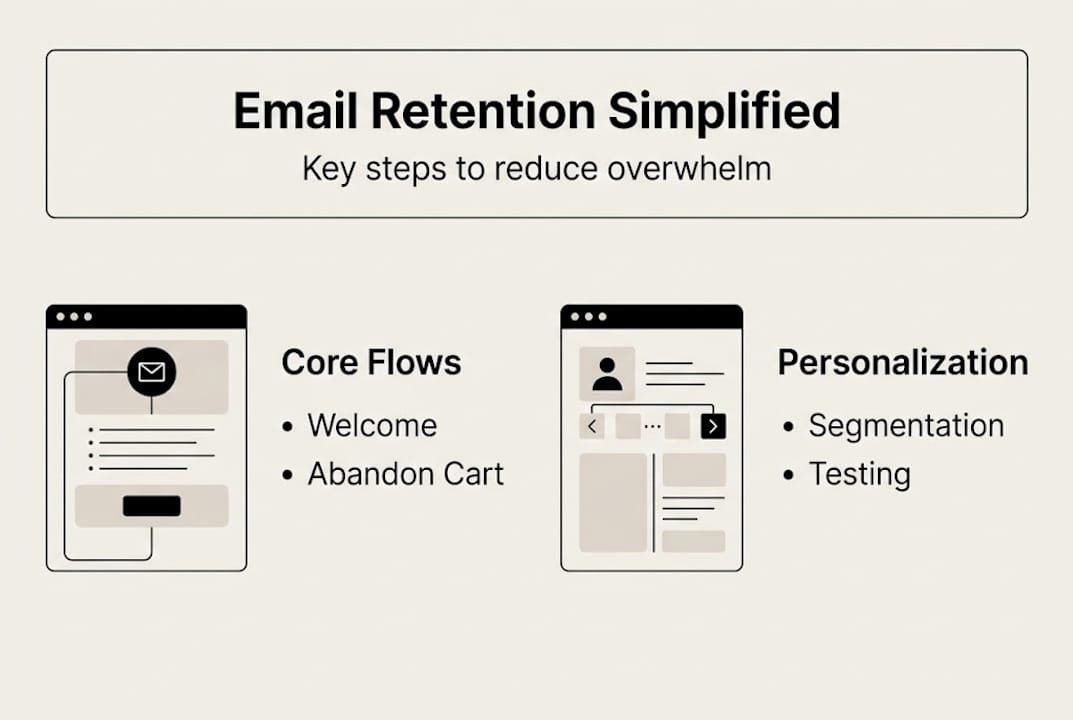
- Prioritize building core flows like welcome, abandoned cart, and post-purchase to maximize retention.
- Regularly audit, test, and segment to maintain system effectiveness and prevent email fatigue.
If your team is buried in manual campaign sends while your automated flows sit half-built, you’re leaving serious money on the table. 41% of ecommerce email revenue comes from automated flows, yet they account for only 5.3% of sends. That gap tells the whole story. Most ecommerce brands chase every channel, every campaign, every trend, and end up exhausted with mediocre results. This guide gives you a focused, evidence-based framework to cut through the noise, prioritize what actually drives retention, and use Klaviyo automation to do more with less. You’ll walk away knowing exactly which flows to build, how to segment smarter, and how to keep your system running strong.
Table of Contents
- Clarify your retention goals and identify overwhelm triggers
- Prioritize Klaviyo core flows for maximum impact
- Segment and personalize to prevent email fatigue
- Audit, test, and maintain for lasting results
- What most marketers miss about automation, overwhelm, and retention
- Ready to conquer your marketing overwhelm?
- Frequently asked questions
Key Takeaways
| Point | Details |
|---|---|
| Prioritize core Klaviyo flows | Start with five essential automations to drive retention and reduce manual workload. |
| Segment for personalization | Use RFM and behavior data for higher engagement and to prevent subscriber fatigue. |
| Audit and test regularly | Monthly reviews and A/B tests keep flow performance and deliverability strong. |
| Focus on retention mindset | Shift from chasing campaigns to nurturing long-term customer value through automation. |
Clarify your retention goals and identify overwhelm triggers
Before you add another flow or launch another campaign, you need to understand what’s actually causing the chaos. Marketing overwhelm rarely comes from doing too much work. It comes from doing the wrong work repeatedly, without a clear measure of what’s succeeding.
Start by setting retention-specific goals tied to profit-moving metrics. Think repeat purchase rate, customer lifetime value, and revenue per email send. These numbers tell you far more than open rates alone. Use Klaviyo’s built-in benchmarks to set realistic targets for your industry, then work backward to identify which activities are actually moving those numbers.
The most common overwhelm triggers for ecommerce marketing teams include:
- Running too many one-off campaigns with no automation backbone
- Treating every email as a manual project instead of a scalable system
- Lacking clear flow prioritization, so everything feels equally urgent
- Measuring success by volume of sends rather than revenue per send
- Skipping measuring email engagement at the flow level, making it hard to know what’s working
Once you spot your triggers, the fix becomes obvious: shift effort from campaigns to flows.
Campaigns are a sprint. Flows are a compounding asset. Every hour you invest in a well-built flow pays dividends for months without additional manual effort.
Klaviyo’s own data shows that campaigns average a 31% open rate, 1.69% click rate, and 0.16% order rate. Flows dramatically outperform those benchmarks across every metric. That’s not a small gap. It’s a structural advantage you’re either using or ignoring.
Deep target audience research also helps here. When you know exactly who you’re talking to and what motivates them to buy again, you stop guessing and start building flows that actually convert.
Pro Tip: Track revenue per send and repeat purchase rate weekly. If those two numbers are improving, your retention strategy is working regardless of what your open rate says.
Prioritize Klaviyo core flows for maximum impact
Once your goals are clear and your overwhelm triggers are identified, the next move is straightforward: build the flows that do the heaviest lifting. Don’t try to build everything at once. That’s how you end up with five half-finished automations and zero results.
The five core retention flows that drive 41% of email revenue are:
- Welcome flow — Introduces your brand, sets expectations, and converts new subscribers into first-time buyers
- Abandoned cart flow — Recovers lost revenue by re-engaging shoppers who left without purchasing
- Post-purchase flow — Builds loyalty, encourages reviews, and plants the seed for the second purchase
- Browse abandonment flow — Targets high-intent visitors who viewed products but didn’t add to cart
- Winback flow — Re-engages lapsed customers before they’re gone for good
Here’s how these flows compare to manual campaign sends:
| Factor | Manual campaigns | Core automated flows |
|---|---|---|
| Setup effort | High, recurring | High once, low ongoing |
| Send frequency | Requires manual action | Triggered automatically |
| Personalization | Limited | Deep, behavior-based |
| ROI consistency | Variable | Compounding over time |
| Team time required | Weekly to daily | Monthly maintenance |
The smart rollout strategy is phased. Get your welcome and abandoned cart flows live first since those generate the fastest return. Then layer in post-purchase and browse abandonment. Save winback for last because it requires a list with history. Exploring top Klaviyo funnels for retention gives you a clear map for sequencing these builds.

If you want to see how automation directly improves ecommerce conversions, the data is clear: triggered, behavior-based emails consistently outperform batch-and-blast sends.
Using Klaviyo automation to improve engagement also means your flows adapt to customer behavior in real time, which no manual campaign can match.
Pro Tip: Set a calendar reminder every 30 days to review each active flow. Even a five-minute check on open rates and revenue generated keeps you from falling into the “set and forget” trap.
Segment and personalize to prevent email fatigue
With core flows running, the next lever is segmentation. Sending the same message to your entire list is the fastest way to train subscribers to ignore you. Personalization is what keeps your emails feeling relevant instead of intrusive.
The performance difference is significant. Segmented campaigns generate 3x earnings per recipient, 1.63x open rates, and 2.16x click rates compared to generic sends. That’s not marginal. That’s transformational.
| Segment type | Avg. open rate lift | Avg. click rate lift | Earnings per recipient |
|---|---|---|---|
| General list | Baseline | Baseline | Baseline |
| Purchase history | +40% | +80% | 2x |
| RFM segmented | +63% | +116% | 3x |
| Zero-party data | +70%+ | +120%+ | 3x+ |
RFM segmentation stands for Recency, Frequency, and Monetary value. It groups customers by how recently they bought, how often they buy, and how much they spend. This framework lets you treat your best customers differently from your one-time buyers, which is exactly how you should be treating them.
Practical ways to personalize your flows include:
- Using first name and purchase history in subject lines and body copy
- Recommending products based on past browsing or buying behavior
- Adjusting send frequency based on engagement level
- Triggering different post-purchase paths for first-time vs. repeat buyers
- Collecting zero-party data (preferences, quiz answers) at signup to inform future sends
Zero-party data is information customers choose to share with you. It’s the most reliable personalization signal you have because it comes directly from the customer rather than inferred behavior.
Strong Klaviyo branding automation ties your segmentation strategy to your visual identity, so personalized emails still feel cohesive and on-brand. Personalization without brand consistency creates a disjointed experience that undermines trust. The personalization benefits for ecommerce go well beyond open rates. They build the kind of loyalty that turns one-time buyers into repeat customers.
Pro Tip: Create a dedicated “champions” segment for your top 10% of customers by lifetime value. Give them early access, exclusive offers, and VIP treatment inside your post-purchase and winback flows. These customers are your most valuable asset.
Audit, test, and maintain for lasting results
Personalization and segmentation only work if your underlying system stays healthy. A flow built six months ago and never touched is quietly losing effectiveness every week. Here’s a simple monthly process to keep everything sharp.
Monthly audit process:
- Pull flow performance reports in Klaviyo and compare against your baseline benchmarks
- Check each flow’s open rate, click rate, and revenue per recipient for drops
- Review your list health: bounce rate, unsubscribe rate, and spam complaints
- Identify any flows with declining performance and flag them for testing
- Archive or suppress unengaged subscribers using winback or sunset flows
Testing is where real gains happen. Most teams test subject lines, which is a good start. But the bigger wins often come from testing send timing, offer type, and email sequence length. For example, does a 10% discount outperform free shipping in your abandoned cart flow? Does sending the second cart email 12 hours later outperform 24 hours? These tests compound over time.
Watch for these early-warning signs of deliverability trouble:
- Spam complaint rate above 0.1%
- Hard bounce rate above 2%
- Open rates dropping 20% or more over 60 days
- Sudden drop in revenue per send without a campaign change
- Increasing unsubscribe rates on flows that previously performed well
Your sender reputation is your most valuable email asset. Once damaged, it takes months to rebuild. Clean lists and engaged subscribers protect every dollar your flows generate.
Unengaged subscribers harm sender reputation, which is why winback and sunset flows aren’t optional. They’re protective infrastructure. For fresh ideas on what to test, finding inspiration for campaigns keeps your creative approach from going stale. And if you want proven frameworks, expert Klaviyo retention strategies offer a deeper look at what top-performing brands do differently. Following Klaviyo flows best practices ensures your maintenance habits align with what the platform rewards.
What most marketers miss about automation, overwhelm, and retention
Here’s the uncomfortable truth: most ecommerce brands treat automation as a task to complete rather than a system to operate. They build the flows, check the box, and move on. That mindset is exactly why so many Klaviyo accounts underperform.
The real shift is moving from campaign-centric thinking to retention-first thinking. Campaigns ask “what do we send this week?” Retention thinking asks “what does this customer need to buy again within the next 30 days?” Those are completely different questions, and they lead to completely different results.
Engineering the second purchase is the highest-leverage move in ecommerce retention. First purchase is just the beginning. The real opportunity is using cohort analysis to identify when customers are most likely to buy again and building your post-purchase flow around that window. Most brands wait too long. Thirty to sixty days after the first purchase is your best shot.
Flows also give you something campaigns never can: ongoing customer listening. Every open, click, and skip is a signal. Use those signals to refine your segments and improve your messaging over time. Customer retention as an ecommerce growth driver is not a support function. It’s a revenue engine.
Pro Tip: Bring your customer service team into quarterly flow reviews. They hear objections, questions, and frustrations directly from buyers. That insight is gold for improving your post-purchase and winback messaging.
Ready to conquer your marketing overwhelm?
Marketing overwhelm doesn’t disappear on its own. But with the right flows, segmentation strategy, and maintenance habits in place, it becomes manageable and then it becomes an advantage. The brands that win at retention aren’t doing more. They’re doing the right things consistently.
At Take Action, we specialize in building and optimizing exactly these systems for ecommerce brands using Klaviyo. From flow architecture to segmentation strategy, our data-driven approach is built to generate measurable results without adding to your team’s workload. Explore our email retention solutions or optimize with Klaviyo experts to see how a focused retention strategy can transform your email channel into your most reliable revenue source. Book a free consultation and let’s map out your next steps together.
Frequently asked questions
What are the best Klaviyo flows for reducing marketing overwhelm?
The five core flows — welcome, abandoned cart, post-purchase, browse abandonment, and winback — deliver 41% of email revenue and replace dozens of manual campaign sends with automated, behavior-triggered sequences.
How often should I review and update my Klaviyo flows?
Audit your flows and email lists at least monthly to prevent performance decay and catch deliverability issues before they damage your sender reputation.
Why is segmentation crucial for email retention?
Segmented campaigns generate 3x earnings per recipient and 1.63x higher open rates, meaning your messages reach the right people with the right offer instead of training subscribers to ignore you.
What are signs my email list needs cleaning?
Declining open rates, rising bounce rates, or spam complaint increases are clear signals that unengaged subscribers are hurting your deliverability and it’s time to run winback or sunset flows.
Recommended
- Managing Business Growth with Automated Email Retention | Take Action Blog | Take Action
- Online Marketing Strategy: Driving Ecommerce Retention | Take Action Blog | Take Action
- Content Creation in Marketing: Driving Email Engagement | Take Action Blog | Take Action
- Avoid Common Email Marketing Mistakes for Higher ROI | Take Action Blog | Take Action
- Increasing User Engagement in your Marketing Message