

Newsletter Best Practices That Drive Retention and Sales
TL;DR:
- Effective newsletters focus on education first and promotion second, building trust and long-term revenue. Mobile-friendly design, clear structure, and a single primary CTA are essential for engagement and readability. Regular testing of sending frequency and segmentation ensures optimal deliverability and audience relevance.
The best practices for newsletters are defined by one principle: educate first, sell second. A newsletter that delivers genuine value on every send builds the subscriber trust that converts to long-term revenue. The HubSpot 2026 playbook recommends a 90% educational to 10% promotional content ratio, and brands that follow it consistently outperform those that treat their list as a broadcast channel. Pair that content discipline with mobile-first design, smart segmentation, and the right performance metrics, and your newsletter becomes one of the most reliable growth tools you own.
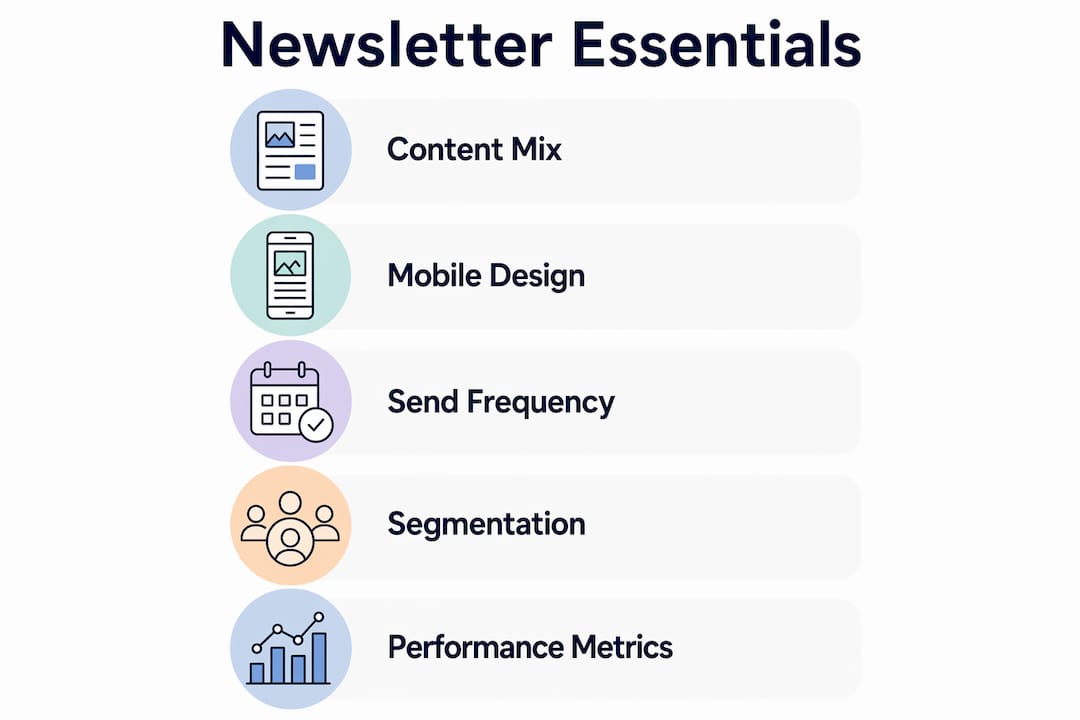
What are the best practices for newsletter content strategy?
The content mix is the foundation of every successful email newsletter. Promotional-heavy newsletters underperform because subscribers unsubscribe the moment they feel sold to on every send. The 90/10 rule keeps your list engaged and primes the 10% of promotional content to actually convert.
Structure matters just as much as content. Clear headers, short paragraphs, and scannable sections support the skim-reading behavior that defines how most people consume email. If a subscriber cannot extract value in 10 seconds of scanning, they move on.
Every newsletter needs a reliable content pipeline. The most practical content ideas for newsletters come from three sources: repurposing your best-performing blog posts, answering real customer questions from support tickets or social media, and summarizing industry news with your own interpretation added. Repurposing is especially powerful because it extends the life of content you already created without starting from scratch.
Pro Tip: Tease your full articles inside the newsletter rather than republishing them in full. A two-sentence summary with a “read more” link drives clicks, keeps your email short, and trains subscribers to expect value in every send.
Every newsletter must contain these core components:
- Subject line: 40–50 characters, specific, and benefit-driven. Avoid clickbait that erodes trust over time.
- Preview text: 85–100 characters that extend the subject line’s promise. Never leave it blank.
- Branded header: Your logo and brand colors, consistent in every issue.
- Body content: Educational or informational, organized under clear subheadings.
- Single primary CTA: One clear action you want the reader to take.
- Footer: Unsubscribe link, physical mailing address, and legal compliance text.
Lifecycle emails like welcome series and win-back campaigns deserve a separate mention. Welcome series revenue per email is 11.5x that of a standard promotional send. That number alone justifies treating your automated flows as a priority, not an afterthought. Explore ecommerce newsletter ideas for specific content formats that work across retail and DTC brands.
How should you design a newsletter for mobile readers?
Mobile-first design is not optional. More than half of all emails are opened on a mobile device, and a newsletter that breaks on a phone loses the reader permanently. The 2026 mobile design specs are specific: 14px minimum for body text, 22px for headlines, and 44x44px tap targets for every button and link.

Single-column layouts are the standard for a reason. Multi-column designs collapse unpredictably on smaller screens, creating a broken reading experience. A single column keeps your visual hierarchy intact regardless of device.
White space is a design tool, not wasted space. Generous padding between sections reduces cognitive load and guides the reader’s eye toward your CTA. Crowded newsletters feel like work to read. Clean ones feel like a gift.
One dominant CTA per issue is the single most impactful newsletter formatting best practice you can apply. Multiple competing CTAs split attention and reduce total clicks. Place your primary CTA above the fold, then use secondary links sparingly in the body.
| Newsletter Design Do | Newsletter Design Don’t |
|---|---|
| Single-column layout | Multi-column grid that collapses on mobile |
| 14px+ body text, 22px headlines | Small fonts that require pinching to read |
| 44x44px tap targets on all buttons | Tiny linked text that causes misclicks |
| One dominant CTA above the fold | Three or more competing CTAs per email |
| Generous white space between sections | Dense blocks of text with no visual breaks |
| Consistent brand colors and logo header | Inconsistent design that confuses subscribers |
Pro Tip: Before every send, preview your newsletter on at least one iOS device and one Android device. What looks perfect in your email builder can render differently in Gmail on Android versus Apple Mail on iPhone.
What sending frequency and segmentation strategies actually work?
Send frequency is one of the most misunderstood levers in email marketing. The common sweet spot is 1–3 sends per week, but the right number depends entirely on your business type and your list’s behavior. E-commerce brands typically send 3–5 times per week. B2B SaaS companies perform best at 1–2 times per week. Media and newsletter-first businesses often send daily without issue.
The mistake most marketers make is picking a frequency and never testing it. Cohort analysis is the correct method: split your list into groups, vary the cadence, and measure unsubscribe rates and click-to-open rates across each group over 30 days. The data tells you what your audience will tolerate.
Here is a practical process for testing and adjusting your send frequency:
- Establish a baseline. Record your current unsubscribe rate, spam complaint rate, and CTOR for the past 90 days.
- Create two cohorts. Segment your active list into two equal groups matched by engagement history.
- Vary the cadence. Send one cohort at your current frequency and the other at a higher or lower rate for 30 days.
- Measure the delta. Compare unsubscribe rates, spam complaints, and revenue per email across both groups.
- Apply and iterate. Roll out the winning cadence to your full list, then test again in 60 days.
Unsubscribe rates above 0.5% per send signal a content or cadence problem. The cross-industry average sits around 0.27%. If you are above that threshold consistently, the issue is either frequency, relevance, or both.
Segmentation is the tool that makes frequency sustainable. Sending the same newsletter to your entire list ignores the fact that a subscriber who bought last week and one who has not opened in four months need completely different messages. Use list segmentation by engagement to separate active subscribers from at-risk ones and tailor your content accordingly.
Engagement-based suppression of non-openers after 90 days is the fastest deliverability improvement you can make without changing a single line of copy. Run a win-back campaign first. If they still do not engage, remove them. Keeping unengaged subscribers on your list actively hurts your sender reputation.
How do you measure newsletter performance beyond open rates?
Open rates are no longer a reliable metric. Apple Mail Privacy Protection pre-loads tracking pixels, which inflates open rate data for any subscriber using Apple Mail. Treating open rates as a primary KPI in 2026 means optimizing for a number that does not reflect real behavior.
Click-to-open rate (CTOR) is the metric that replaced open rate as the primary engagement signal. CTOR measures clicks as a percentage of unique opens, filtering out the noise from privacy-inflated open counts. The median CTOR benchmark is 6.81% in 2026. If you are below that, your content or CTA is not compelling enough for the people who did open.
Deliverability is the silent performance variable that most marketers ignore until it becomes a crisis. Key metrics and the actions they require:
- Spam complaint rate above 0.10%: Audit your content for overly promotional language and review your opt-in process for list quality issues.
- Spam complaint rate above 0.30%: Your sends may be paused by your ESP. Immediately suppress non-engagers and review your sending domain’s authentication.
- CTOR below 5%: Rewrite your CTA copy, test button placement, and simplify the email to reduce distraction.
- Unsubscribe rate above 0.5%: Reduce send frequency, improve segmentation, or audit your content mix for promotional overload.
- Bounce rate above 2%: Run a list hygiene pass using a tool like NeverBounce or ZeroBounce to remove invalid addresses.
Authentication protocols are non-negotiable for inbox placement. SPF, DKIM, and DMARC records tell receiving mail servers that your emails are legitimate. Without them, even a perfectly written newsletter lands in spam. Confirm all three are configured correctly in your DNS settings before your next send. For a deeper look at current newsletter strategies and how metrics connect to revenue, the Take-action blog covers the full picture.
Key takeaways
Effective newsletters require the right content ratio, mobile-first design, engagement-based segmentation, and CTOR-focused measurement to consistently drive retention and revenue.
| Point | Details |
|---|---|
| Content ratio drives engagement | Follow the 90/10 rule: 90% educational content, 10% promotional per issue. |
| Mobile design specs matter | Use 14px body text, 22px headlines, and 44x44px tap targets in a single-column layout. |
| Frequency needs testing | Use cohort analysis to find your optimal send cadence; unsubscribe rates above 0.5% signal a problem. |
| CTOR replaces open rate | Target a CTOR above 6.81% as your primary engagement benchmark in 2026. |
| List hygiene protects deliverability | Suppress non-openers after 90 days and keep spam complaint rates below 0.10%. |
What i have learned running newsletter programs at scale
Most marketers treat newsletter frequency as a policy decision. They pick a number, announce it internally, and stick to it regardless of what the data says. That is the wrong approach. Frequency is a variable you test continuously, not a rule you set once.
The single-CTA principle is the one I see ignored most often. Marketing teams want to include every update, every product, and every announcement in one send. The result is a newsletter that asks readers to do six things and gets them to do none. One clear action, placed prominently, outperforms a content-packed email every time. I have seen this play out repeatedly across Klaviyo accounts where consolidating CTAs lifted click rates without changing a single word of copy.
List hygiene is the most overlooked lever in email marketing. Unengaged subscribers do not just sit quietly. They actively drag down your sender reputation by lowering your engagement rate, which signals to Gmail and Outlook that your emails are not worth delivering. Cleaning your list feels counterintuitive because the number goes down. But the performance metrics go up, and that is what drives revenue.
The last thing I would tell any marketer starting a newsletter program: do not automate everything from day one. Build the manual version first. Send it yourself, read the replies, and understand what your audience actually responds to. Then automate the patterns you have validated. Automation built on assumptions fails. Automation built on real engagement data scales.
— Take
How Take-action helps you build newsletters that perform
Take-action is a specialized email marketing and retention agency that builds newsletter programs designed to drive measurable revenue, not just open rates. The team works primarily in Klaviyo, setting up the full infrastructure: campaign strategy, segmentation, automated flows, and ongoing performance optimization.
If you are spending time on newsletters without a clear system for content, design, frequency, and measurement, Take-action can build that system for you. From welcome series to win-back campaigns, every element is built around your brand’s data and your customers’ behavior. Visit Take-action’s email marketing services to see how the agency turns email into a primary growth channel for ecommerce brands and online businesses ready to scale.
FAQ
What is the ideal content ratio for a newsletter?
The recommended ratio is 90% educational or informational content to 10% promotional. HubSpot’s 2026 playbook confirms that promotional-heavy newsletters consistently underperform in engagement and retention.
How often should i send a newsletter?
The optimal send frequency is 1–3 times per week for most businesses, with e-commerce brands sending up to 5 times per week. Test cadence with cohort analysis and use unsubscribe rates as your primary signal.
Why is CTOR a better metric than open rate?
Apple Mail Privacy Protection inflates open rates by pre-loading tracking pixels. CTOR measures clicks against actual opens, making it a more accurate engagement signal. The 2026 median CTOR benchmark is 6.81%.
What spam complaint rate should i stay below?
Keep your spam complaint rate below 0.10% to protect deliverability. Rates above 0.30% can trigger send pauses from your email service provider and require immediate list suppression.
How do i improve a newsletter with high unsubscribe rates?
Unsubscribe rates above 0.5% per send indicate a content or frequency mismatch. Reduce send cadence, improve segmentation, and audit your content mix to shift toward the 90/10 educational-to-promotional ratio.