

Maximize email revenue with Klaviyo mail marketing
TL;DR:
- Most ecommerce brands using Klaviyo leave significant revenue on the table due to underbuilt automated flows. Flows generate 41% of email revenue from only 5.3% of sends, outperforming campaigns in relevance and engagement. Prioritizing well-structured flows, segmentation, and deliverability optimization can transform email into a core revenue channel.
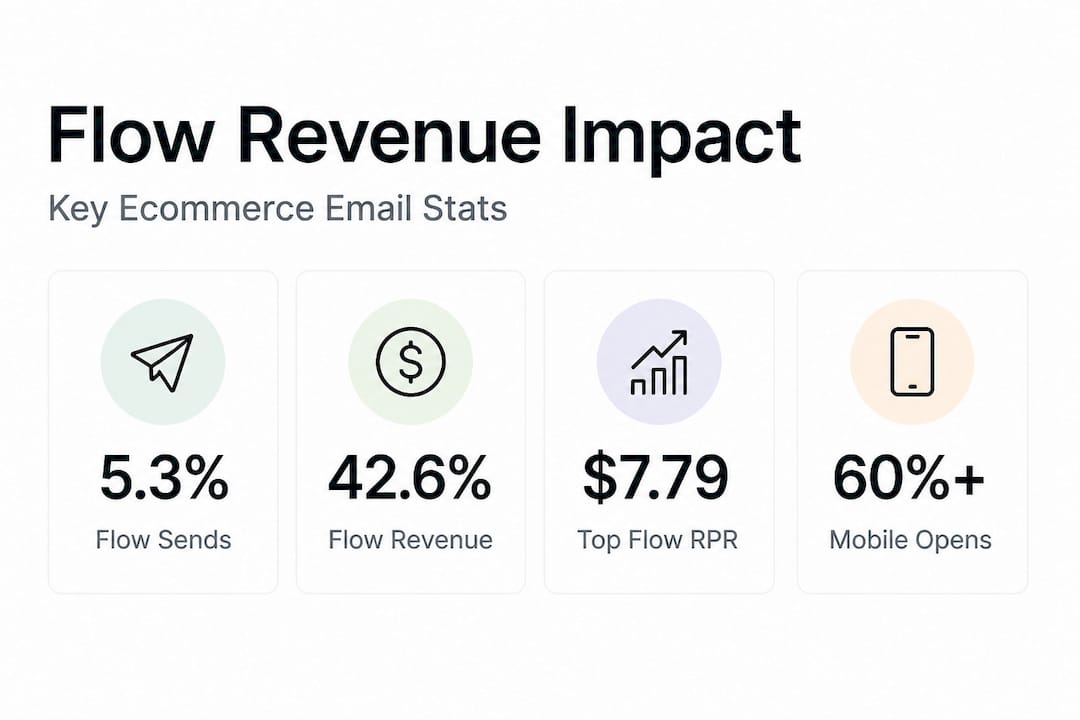
Most ecommerce brands running Klaviyo are leaving serious money on the table. While they send weekly campaign blasts, their automated flows sit underbuilt, undertested, and underperforming. The data tells a stark story: flows generate 41% of total email revenue from just 5.3% of sends, with 18x higher revenue per recipient than campaigns. That gap between what you’re earning and what’s possible is exactly what this guide is built to close.
Table of Contents
- Understanding campaigns vs. flows in Klaviyo
- Which flows drive the most ecommerce revenue?
- Advanced segmentation and personalization for retention
- Deliverability, list hygiene, and optimization strategies for 2026
- Modern mail marketing: What most DTC brands still get wrong
- Level up your mail marketing results with expert support
- Frequently asked questions
Key Takeaways
| Point | Details |
|---|---|
| Flows drive the most revenue | Automated flows generate a disproportionate share of ecommerce email revenue compared to manual campaigns. |
| Essential flows power retention | Welcome, abandonment, post-purchase, and winback flows are the backbone of advanced retention strategies. |
| Segmentation and AI boost results | Personalized targeting and AI recommendations lead to higher click rates and order value per send. |
| Inbox placement demands focus | Strong deliverability and list hygiene are essential as 2026 brings declining inbox rates and growing competition. |
| Expert execution accelerates growth | Brands prioritizing holistic automation and frequent optimization see outsized returns, especially with expert agency support. |
Understanding campaigns vs. flows in Klaviyo
To build a powerful mail marketing service, you first need to understand the two core sending mechanics inside Klaviyo. They’re fundamentally different tools, and using them interchangeably is one of the most expensive mistakes a DTC brand can make.
Klaviyo separates email into campaigns and flows. Campaigns are one-time, manually scheduled sends. You write the email, choose a segment, pick a send time, and fire it off. Think product launches, flash sales, holiday promotions, or editorial newsletters. Campaigns are excellent for time-sensitive announcements where the message is the same for everyone receiving it.
Flows are completely different. They’re automated sequences triggered by specific customer behaviors, such as signing up, abandoning a cart, making a purchase, or going dormant for 90 days. Once you build a flow, it runs continuously and reaches each customer at exactly the right moment in their journey. No manual work. No batch-and-blast thinking.
The performance difference between the two is not subtle:
| Metric | Campaigns | Flows |
|---|---|---|
| Share of total email sends | 94.7% | 5.3% |
| Share of total email revenue | 59% | 41% |
| Revenue per recipient (RPR) | ~$0.08 | ~$1.44 |
| Average click rate | 1.69% | 5.58% |
| Placed order rate | Baseline | 13x higher |
That table tells you everything. Flows reach far fewer people but punch dramatically above their weight in every performance category. The reason is simple: relevance. A flow email lands when a customer just did something. A campaign email lands whenever you decided to send it.
The most effective email automation tools treat flows as the backbone of lifecycle marketing. Campaigns fill gaps and keep your brand top of mind, but flows do the heavy lifting on revenue and retention.
Pro Tip: Build your flow infrastructure before you invest heavily in campaign frequency. A brand with five well-built flows and two campaigns per month will consistently outperform a brand with ten campaigns and no flows.
Which flows drive the most ecommerce revenue?
Not all flows are equal. Some are table stakes for every DTC brand. Others become powerful once your baseline is solid. Here’s where to focus your energy first.
The four essential flows every ecommerce brand needs are:
- Welcome series: Triggered when someone joins your list. These emails carry some of the highest open rates in all of email marketing, often exceeding 50%, because the subscriber literally just raised their hand. Use this series to tell your brand story, introduce bestsellers, and convert that first purchase with a strategic offer.
- Browse and cart abandonment: Triggered within 60 minutes of someone leaving your site without buying. Cart abandonment flows alone routinely recover 5 to 15% of abandoned carts. Speed matters enormously here. Every hour you wait, the chance of recovery drops.
- Checkout abandonment: A more targeted version of cart abandonment, fired when someone reaches checkout but doesn’t complete the purchase. These prospects are extremely close to buying and convert at higher rates than earlier-funnel abandonment flows.
- Post-purchase series: Triggered after every order. This is your highest-leverage retention tool. Use it for order confirmation, product education, review requests, and cross-sell recommendations. Brands that skip this flow are leaving repeat purchase revenue sitting unclaimed.
- Winback flow: Triggered when a subscriber hasn’t opened, clicked, or purchased in 90 to 180 days. These emails re-engage dormant customers before they go cold permanently. Done right, winback flows extend customer lifetime value significantly.
The results from automated ecommerce workflows built around these five sequences can be transformative. Real-world case studies show dramatic results: PERL Cosmetics tripled their monthly email revenue, Tibi achieved 100x ROI, and Collagen Co drove 698% year-over-year revenue growth, all primarily through flow optimization.
“The moment we stopped treating email like a broadcast channel and started treating it like a timed, behavioral conversation, our revenue per send tripled.” This mindset shift is what separates high-performing DTC brands from the rest.
Building these flows is step one on any solid ecommerce marketing checklist. But building them and optimizing them are two different challenges.
Pro Tip: Set your cart abandonment and checkout abandonment flows to trigger within 30 to 60 minutes of the behavior. Waiting 24 hours isn’t just suboptimal, it’s leaving your highest-intent prospects to buy from a competitor.
Advanced segmentation and personalization for retention
Once your core flows are live, the next performance lever is precision targeting. Generic flows sent to your entire list will underperform compared to flows that speak directly to where each customer is in their lifecycle.
RFM segmentation is the framework that powers elite retention programs. RFM stands for recency (how recently someone bought), frequency (how often they buy), and monetary value (how much they spend). By scoring your customers across these three dimensions, you can build distinct segments that each receive different messaging, offers, and timing.
Here’s how to build a retention-boosting segment in Klaviyo:
- Identify your VIP buyers. Filter for customers with high order frequency and high average order value in the last 90 days. These people deserve early access, exclusive offers, and loyalty-focused messaging.
- Isolate one-time purchasers. Anyone who bought once but hasn’t returned in 60 to 90 days is at serious churn risk. Build a specific second-purchase flow targeting this group with social proof and a compelling reason to reorder.
- Create an at-risk segment. Customers who used to buy regularly but haven’t purchased in 60 to 120 days are slipping away. A personalized winback sequence with product recommendations based on past behavior works far better than a generic discount email.
- Flag your unengaged subscribers. Anyone who hasn’t opened or clicked in 180 days is hurting your deliverability. Suppress them from regular sends or run a specific re-engagement campaign before removing them entirely.
- Build a browse-behavior segment. Customers who view specific product categories repeatedly are showing buying intent. Trigger personalized product recommendation flows based on what they keep looking at.
RFM segmentation in Klaviyo delivers measurable results. Ruffwear used this approach to reduce their discount rate by 10% year over year while achieving 57% higher RPR. They were able to reward the right customers without over-discounting to people who would have bought anyway. New West Knifeworks used the same framework to reactivate customers who had been dormant for over three years.
The performance ceiling for advanced segmentation is high. Top 10% performing flows achieve $7.79 RPR and click rates above 10%. AI-powered product recommendations push average click-through rates to 3.75%, with the best performers hitting 8.79%.

Klaviyo personalization strategies using AI-driven product blocks inside flows can match the right product to each customer automatically, eliminating guesswork and increasing relevance at scale.
Pro Tip: Audit your segments every 30 days. Customers move between lifecycle stages constantly, and a segment built in January may be pulling in the wrong people by March. Stale segments erode both performance and deliverability.
Deliverability, list hygiene, and optimization strategies for 2026
Even the most brilliantly built flow system fails if your emails don’t reach the inbox. Deliverability is the invisible foundation of email marketing, and in 2026, it has become significantly harder to maintain.
Inbox placement dropped 13% year over year for Klaviyo senders in 2026, driven by stricter filtering from Gmail and Yahoo and an explosion of low-quality list signups. Every undelivered email is a lost revenue opportunity, and a damaged sender reputation compounds the problem over time.
Here’s what high-performing brands do differently on deliverability:
- Authenticate your sending domain. Set up SPF, DKIM, and DMARC records for your custom domain. Sending from a properly authenticated domain dramatically improves inbox placement and signals trust to email providers.
- Use engagement-based filters. Add engagement filters to your campaigns and flows that limit sends to subscribers who have opened or clicked in the last 90 to 180 days. Sending to people who never engage trains inbox providers to treat your emails as spam.
- Enable Smart Sending. Klaviyo’s Smart Sending feature enforces a 16-hour gap between sends to any individual contact. This prevents over-messaging, which is a leading cause of unsubscribes and spam complaints.
- Run monthly list cleaning. Suppress hard bounces, spam complaints, and anyone who hasn’t engaged in over 180 days. A clean list of 20,000 active subscribers will outperform a neglected list of 80,000 every single time.
- Use double opt-in for new signups. Yes, it reduces immediate list growth. But it dramatically improves list quality, which protects your sender score and ensures you’re spending marketing budget on people who actually want to hear from you.
- Validate emails at the point of capture. Real-time email validation tools block disposable addresses and typos before they enter your list. This alone can reduce bounce rates by 30 to 40% for brands with high-volume pop-up acquisition.
Avoiding common email marketing mistakes around list hygiene is non-negotiable in 2026. Brands that treat their list as a vanity metric rather than an active asset will see declining open rates, rising spam complaints, and shrinking revenue from every send.
Pro Tip: Track your sender reputation using Google Postmaster Tools and monitor your inbox placement rate monthly. Falling open rates are sometimes a deliverability problem in disguise, not a content or offer problem.
Modern mail marketing: What most DTC brands still get wrong
Here’s the pattern we see repeatedly: brands invest heavily in paid social, build a decent email list, send campaigns every week, and wonder why email contributes 15 to 20% of revenue instead of 40%. The answer is almost always the same. They built their email program around campaigns because campaigns feel active. You write the email, you press send, you see results. Flows feel passive, but that’s precisely what makes them powerful.
The brands that consistently generate 40%+ of their revenue from email have one thing in common: they treat flows as infrastructure, not a nice-to-have. They build them once, optimize them constantly, and let the system work while their team focuses on campaigns and strategy.
The other persistent mistake is chasing list size over list quality. Growing from 50,000 to 100,000 subscribers sounds like progress, but if that new growth is coming from giveaway signups, low-intent incentive traffic, or purchased data, you’re actually degrading your program. Deliverability suffers. Open rates fall. Revenue per send declines. The 2026 benchmarks are clear: brands that prioritize A/B testing, mobile-first design, and RPR-focused optimization outperform those chasing open rate and list size metrics.
Mobile-first design is another area where we see significant revenue left behind. Over 60% of email opens happen on mobile devices, yet many brands still design their emails on desktop and check mobile as an afterthought. Buttons that are too small, fonts that require pinching to read, and images that don’t load correctly on mobile all destroy conversion rates regardless of how good your copy is.
The uncomfortable truth is that most brands don’t need more campaigns. They need better flows, cleaner lists, tighter segments, and a willingness to let performance data drive decisions instead of habit or tradition. Pairing your email program with SEO and Klaviyo automation creates a compounding growth engine that paid channels alone can never replicate.
Set a real target: flows should deliver at least 40% of your email revenue within 90 days of properly building and optimizing them. If they’re not, the problem isn’t your product or your audience. It’s your setup.
Level up your mail marketing results with expert support
The frameworks in this guide work. Brands that implement these flows, sharpen their segmentation, and protect their deliverability consistently see email become their most profitable owned channel, often generating 35 to 50% of total revenue without increasing ad spend.
But the gap between knowing what to do and executing it flawlessly is where most brands stall. Building five high-performing flows, maintaining list hygiene, testing segments, and keeping up with Klaviyo’s evolving features is a full-time job in itself. That’s where working with a dedicated email marketing & retention agency changes everything. If you want expert hands on your Klaviyo account, ongoing optimization, and a team that treats your email program like a core revenue driver, expert email retention support is the fastest path to sustainable, compounding growth.
Frequently asked questions
What is the difference between an email campaign and a flow in Klaviyo?
A campaign is a one-time, manually scheduled email send, while a flow is an automated sequence triggered by specific customer actions like signing up, abandoning a cart, or making a purchase.
Which Klaviyo flows should every ecommerce brand prioritize for retention?
The four must-have flows are welcome, cart abandonment, post-purchase, and winback sequences, as these cover critical retention touchpoints across the full customer lifecycle.
How does segmentation improve email marketing revenue?
Targeting customers based on behavior and purchase history increases message relevance, and RFM-based segmentation has helped brands like Ruffwear achieve 57% higher revenue per recipient while reducing reliance on discounting.
What deliverability risks should ecommerce marketers watch for in 2026?
The biggest risks are declining inbox placement, low-quality signups, and sending to disengaged subscribers, all of which can be mitigated through engagement filters, double opt-in, and consistent list cleaning.
How much revenue should flows contribute to my email program?
Flows should deliver at least 40% of total email revenue once properly built and optimized, with top-tier automation programs regularly exceeding that threshold through strong lifecycle sequencing and smart segmentation.
Recommended
- Master Target Audience Research for Higher Email ROI | Take Action Blog | Take Action
- Engage Customers with Klaviyo: Boost Open Rates 40% in 2026 | Take Action Blog | Take Action
- Marketing Budget: 25% to Klaviyo = 45% Revenue Boost | Take Action Blog | Take Action
- Optimize ecommerce growth with a performance agency | Take Action Blog | Take Action
- How to Build an Automated Email Campaign Generator With Claude Code
- Winning email marketing strategies to boost SMB sales