

How to Grow an Email List: Strategies That Work
TL;DR:
- Growing an email list involves using targeted acquisition tactics, optimized sign-up forms, and strict compliance practices to minimize churn.
- Focusing on high-converting, specific lead magnets and relevant traffic sources enhances subscriber quality and long-term growth.
- Maintaining list hygiene and accurate segmenting ensures better deliverability, engagement, and revenue from an engaged, regulated audience.
Growing an email list is the process of increasing net subscribers through proven acquisition tactics, optimized capture tools, and strict compliance practices. Email marketing delivers an average $36 ROI for every dollar spent, making a healthy list one of the highest-return assets any business can own. The challenge is that email list churn runs 25 to 30% annually, meaning you lose roughly one in four subscribers every year before you send a single campaign. Platforms like Klaviyo, Mailchimp, and ConvertKit give you the infrastructure, but the tactics you use to attract email signups determine whether your list grows or stagnates. This guide covers every layer of a working email list building strategy, from lead magnets to deliverability.
How to grow an email list with high-converting lead magnets
A lead magnet is a free resource you offer in exchange for an email address, and specificity is what separates a 2% conversion rate from a 15% one. Generic offers like “Sign up for our newsletter” give visitors no reason to act. A narrowly targeted resource that solves one concrete problem converts far better because it matches the exact intent of the visitor reading it.
The most effective lead magnet formats include:
- PDF guides and checklists: Fast to create, easy to consume, and highly shareable. A 10-point product launch checklist for Shopify store owners outperforms a generic “ecommerce guide” every time.
- Email templates: Pre-written copy that saves the reader hours of work. Templates work especially well for B2B audiences and SaaS users.
- Quizzes and calculators: Interactive tools that return a personalized result. Templates, interactive tools, and quizzes consistently outperform static PDFs because they create a two-way exchange.
- Mini-courses: A 5-day email course delivered automatically through Klaviyo or ConvertKit positions you as an authority while keeping new subscribers engaged from day one.
- Discount codes and free shipping offers: The standard for ecommerce. They work because the value is immediate and tangible.
Delivery matters as much as creation. A successful lead magnet campaign requires four coordinated stages: creation, capture via signup form, delivery through your email service provider, and cross-promotion through referrals or partnerships. Skipping any stage leaves conversions on the table.
Pro Tip: Test your lead magnet idea before building it. Post the concept on social media or run a 48-hour paid ad to a landing page. If it does not convert at 20% or higher, refine the offer before investing in full production.

How to optimize signup forms for maximum conversions
Form design is where most businesses lose subscribers they already earned through good content or paid traffic. The fix is almost always simpler than marketers expect.
- Use single-field forms. Forms asking only for an email address convert 12 to 18% better than forms that also request a name or phone number. Collect additional data later through progressive profiling inside your welcome flow.
- Place forms where attention already exists. Exit-intent popups, sticky header bars, and inline forms embedded within blog content each serve a different visitor behavior. Exit-intent captures users about to leave. Sticky bars stay visible during scrolling. Inline forms catch readers mid-engagement.
- Write copy that states the outcome, not the action. “Get the free shipping calculator” beats “Subscribe to our list.” The first tells the reader exactly what they receive.
- Add social proof near the form. A line like “Joined by 8,400 store owners” reduces hesitation without adding a form field.
- Use inline validation. Form UX improvements like inline validation produce measurable conversion lift without increasing traffic costs. Showing a green checkmark when an email is entered correctly removes uncertainty at the moment of commitment.
| Form element | Impact on conversion |
|---|---|
| Single email field only | 12 to 18% higher conversion vs. multi-field |
| Exit-intent popup | Captures 10 to 15% of abandoning visitors |
| Inline social proof | Reduces hesitation at point of signup |
| Outcome-focused copy | Increases perceived value of the offer |
Pro Tip: Run an A/B test on your popup headline for two weeks before changing anything else. Headline copy is the single highest-leverage variable in signup form performance.
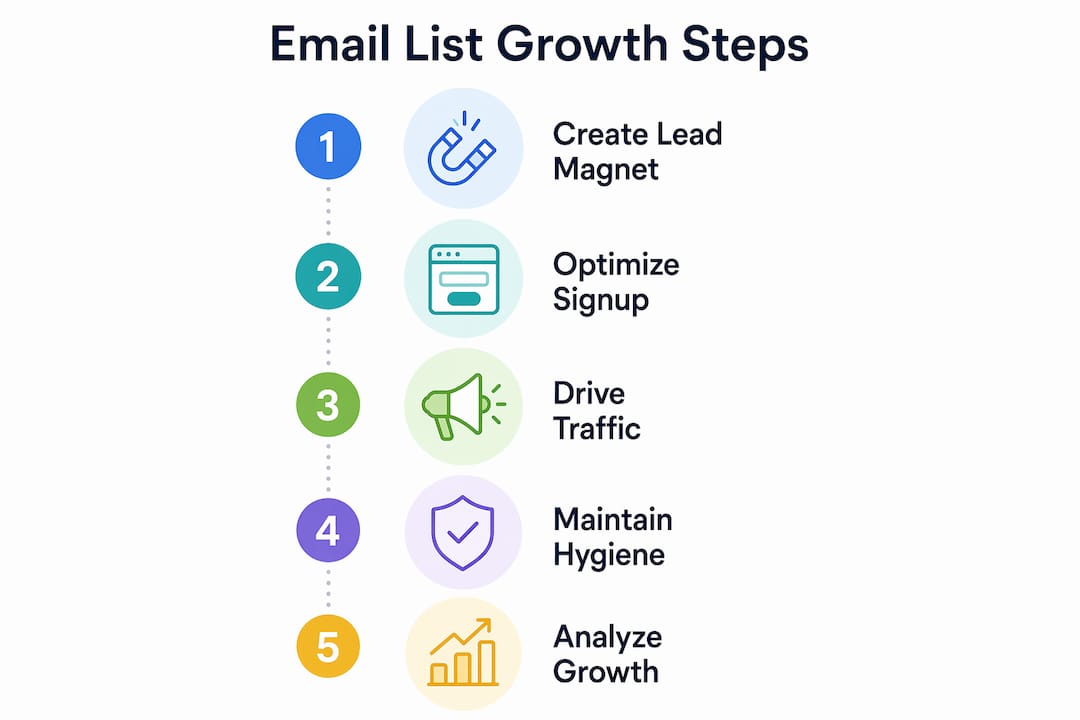
What are the best ways to drive relevant traffic to your signup forms
A perfectly optimized form converts no one without traffic. The goal is not volume. It is relevance. Visitors who arrive with a specific problem your lead magnet solves will subscribe at rates three to five times higher than cold, untargeted traffic.
The most reliable traffic channels for email list building strategies include:
- Content upgrades on blog posts: A content upgrade is a lead magnet specific to a single article. A post about abandoned cart recovery offers a free Klaviyo flow template. Readers already engaged with the topic convert at dramatically higher rates than homepage visitors.
- Instagram and TikTok funnels: Short-form video that ends with a clear call to action (“Link in bio to get the free guide”) drives consistent signups when the lead magnet matches the content topic. Pinned posts and story highlights keep the offer visible beyond the initial post.
- Twitter and LinkedIn threads: Long-form threads that deliver genuine value and end with a signup link attract high-intent subscribers. The audience self-selects based on the thread topic.
- Referral programs: Offer existing subscribers a reward for referring a friend. SparkLoop and ReferralHero both integrate with major email platforms and automate the tracking. Referred subscribers also tend to have higher lifetime engagement because they arrived through a trusted recommendation.
- Cross-promotions and newsletter swaps: Partner with a complementary brand or newsletter that shares your audience. Each party promotes the other’s list to their own subscribers. This tactic costs nothing and produces warm, pre-qualified signups.
- Paid ads for list building: Meta and Google ads work well for growing your email audience when the cost per lead is lower than your subscriber lifetime value. Run ads to a dedicated landing page, not your homepage, and track cost per acquisition weekly.
The key principle across all channels is matching the traffic source to the lead magnet. A TikTok audience expects entertainment and speed. A LinkedIn audience expects depth and professional relevance. Mismatched offers produce low conversion rates regardless of traffic volume.
How to maintain list hygiene and deliverability for long-term growth
List hygiene is the practice of keeping your subscriber database clean, compliant, and filled with people who actually open your emails. It is the least glamorous part of email marketing and the most consequential for sustainable growth.
A net list growth rate of 2.5 to 5% per month is the benchmark for a healthy program. Below 1% means your acquisition barely replaces churn. Tracking net growth (new subscribers minus unsubscribes and bounces) gives you a far more accurate picture than gross signups alone.
Compliance is non-negotiable. CAN-SPAM requires every marketing email to include a working unsubscribe link and a physical sender address, with opt-out requests processed within 10 business days. GDPR mandates opt-out processing within 30 days and requires documented consent for European subscribers. Failing to map unsubscribe requests correctly in platforms like Klaviyo or Salesforce Marketing Cloud can leave opted-out subscribers marked as active in your reports, inflating your engagement metrics while damaging your sender reputation.
Compliance is not a legal checkbox. It is a deliverability strategy. Every unprocessed opt-out is a potential spam complaint, and spam complaints above 0.1% trigger inbox filtering by Gmail and Outlook.
Technical authentication is the foundation of inbox placement. Setting SPF, DKIM, and DMARC records for your sending domain tells inbox providers that your emails are legitimate. Without all three, even well-crafted campaigns land in spam.
Ongoing hygiene practices that protect your list:
- Run a re-engagement campaign for subscribers inactive for 90 days before removing them
- Remove inactive subscribers who do not respond to re-engagement attempts
- Suppress hard bounces immediately after they occur
- Segment by engagement level so your most active subscribers receive your highest-frequency sends
Expert marketers treat subscriber quality as a deliverability variable, not just a vanity metric. A list of 10,000 engaged subscribers outperforms a list of 50,000 disengaged ones on every metric that matters: open rate, click rate, revenue per email, and inbox placement.
Key takeaways
Sustainable email list growth requires combining targeted acquisition tactics with disciplined list hygiene and full compliance from day one.
| Point | Details |
|---|---|
| Track net growth, not gross signups | Subtract unsubscribes and bounces to measure true list health monthly. |
| Specificity wins in lead magnets | Narrow, problem-specific offers convert significantly better than generic newsletters. |
| Reduce form friction first | Single-field email forms convert 12 to 18% better than multi-field alternatives. |
| Match traffic to offer intent | Relevant visitors convert at 3 to 5 times the rate of untargeted cold traffic. |
| Compliance protects deliverability | Unprocessed opt-outs generate spam complaints that damage inbox placement for all subscribers. |
Why list size is the wrong goal to optimize for
Most business owners I work with come in focused on one number: total subscribers. I understand the instinct. A bigger list feels like progress. But after working with ecommerce brands across dozens of Klaviyo builds, I have seen the same pattern repeatedly. A brand with 80,000 subscribers and 12% open rates generates less revenue from email than a brand with 22,000 subscribers and 41% open rates. The math is not close.
The real goal is an engaged list, and that requires saying no to tactics that inflate subscriber counts without improving quality. Purchased email lists destroy sender reputation, generate spam complaints, and violate CAN-SPAM and GDPR. I have never seen a bought list produce positive ROI. Not once.
What I recommend instead is running no more than three acquisition tactics simultaneously. Test each one for 30 days, measure cost per subscriber and 30-day open rate, then cut what underperforms and scale what works. This approach from focused testing produces faster growth than running ten tactics at half-effort. It also keeps your team from burning out on execution.
The brands that grow the most sustainable email audiences treat their list like a community, not a broadcast channel. They use email segmentation strategies to send relevant content to the right people, they monitor deliverability weekly, and they prune inactive subscribers without hesitation. That discipline is what separates a list that generates 30% of revenue from one that generates noise.
— Take
Ready to turn your email list into a revenue channel?
Building a list is step one. Turning it into a consistent revenue driver requires the right flows, segmentation, and campaign strategy working together.
Take-action is a specialized email marketing and retention agency that helps ecommerce brands build, grow, and monetize their email lists using Klaviyo. From lead magnet strategy and signup form optimization to welcome flows, abandoned cart sequences, and long-term campaign management, Take-action handles the full execution. If you are ready to make email your primary growth channel, explore Take-action’s services and see what a data-driven approach can do for your brand.
FAQ
What is a healthy email list growth rate?
A net growth rate of 2.5 to 5% per month is considered healthy. Below 1% means new signups are barely replacing the subscribers you lose to churn each month.
How many fields should a signup form have?
One field is optimal. Forms that ask only for an email address convert 12 to 18% better than forms requesting additional information like name or phone number.
What is the best lead magnet for growing an email list?
The best lead magnet solves one specific problem for a clearly defined audience. Quizzes, calculators, and templates consistently outperform generic guides because they deliver personalized or immediately usable value.
How do I stay compliant while growing my list?
Include a working unsubscribe link in every email, process opt-out requests within 10 business days under CAN-SPAM and within 30 days under GDPR, and authenticate your sending domain with SPF, DKIM, and DMARC records.
Should I remove inactive subscribers from my list?
Yes. Removing inactive subscribers after a re-engagement attempt improves open rates, reduces spam complaints, and protects your sender reputation with inbox providers like Gmail and Outlook.