

Future-proof email marketing: data-driven growth strategies
TL;DR:
- Automated flows generate 41% of revenue from only 5.3% of email sends.
- Segmentation and AI personalization can increase revenue and engagement significantly.
- Deliverability, data privacy, and human creativity are crucial for future email success.
Most ecommerce marketers spend the bulk of their time crafting broadcast campaigns, yet automated flows generate 41% of revenue from just 5.3% of total sends. That gap between effort and output should make you stop and rethink your entire email strategy. The brands pulling ahead in 2026 are not the ones sending more emails. They are the ones sending smarter emails, triggered by real behavior, personalized at scale, and built on clean data. This guide walks through the advanced segmentation, automation, and deliverability tactics that will define email marketing’s next chapter, giving you a clear path from where you are today to where your revenue needs to be.
Table of Contents
- Why automation is reshaping ecommerce email
- The revenue impact of segmentation and personalization
- Automation at scale: Real-time tactics for ecommerce
- Deliverability and data: Powering personalization in a privacy-first world
- The real future: Human creativity meets machine intelligence
- Take your email marketing into the future with expert help
- Frequently asked questions
Key Takeaways
| Point | Details |
|---|---|
| Automation delivers results | Automated flows generate much higher revenue and engagement than batch campaigns. |
| Segmentation boosts revenue | Personalized email segmentation drives up to 760% more revenue for ecommerce brands. |
| Data and deliverability matter | Ethical data collection and strong authentication ensure high inbox placement and privacy compliance. |
| AI enhances but humans excel | Machine intelligence enables scale, but creativity and strategy set brands apart. |
Why automation is reshaping ecommerce email
The shift from batch-and-blast campaigns to behavioral automation is not a trend. It is a fundamental restructuring of how email drives revenue. When you send a campaign, you are guessing. When you trigger a flow, you are responding. That difference compounds over time in a dramatic way.
The numbers back this up clearly. Automated flows outperform campaigns on every meaningful metric, generating 18x higher revenue per recipient compared to standard campaign sends. This is not a marginal improvement. It is a different category of performance.
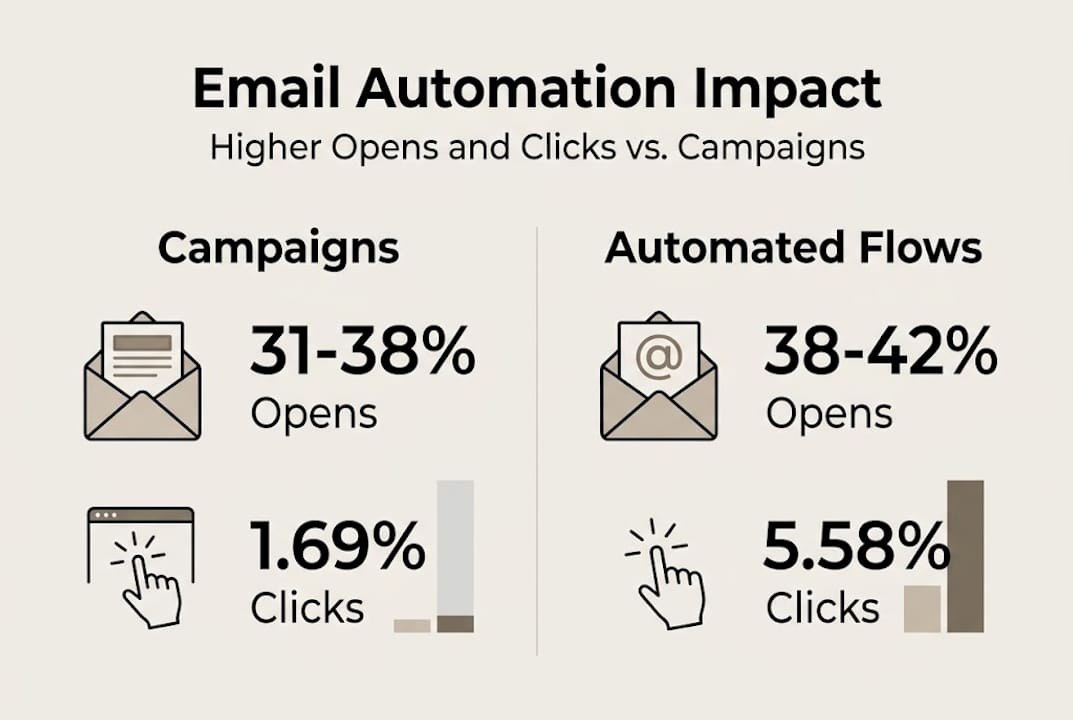
Here is how the benchmarks compare across the key metrics ecommerce brands care about most:
| Metric | Campaigns | Flows |
|---|---|---|
| Open rate | 31%–38% | 38%–42% |
| Click rate | 1.69% | 5.58% |
| Placed order rate | 0.16% | 2.11% |
According to 2026 ecommerce benchmarks, flows convert at more than 13x the rate of campaigns on placed orders alone. Think about what that means for a brand sending 100,000 emails per month. The same list, the same subscribers, but a fundamentally different outcome depending on whether the message was triggered by behavior or sent on a schedule.
Behavioral triggers are what make flows so powerful. An abandoned cart email arrives when a shopper’s intent is highest. A replenishment reminder lands when a customer is statistically likely to run out of a consumable product. A post-purchase sequence deepens loyalty precisely when a buyer feels most connected to your brand. These are not coincidences. They are engineered moments that connect with people at the right time.
Flows also scale in a way campaigns cannot. Once you build a well-structured abandoned cart sequence, it works for every customer who leaves without buying, every single day, without any additional effort from your team. This is why productivity and email effectiveness are so tightly linked for high-growth ecommerce brands. The automation handles the volume while your team focuses on strategy and creative.
Pro Tip: Start with three high-intent flows before anything else: abandoned cart, browse abandonment, and winback. These directly target purchase intent and lapsed buyers, delivering the fastest return on your setup investment.
If you want a practical overview of where to focus first, explore these email marketing tips and automation workflow examples that ecommerce brands are using right now to drive consistent revenue.
The revenue impact of segmentation and personalization
Automation sets the foundation. Segmentation is what multiplies the results. Sending the right email at the right time only works if the right message is going to the right person. That is where segmentation strategy becomes the most leveraged skill in your entire email program.

The data on this is striking. Hyper-segmentation yields 760% more revenue than non-segmented blasts. Even basic segmented campaigns drive 30 to 50% more revenue than generic sends. The implication is clear: every email you send to your full list without segmentation is leaving a significant portion of potential revenue on the table.
Here is a breakdown of common segment types and their typical impact on ecommerce revenue:
| Segment type | Revenue impact | Best use case |
|---|---|---|
| VIP buyers (top 10%) | Very high | Exclusive launches, loyalty rewards |
| At-risk customers | High | Winback offers, reactivation |
| Category browsers | Medium-high | Product recommendations, targeted promos |
| New subscribers | Medium | Welcome series, first purchase incentives |
| Lapsed customers | Medium | Re-engagement campaigns, sunset flows |
Behavioral segments, especially those built around RFM data (recency, frequency, monetary value), consistently outperform demographic segments. A customer who bought three times in the last 60 days needs a completely different message than someone who purchased once eight months ago. Treating them the same wastes both relationships.
AI-powered personalization is raising the ceiling even higher. AI personalization boosts revenue by 41% and drives click-through rates of 13.44% compared to just 3% for generic sends. Open rates run 50% higher with AI-driven content personalization. These are not theoretical gains. Brands using Klaviyo’s predictive analytics features and AI-generated product recommendations are seeing these numbers in live campaigns right now.
Key segment types worth prioritizing in your strategy:
- RFM segments: Divide your list by purchase recency, frequency, and spend to identify your highest-value and most at-risk customers.
- Engagement-based segments: Separate your highly active openers from cold subscribers so your campaigns don’t drag down deliverability metrics.
- Category affinity segments: Tag customers by the product types they browse or purchase so every recommendation feels tailored.
- Lifecycle stage segments: Target subscribers differently based on whether they are new, active, lapsing, or fully dormant.
- Purchase intent segments: Use browse behavior, wishlist additions, and cart activity to identify who is close to buying right now.
Pro Tip: Build your RFM and behavioral segments before you experiment with more granular hyper-segmentation. The foundational segments will generate the most immediate revenue lift, and the learnings will inform how you get more specific over time.
For a deeper look at building high-performing segments from scratch, these segmentation strategies walk through the process step by step.
Automation at scale: Real-time tactics for ecommerce
Segmentation is powerful in theory. At scale, manual segmentation breaks down fast. If you are updating lists by hand, relying on static filters, or building segments once and forgetting them, you are working with stale data. And stale data leads to irrelevant emails, which leads to unsubscribes and spam complaints.
The solution is real-time automated segmentation. Automated segmentation increases email revenue by 40% within 90 days through live RFM updates and behavioral triggers that respond to customer actions as they happen. This is not a set-it-and-forget-it process. It is a dynamic system that continuously reflects the current state of your customer relationships.
Here is how a real-time segmentation system works in practice:
- Data ingestion: Every customer action, whether a purchase, browse session, email open, or product review, gets recorded in your email platform in real time.
- Trigger evaluation: Your automation engine checks which flows and segments each action qualifies a customer for, updating their profile instantly.
- Segment assignment: Customers move between segments automatically based on their current RFM scores, engagement status, and behavioral signals.
- Flow activation: The right email sequence fires at exactly the right moment, triggered by the qualifying action without any manual input.
- Performance monitoring: Metrics like open rates, conversion rates, and revenue per recipient feed back into the system so you can optimize triggers and content continuously.
“The brands that win at email in 2026 are not the ones with the biggest lists. They are the ones whose lists are most precisely organized around customer behavior and intent.”
This system eliminates the problem of sending irrelevant messages to people who have already converted or moved on. It also dramatically improves deliverability because you are consistently sending content that matches what subscribers actually want to see. Relevant email gets opened. Opened email signals to inbox providers that your domain is trustworthy.
Integrating your email automation with your full data stack is what keeps segments current. Your ecommerce platform, loyalty program, customer service tool, and review platform should all feed signals into Klaviyo. The richer your data, the sharper your targeting.
Pro Tip: Connect your post-purchase data and loyalty program activity to your email platform so replenishment and reward flows trigger automatically based on real purchase history, not estimated timelines.
For a closer look at how platforms handle this, these automation tool comparisons and workflow examples give you a practical framework to evaluate your options.
Deliverability and data: Powering personalization in a privacy-first world
All of the automation and segmentation in the world will not help you if your emails are landing in spam. Deliverability is the unglamorous foundation that makes everything else work. In 2026, it is also more technically demanding than ever.
Ecommerce inbox placement sits at 89% on average, with spam rates at 7.4%. Those numbers sound acceptable until you realize that a 7.4% spam rate is high enough to damage your sender reputation and trigger filtering from major inbox providers. Getting under 0.1% spam complaints is the real target, and achieving it requires both technical setup and ongoing list hygiene.
Here is what strong deliverability infrastructure looks like in practice:
- SPF authentication: Publishes a DNS record that tells inbox providers which servers are authorized to send email on your behalf.
- DKIM signing: Attaches a cryptographic signature to every email so providers can verify it has not been tampered with in transit.
- DMARC policy: Tells inbox providers what to do with messages that fail SPF or DKIM checks, protecting your domain from spoofing.
- Engagement-based sending: Only send to subscribers who have opened or clicked within a defined window, such as the last 90 or 180 days, to keep engagement rates high.
- Preference centers: Let subscribers choose their email frequency and topic interests, reducing unsubscribes and spam complaints from frequency fatigue.
- Regular list hygiene: Remove hard bounces immediately and sunset unengaged subscribers on a consistent schedule, at minimum quarterly.
“Deliverability is not a technical afterthought. It is the commercial infrastructure that determines whether your email strategy actually reaches anyone.”
The other major shift reshaping deliverability strategy is the move away from third-party cookies. With cookies fading out across browsers and privacy regulations tightening, zero-party data collection via quizzes and preference centers has become the primary path to privacy-compliant personalization. Zero-party data is information customers intentionally share with you: their style preferences, product interests, shopping goals, and communication preferences. It is more accurate than inferred data and far more durable than cookie-based tracking.
Mobile-first design is now equally non-negotiable. Over 60% of emails are opened on mobile devices, and inbox providers increasingly weight mobile engagement signals in their filtering decisions. If your emails are not rendering well on a 375-pixel screen, you are losing opens, clicks, and ultimately your sender reputation.
For a deeper look at how to protect and improve your inbox placement, explore these email deliverability insights from brands working through the same challenges.
The real future: Human creativity meets machine intelligence
Here is an uncomfortable truth that most automation-first narratives skip over: technology does not build customer relationships. People do. AI can optimize send times, predict churn risk, and generate subject line variants. It cannot tell your brand story, understand the nuance of a cultural moment, or write copy that makes someone feel genuinely seen.
The brands that will dominate email marketing in 2026 and beyond are the ones that treat automation as an amplifier, not a replacement. When you hand the creative layer entirely to machine-generated content, you get emails that are technically optimized but emotionally empty. Subscribers notice. Engagement drifts. Revenue flattens.
The real edge comes from pairing precise automation with human-crafted storytelling. Your data tells you when to send and who to send to. Your people determine what to say and how to say it in a way that reflects your brand’s actual personality. Strategic experimentation, a distinct creative voice, and genuine empathy for your customer’s journey are what separate the brands customers actually look forward to hearing from versus the ones they filter out.
The most effective retention marketers we have seen use technology to free up their creative capacity, not to replace it. If you want to explore how that balance plays out in practice, these advanced email growth tactics show what it looks like when strategy and automation work together intelligently.
Take your email marketing into the future with expert help
Advanced flows, real-time segmentation, and bulletproof deliverability are all achievable. But getting there faster requires knowing exactly what to build, in what order, and how to avoid the costly missteps that slow most brands down.
Take Action Agency specializes in helping ecommerce brands deploy the full stack: automated flows that convert, behavioral segments that stay current, and Klaviyo setups built for long-term revenue growth. If you are ready to stop leaving retention revenue on the table and want a team that treats email as your most powerful owned channel, explore what our email growth services can do for your brand. The strategies in this article become your reality faster with the right expert support behind you.
Frequently asked questions
What email automation flows drive the most revenue for ecommerce?
Abandoned cart, post-purchase, and winback flows generate the highest revenue and engagement for ecommerce brands. Automated flows generate 41% of revenue from just 5.3% of total sends, making them the highest-leverage investment in any email program.
How often should ecommerce brands clean their email list?
Clean your email list at least quarterly to reduce spam rates and protect your sender reputation. With ecommerce spam rates averaging 7.4%, consistent hygiene is essential for maintaining strong inbox placement over time.
Is collecting zero-party data now essential for email personalization?
Yes, with cookies fading out, zero-party data collection through quizzes and preference centers is now the most reliable path to privacy-compliant, highly accurate personalization. It also produces more durable subscriber relationships than inferred behavioral data alone.
What authentication protocols do I need for inbox placement in 2026?
You need SPF, DKIM, and DMARC authentication configured correctly on your sending domain. These three protocols work together to verify your identity as a sender and protect your domain, which is required for strong ecommerce inbox placement in 2026.
Recommended
- Managing Business Growth with Automated Email Retention | Take Action Blog | Take Action
- Improving Email Open Rates: Proven Strategies for Growth | Take Action Blog | Take Action
- Blog - Email Marketing Insights | Take Action | Take Action
- Email Segmentation Strategies for Ecommerce Growth | Take Action Blog | Take Action