

Email Subject Line Best Practices That Boost Open Rates
TL;DR:
- Effective email subject lines are specific, honest, and reader-focused, directly impacting open rates.
- Testing, measuring, and optimizing length and personalization strategies significantly improve campaign performance.
Email subject line best practices are proven techniques that directly determine whether your subscribers open, ignore, or delete your campaigns. The subject line is the first and often only impression your email makes. Get it wrong and your message never gets read, regardless of what’s inside. Get it right and you turn a passive list into an active revenue channel.
What are the best practices for email subject lines?
The most effective subject lines share three qualities: they are specific, honest, and written for the reader, not the sender. Generic lines like “Our latest update” signal low value immediately. Lines like “Your cart expires at midnight, Sarah” signal relevance and urgency. The gap between those two examples explains most of the difference between a 15% open rate and a 35% open rate.

Subject line optimization is the systematic process of testing, measuring, and refining the text that appears in the inbox preview. It sits at the intersection of copywriting, data analysis, and deliverability. Marketers who treat it as an afterthought consistently underperform those who build a repeatable process around it.
What is the optimal length for email subject lines?
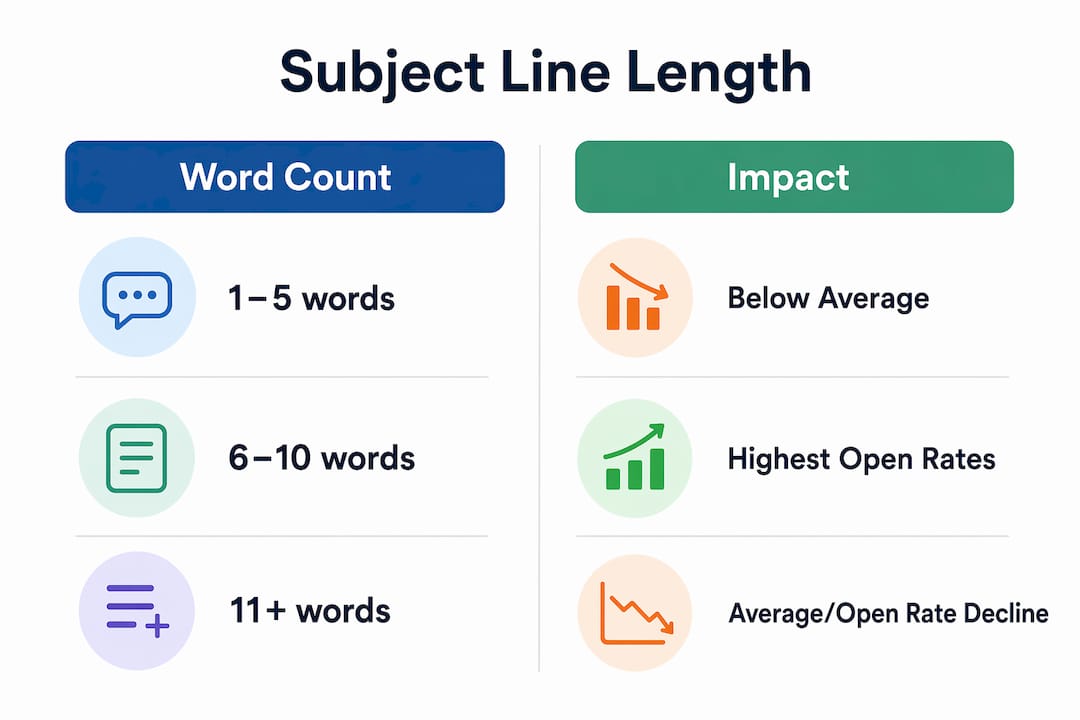
Length is the most measurable variable in subject line writing, and the data is clear. Subject lines between 6 and 10 words achieve the highest open rates, with 41 characters as the mobile-friendly cutoff for full visibility. That number matters because the majority of email opens now happen on mobile devices, where inbox previews are shorter than on desktop.
Front-loading is the structural rule that follows from this. Place your most important word or phrase at the start of the subject line, not the end. “50% off ends tonight” outperforms “Tonight is the last night to get 50% off” because the value is visible before the line gets cut.
| Subject line length | Open rate impact | Best use case |
|---|---|---|
| 1–5 words | Below average | Rarely effective; lacks context |
| 6–10 words | Highest open rates | Standard campaigns, promotions |
| 11–15 words | Moderate | Newsletters, content emails |
| 16+ words | Lowest open rates | Avoid on mobile-first lists |
Pro Tip: Write your subject line last. Draft the email body first, then pull the single most compelling detail from it and use that as your subject line. You will stop writing generic lines immediately.
Preheader text functions as a second subject line. Preheader text between 40 and 130 characters gives you additional space to add context without repeating the subject. Use it to extend the thought, not restate it. “50% off ends tonight” paired with a preheader of “Everything in the summer collection, no exclusions” is far stronger than repeating the discount twice.
How can personalization improve email subject line performance?
Personalization in subject lines goes well beyond inserting a first name. Dynamic personalization that references purchase history or behavioral triggers increases open rates by 26–30% compared to generic lines. That lift is the difference between a campaign that breaks even and one that drives real revenue.
The most effective personalization signals include:
- Recent purchase behavior. “Back in stock: the shoes you viewed last week” outperforms any generic product announcement.
- Location data. Referencing a subscriber’s city or region creates immediate relevance, especially for event-based or seasonal campaigns.
- Lifecycle stage. A new subscriber responds differently than a lapsed customer. Tailor the subject line to where they are in the relationship.
- Browse and cart activity. Abandoned cart subject lines that name the specific product convert at a significantly higher rate than generic “you left something behind” lines.
Segmentation is the infrastructure that makes personalization possible. You cannot write a relevant subject line for a list of 50,000 undifferentiated contacts. Splitting your list by purchase frequency, product category, or engagement level lets you write lines that feel personal because they are. Take-action builds this kind of segmentation architecture for ecommerce brands using Klaviyo, where behavioral data flows directly into subject line logic.
Pro Tip: Treat your most engaged segment as a testing lab. Send your experimental subject lines to your top 20% of openers first. If a line performs well there, it will almost always perform well with the broader list.
For a deeper look at how data drives email performance, the connection between segmentation and subject line relevance becomes even clearer.
What language and content strategies make subject lines compelling?
The Curiosity-Urgency-Value framework produces the most effective subject lines consistently. Curiosity pulls the reader in. Urgency gives them a reason to act now. Value tells them what they get. The strongest subject lines hit at least two of these three.
Action verbs outperform passive constructions in every test. “Grab your exclusive offer” beats “Your exclusive offer is available.” The verb creates forward motion. Passive phrasing creates distance. This is not a stylistic preference. It is a measurable pattern across millions of sends.
“The subject lines that perform best over time are not the cleverest ones. They are the most honest ones. Subscribers learn to trust a sender who delivers on the promise made in the subject line. That trust compounds into higher open rates on every future campaign.”
Numbers and specific promises work because they set clear expectations. “3 ways to cut your ad spend this month” is more clickable than “Tips for reducing ad spend” because it signals a defined, scannable payoff. Specificity also filters for intent. The reader who opens a numbered list email is more likely to engage with the content inside.
Spam trigger words actively damage deliverability and open rates. Avoid phrases like “FREE!!!”, “Act now,” “Guaranteed,” and excessive punctuation. These patterns train spam filters to route your emails away from the inbox. They also train subscribers to distrust your brand. The short-term click is not worth the long-term reputation cost.
How do you run A/B tests to improve subject lines over time?
A/B testing is the only reliable way to know what works for your specific audience. General best practices give you a starting point. Your own test data gives you a competitive advantage.
A structured testing process follows these steps:
- Isolate one variable. Test subject line length, or tone, or personalization, but never all three at once. Testing multiple variables simultaneously corrupts results and makes it impossible to identify what drove the change.
- Use a sufficient sample size. A minimum of 1,000 recipients per variant is required for statistically meaningful results. Smaller samples produce noise, not insight.
- Document every test. Record the subject lines tested, the audience segment, the send date, and the open rate for each variant. Patterns emerge over months, not individual sends.
- Run tests consistently. Monthly testing builds a body of evidence. Sporadic testing produces anecdotes.
- Act on the winner. Apply the winning approach to your next campaign and use it as the new baseline for the following test.
| Test variable | What to measure | Common outcome |
|---|---|---|
| Subject line length | Open rate by word count | 6–10 words typically wins |
| Personalization token | Open rate with vs. without name | Personalized lines often outperform |
| Urgency framing | Deadline vs. no deadline | Deadline lines win for promotions |
| Question vs. statement | Open rate by format | Varies by audience; always test |
Pro Tip: Keep a running subject line test log in a shared spreadsheet. After six months, you will have a pattern map of what your audience responds to. That document is worth more than any general best practices guide.
For more on improving email open rates through systematic testing, the principles of isolation and documentation apply across every campaign type.
What technical factors affect whether subject lines reach the inbox?
A perfectly written subject line fails completely if it never reaches the inbox. Technical deliverability is the foundation that all creative work rests on.
- Authenticate your sending domain. SPF, DKIM, and DMARC authentication are non-negotiable. Without them, inbox providers treat your emails as suspicious, regardless of content quality.
- Keep spam complaint rates below 0.3%. Rates above that threshold trigger throttling and blocking from major inbox providers. Monitor this metric after every send.
- Clean your list regularly. Inactive contacts inflate your list size and drag down your engagement rates. Remove subscribers who have not opened in 6–12 months, or run a re-engagement campaign before removing them.
- Use engagement-led sending. Start sends with your most recently engaged subscribers and expand gradually. This approach rebuilds sender reputation when deliverability has slipped and protects it when it is healthy.
Sender reputation is cumulative. Every send either builds or erodes it. Marketers who ignore list hygiene and authentication eventually find that their best subject lines land in spam folders, where open rates are effectively zero.
Key Takeaways
Effective subject lines combine the right length, honest personalization, clear language, systematic testing, and technical deliverability to consistently increase open rates.
| Point | Details |
|---|---|
| Optimal length | Use 6–10 words and stay under 41 characters for full mobile visibility. |
| Personalization depth | Reference behavior and purchase history, not just first names, for a 26–30% open rate lift. |
| Language clarity | Lead with action verbs, tie urgency to real deadlines, and avoid spam trigger words. |
| A/B testing discipline | Test one variable at a time with at least 1,000 recipients and document every result. |
| Technical foundation | Authenticate with SPF, DKIM, and DMARC, and keep spam complaint rates below 0.3%. |
What I have learned from years of subject line testing
The most common mistake I see from brands is treating subject lines as a creative exercise rather than a scientific one. They write something that sounds clever, send it to their whole list, and move on. No test. No log. No learning.
The brands that consistently win in email do the opposite. They treat every send as a data point. They know which tone their audience responds to, which urgency framing converts, and which personalization tokens actually move the needle. That knowledge comes from months of documented testing, not intuition.
The second thing I have learned is that trust is the real asset. A subject line that overpromises and underdelivers gets one open and one unsubscribe. A subject line that accurately previews genuinely valuable content builds a subscriber who opens every time. Gimmicks spike open rates for one campaign. Consistency builds an audience that reads everything you send.
Technical hygiene is not optional and it is not a one-time setup. List cleaning, authentication checks, and complaint rate monitoring are ongoing disciplines. No subject line strategy survives poor deliverability. The creative work only matters if the email arrives.
— Take
How Take-action helps brands write and test subject lines that perform
Take-action is a specialized email marketing and retention agency that builds the full infrastructure behind high-performing email programs. That includes subject line strategy, A/B testing frameworks, Klaviyo segmentation, and deliverability audits. The agency works with ecommerce brands that want email to function as a primary revenue channel, not an afterthought.
If your open rates have plateaued or your subject lines feel like guesswork, Take-action builds the systems that turn email into a predictable growth channel. Every engagement starts with a clear audit of what is working, what is not, and where the fastest improvements are.
FAQ
What is the ideal subject line length for email marketing?
Subject lines between 6 and 10 words, or roughly 41 characters, achieve the highest open rates. Keep key information at the start so mobile truncation does not cut your core message.
How much does personalization affect email open rates?
Dynamic personalization that references purchase history or behavioral data increases open rates by 26–30% compared to generic subject lines. First-name tokens alone produce a much smaller lift.
How many recipients do I need for a valid A/B test?
A minimum of 1,000 recipients per variant is required for statistically reliable results. Smaller sample sizes produce results that do not hold up across future sends.
What words should I avoid in email subject lines?
Avoid phrases like “FREE!!!”, “Act now,” “Guaranteed,” and excessive exclamation points. These trigger spam filters and train subscribers to distrust your brand over time.
What is preheader text and why does it matter?
Preheader text is the short preview line that appears next to the subject line in the inbox. At 40–130 characters, it functions as a second subject line and should add context rather than repeat the subject.