

Email Marketing Scalability: Your 2026 Growth Guide
TL;DR:
- Scaling email marketing requires strong infrastructure, including separate domains for transactional and marketing emails. Building segmented, automated flows and maintaining operational discipline help ensure deliverability and revenue growth. Properly warming IPs and avoiding over-segmentation are essential for sustainable program expansion.
Email marketing scalability is the ability to grow your email program, from hundreds to millions of sends, without losing deliverability, engagement, or revenue efficiency. Most email programs fail at scale not because of bad content, but because of bad architecture. Email marketing delivers $36–$42 for every $1 spent, making it the highest-ROI channel available to ecommerce brands. The brands that capture that return at volume are the ones that treat email as infrastructure, not just a campaign tool. This guide covers what email marketing scalability actually requires, from technical foundations to segmentation maturity to operational discipline.

What is email marketing scalability, and why does it matter?
Email marketing scalability is the capacity to increase send volume, list size, and campaign complexity while maintaining sender reputation, inbox placement, and revenue per recipient. The industry term for this capability is “scalable email infrastructure,” and it covers everything from domain authentication to lifecycle automation design.
Scalability matters because growth without infrastructure causes collapse. DTC brands at $5M–$20M annual revenue typically attribute 30–40% of total revenue to email, but only when list hygiene and segmentation are maintained at scale. Without those foundations, list growth produces diminishing returns: more sends, lower engagement, worse deliverability, and eventually, inbox blacklisting.
The distinction between a campaign mindset and a scalability mindset is architectural. A campaign mindset asks, “What should we send this week?” A scalability mindset asks, “What systems do we need to send reliably to 500,000 subscribers next year?” That shift in thinking is what separates programs that plateau from programs that compound.
What technical infrastructure supports scalable email marketing?
Technical infrastructure is the foundation every scalable email program is built on. Getting it wrong early creates months of deliverability problems that are expensive and slow to fix. Infrastructure decisions made early have a lasting impact; companies that build correctly rarely revisit it, while poorly planned scaling causes revenue loss that compounds over time.
Separate your sending infrastructure
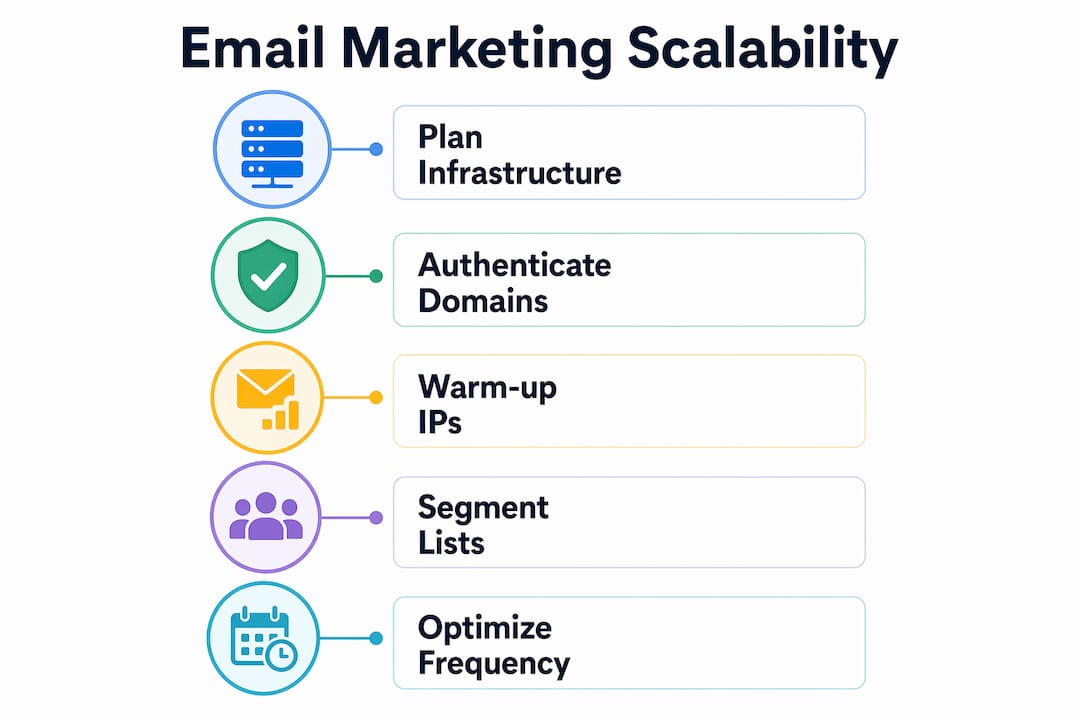
Separating transactional and marketing email infrastructure is the single most important architectural decision you will make. Transactional emails (order confirmations, password resets) must reach the inbox every time. Marketing emails carry more complaint risk. Mixing them on the same domain and IP means a spike in marketing complaints can block your transactional sends. Use different subdomains, separate IP ranges, and, where volume justifies it, separate sending providers for each type.
Mailbox providers do not distinguish transactional from marketing email by category. They judge by sender reputation. Reputation damage in one stream affects delivery of all, which is why separation on subdomains and dedicated IPs is a non-negotiable standard at scale.
Authenticate your sending domains
Three protocols form the authentication baseline for any scalable program:
- SPF (Sender Policy Framework): Specifies which servers are authorized to send on behalf of your domain.
- DKIM (DomainKeys Identified Mail): Adds a cryptographic signature to each email, proving it has not been altered in transit.
- DMARC (Domain-based Message Authentication, Reporting, and Conformance): Tells mailbox providers what to do when SPF or DKIM checks fail, and sends you reports on authentication results.
All three must be configured correctly before you scale. Missing any one of them creates authentication gaps that mailbox providers penalize, especially at high volume.
Warm up new IPs the right way
Gradual IP warm-up increases reputation with mailbox providers. Rapid ramp-up risks spam flagging and permanent reputation damage. The recommended approach is a structured increase of 30–50% in daily volume over 4–6 weeks, starting with your most engaged subscribers. Engaged subscribers generate positive signals (opens, clicks) that build trust with Gmail, Outlook, and Yahoo Mail before you introduce colder segments.
Pro Tip: Start your warm-up with subscribers who opened or clicked within the last 30 days. Their positive engagement signals tell mailbox providers your domain sends wanted mail, which protects your reputation as volume grows.
The deliverability standards you must maintain throughout warm-up and beyond are clear: spam complaint rates must stay under 0.1%, and bounce rates must stay under 2%. Exceeding the complaint threshold significantly degrades inbox placement, often within days.
| Metric | Safe threshold | Risk level if exceeded |
|---|---|---|
| Spam complaint rate | Under 0.1% | High: inbox placement drops fast |
| Hard bounce rate | Under 2% | Medium: signals poor list hygiene |
| Unsubscribe rate | Under 0.5% | Low to medium: watch for trends |
| Open rate (engaged segment) | Above 20% | Benchmark for warm-up targeting |
How does segmentation and personalization enhance email marketing scalability?
Segmentation is how you keep relevance as your list grows. Without it, a larger list produces lower engagement rates, which damages sender reputation and reduces revenue per send. Personalization at scale requires a clean data foundation, mature content production processes, and an email platform that automates segmentation without manual workarounds. Failure to build these systems results in complex campaigns with no measurable lift.
The most common mistake marketers make when scaling is over-segmenting. Five well-supported segments perform better than 20 with stale or generic content. Research from MarketingOps shows 44% of teams are too small to support large segment counts effectively. More segments mean more content to produce, more flows to maintain, and more opportunities for errors. Start with segments that map directly to purchase behavior, engagement recency, and product category interest.
A practical segmentation framework for growth
- Engagement tiers: Active (opened in 30 days), warm (31–90 days), cold (91+ days). Each tier gets different frequency and content.
- Purchase history: First-time buyers, repeat buyers, and high-value customers each have different retention needs and revenue potential.
- Product affinity: Subscribers who bought from a specific category respond better to category-relevant content than to broad catalog sends.
- Lifecycle stage: New subscribers, active customers, and lapsed customers require different messaging strategies entirely.
Automation is what makes personalization at scale possible. Platforms like Klaviyo allow you to build dynamic segments that update in real time based on behavior, so your content stays relevant without manual list pulls. For a deeper look at how to apply these frameworks in ecommerce, the email segmentation strategies guide from Take-action covers advanced approaches that work at volume.
Pro Tip: Treat personalization as a progression, not a tactic. Start with behavioral triggers (browse abandonment, cart abandonment), then layer in product recommendations, then dynamic content blocks. Each stage requires more data maturity, so build the foundation before adding complexity.
What operational practices ensure sustainable scaling for email programs?
Sustainable scaling requires ongoing maintenance, not just a good setup. The programs that maintain high performance at volume are the ones that treat email operations as a continuous discipline, not a one-time project.
Lifecycle email flows such as welcome, abandoned cart, and post-purchase sequences generate 41% of total email revenue from just 5.3% of sends. That ratio is the clearest argument for investing in automation over campaign volume. Sending more campaigns does not produce proportional revenue gains. Building better flows does. The automated email retention guide from Take-action explains how these flows contribute to incremental revenue as programs grow.
The operational practices that keep scaled programs healthy include:
- List cleaning on a regular schedule: Remove hard bounces immediately. Suppress cold subscribers (no opens in 180+ days) before they drag down engagement metrics. Re-engagement campaigns can recover some, but suppression protects the active list.
- Monitoring beyond open rates: Track clicks, conversion rate, revenue per email, and unsubscribe rate by segment. Open rates alone do not tell you whether your program is healthy or declining.
- Frequency calibration by segment: Active subscribers can receive more frequent sends without complaint risk. Cold segments need reduced frequency and re-engagement content. Sending the same cadence to every subscriber is one of the fastest ways to inflate complaint rates.
- Complaint monitoring in real time: Google Postmaster Tools and Microsoft SNDS provide sender reputation data directly from the mailbox providers. Check them weekly, not monthly.
Balancing frequency with subscriber tolerance is one of the hardest operational challenges at scale. The right answer is not a universal send cadence. It is a segmented cadence, where your most engaged subscribers hear from you more often and your coldest subscribers hear from you less, or not at all until re-engaged.
How can businesses practically implement scalable email strategies?
Building a scalable email program is a phased process. Trying to implement everything at once produces errors and gaps. The following sequence works for programs at any starting volume.
- Audit your current infrastructure. Verify SPF, DKIM, and DMARC are correctly configured. Check whether transactional and marketing sends share a domain or IP. Identify any existing deliverability issues by reviewing bounce rates and complaint rates.
- Separate your infrastructure. Set up dedicated subdomains for transactional and marketing sends. If your volume exceeds 50,000 sends per month, consider dedicated IPs for marketing sends.
- Build your segmentation foundation. Define your core engagement tiers and purchase-based segments before adding complexity. Clean your list before expanding it. Resources like proven list growth strategies can help you grow your subscriber base without sacrificing quality.
- Design and launch your core lifecycle flows. Welcome series, abandoned cart, and post-purchase sequences are the highest-ROI automations. Build these before scaling campaign volume.
- Execute a structured warm-up. If you are on new IPs or a new domain, follow the 30–50% daily volume increase protocol over 4–6 weeks, starting with engaged subscribers.
- Establish a performance review cadence. Review deliverability metrics weekly. Review revenue per email and segment performance monthly. Adjust frequency, content, and segmentation based on data, not assumptions.
Pro Tip: Before scaling volume, run a deliverability audit using Google Postmaster Tools and a seed list test. These two checks reveal inbox placement problems that aggregate metrics like open rates will not show until the damage is already done.
Scaling beyond 500,000 to 2 million contacts requires moving to tiered architectures that separate lifecycle, tactical, and compliance sends. Monolithic segmentation, where every subscriber lives in one undifferentiated list, breaks down at that volume. The architecture must evolve with the program.
Key Takeaways
Email marketing scalability requires architectural discipline first, then segmentation maturity, then operational consistency. Programs that build in that order compound their returns; programs that skip the foundation spend months recovering from deliverability failures.
| Point | Details |
|---|---|
| Infrastructure separation | Use separate subdomains and IPs for transactional and marketing sends to protect reputation. |
| Authentication is non-negotiable | SPF, DKIM, and DMARC must all be correctly configured before scaling volume. |
| Warm up gradually | Increase send volume by 30–50% daily over 4–6 weeks, starting with your most engaged subscribers. |
| Segmentation over volume | Five well-maintained segments outperform 20 under-resourced ones at any list size. |
| Lifecycle flows drive revenue | Automated welcome, cart, and post-purchase flows generate 41% of email revenue from 5.3% of sends. |
The architectural shift most email marketers miss
Most email marketers I work with underestimate scalability until they hit a wall. They are sending 20,000 emails a month, things are working fine, and then they grow to 200,000 sends and suddenly their open rates collapse and their best campaigns are landing in spam. The problem was never the content. It was the foundation.
The shift I always push for is treating email infrastructure the way an engineering team treats a production system. You do not add load to a server without checking capacity first. You do not scale email volume without checking sender reputation, authentication, and list hygiene first. The marketers who make this mindset shift early rarely have deliverability crises. The ones who treat email as just a channel, rather than a system, spend months cleaning up problems that were entirely preventable.
The other thing I have seen consistently: personalization gets added too fast. Teams want dynamic content and one-to-one messaging before they have clean data or a content production process that can support it. The result is broken merge tags, irrelevant recommendations, and campaigns that feel worse than a generic send. Build the data foundation first. Personalization is a reward for doing the basics right, not a shortcut around them.
— Take
How Take-action helps brands build email programs that grow
Scaling email marketing is not just a technical problem. It requires the right strategy, the right flows, and the right ongoing management to keep performance high as volume grows.
Take-action is a specialized email marketing and retention agency that helps ecommerce brands build programs designed to grow. From Klaviyo flow setup and domain authentication to advanced segmentation and campaign strategy, Take-action handles the full architecture of a scalable email program. The agency’s approach combines human expertise with data-driven execution, so your email channel becomes a primary revenue driver rather than a secondary one. If you are ready to build an email program that compounds over time, Take-action’s email marketing services are built for exactly that.
FAQ
What is email marketing scalability?
Email marketing scalability is the ability to grow send volume, list size, and campaign complexity while maintaining deliverability, engagement, and revenue per recipient. It requires technical infrastructure, segmentation systems, and operational discipline working together.
What complaint rate is safe for scaled email programs?
Spam complaint rates must stay under 0.1% to maintain inbox placement at scale. Exceeding this threshold significantly degrades deliverability, often within days of the spike.
How long does IP warm-up take?
A structured IP warm-up takes 4–6 weeks, with send volume increasing by 30–50% each day, starting with your most engaged subscribers. Rushing this process risks spam flagging and lasting reputation damage.
Why should transactional and marketing emails be separated?
Mailbox providers judge sender reputation without distinguishing email type. A complaint spike from marketing sends can block transactional emails like order confirmations, which is why separate subdomains and IPs are the standard practice at scale.
How many segments should a scaled email program use?
Five well-supported segments consistently outperform 20 under-resourced ones. Segment count should match your team’s capacity to produce relevant content for each group, not your platform’s technical limits.