

Maximize retention with email marketing for service providers
TL;DR:
- Email automations like welcome and win-back flows drive significantly higher revenue than standard campaigns for service businesses.
- Well-designed automated flows reduce churn, increase repeat bookings, and support long-term client retention.
- Segmentation and personalization enhance engagement, making messages more relevant and improving automation effectiveness.
Most service providers assume email automations are built for product sellers pushing flash sales and abandoned carts. That assumption is costing you repeat business. Klaviyo automations, including welcome series, post-booking follow-ups, and win-back flows, drive up to 30x higher revenue per recipient compared to standard campaigns. For service-based businesses, that gap represents a massive, largely untapped opportunity. This article breaks down exactly which automated flows to build, how to segment your audience for maximum relevance, and how to measure results so your email channel becomes a reliable engine for client retention and growth.
Table of Contents
- Why automation beats campaigns for service provider retention
- Essential automated flows for service providers using Klaviyo
- Segmentation and personalization: The power duo for engagement
- Measuring impact: Analytics and retention for ongoing growth
- Beyond the template: Expert secrets for retention-driven service email
- Take action: Accelerate your service business’s retention
- Frequently asked questions
Key Takeaways
| Point | Details |
|---|---|
| Automations outperform campaigns | Using automated flows in Klaviyo can boost revenue per recipient up to 30 times compared to simple campaigns. |
| Segmentation is crucial | Personalizing your messaging through behavioral and zero-party data segments drives engagement and retention. |
| Monitor analytics for growth | Tracking RPR, repeat rate, and flow mixes allows you to refine your strategy for maximum client lifetime value. |
| Retention begins with education | Service providers see more loyalty when flows focus on value, education, and proactive support rather than just offers. |
Why automation beats campaigns for service provider retention
To understand why automation matters, let’s examine how the numbers stack up against traditional campaigns.
One-off email campaigns have their place, but they are not a retention strategy. They require constant manual effort, rely on your team’s bandwidth, and deliver inconsistent results. Automation, by contrast, works around the clock and responds to actual client behavior, not a calendar date you picked.
The performance gap is significant. Average campaign conversion sits at just 0.08% with a revenue per recipient of $0.10. Automated flows like abandoned cart sequences generate $3.65 RPR. That is a 36x difference in revenue efficiency from a single flow type. Top-performing brands in the top 10% achieve 5x the order rates and 7x the RPR of the average sender.
For service providers, this translates directly to repeat bookings, subscription renewals, and long-term client relationships. The flows that matter most for your model include:
- Welcome series: Converts new leads into first-time clients by setting expectations and delivering immediate value
- Post-booking follow-up: Reinforces the client’s decision, reduces cancellations, and plants seeds for upsells
- Appointment or renewal reminders: Reduces no-shows and lapses in subscription or retainer relationships
- Win-back flows: Re-engages dormant clients who haven’t booked or purchased in a defined period
Looking at email automation tools side by side, Klaviyo consistently stands out for its behavior-based triggers, which are essential for service models where timing is everything. A reminder sent three days before a subscription renewal is far more powerful than a generic newsletter.
Service providers who explore automated workflow examples built for real business scenarios often discover that the same logic applies to their model. Trigger an email when a client hasn’t rebooked within 30 days. Send a nurture sequence when someone downloads a service guide but doesn’t schedule a call. These are the moments where automation pays for itself.
The acquisition strategy insights from Klaviyo confirm what top agencies already know: retention is cheaper than acquisition, and automation is the most scalable way to retain.
Essential automated flows for service providers using Klaviyo
Once you see why automation wins for retention, the next step is understanding which flows are vital for service businesses.
Not every flow designed for a product brand will translate cleanly to a service model. But the core logic, reaching the right person at the right moment with the right message, applies universally. Here are the flows every service provider should have active in Klaviyo:
- Lead capture and nurture: Triggered when someone opts in but hasn’t booked yet. Deliver value, address objections, and guide them toward a first appointment or purchase
- Onboarding flow: Sends immediately after a first booking or sign-up to set expectations and reduce buyer’s remorse
- Recurring reminders: Timed to subscription renewal dates, appointment windows, or contract review periods
- Cancellation win-back: Triggered when a client cancels or churns, offering a reason to return without defaulting to discounts
- Re-engagement flow: Targets clients who haven’t interacted in 60 to 90 days with personalized content based on their service history
For subscription-style service models, segmenting by behavior is what separates a generic drip sequence from a genuinely personalized experience. A client who has renewed three times should receive different messaging than someone on their first renewal window.
| Flow type | Trigger | Primary goal |
|---|---|---|
| Welcome and lead nurture | Opt-in or first visit | Convert lead to client |
| Onboarding | First booking confirmed | Reduce churn, set expectations |
| Renewal reminder | 7 to 14 days before renewal | Retain subscribers |
| Cancellation win-back | Cancellation event | Re-engage churned clients |
| Re-engagement | 60 to 90 days of inactivity | Revive dormant relationships |
The workflow automation benefits extend beyond revenue. Automations reduce the manual workload on your team, ensure consistent communication, and create a professional client experience at every stage.

For deeper inspiration on building these out, explore workflow examples for services and automated retention strategies that show how real brands structure their flows.
Pro Tip: Suppress or adjust your active flows for clients who have open service tickets or unresolved issues. Sending a renewal upsell to someone mid-complaint creates friction and damages trust.
Segmentation and personalization: The power duo for engagement
With your essential flows set up, tailoring your messaging comes down to robust segmentation and data-driven personalization.
Segmentation is not just about sorting your list. It is about sending messages that feel like they were written specifically for one person. In Klaviyo, you can segment by engagement level, purchase or booking behavior, demographics, service usage patterns, and even zero-party data, which is information your clients explicitly share with you through surveys or preference centers.
Here is a practical framework for building segments that actually move the needle:
- Engagement-based segments: Active openers and clickers vs. passive subscribers vs. at-risk contacts who haven’t engaged in 90 days
- Behavioral segments: Clients who have booked once vs. repeat clients vs. high-value clients with multiple service purchases
- Service-specific segments: Clients using service A vs. service B, allowing you to send relevant upsell or cross-sell messages
- Zero-party data segments: Clients who completed a preference survey and indicated interest in specific service categories
- Predictive segments: Using Klaviyo’s AI features to identify clients likely to churn or likely to purchase again within a set window
Retention strategies built on cohort analysis and champion customer segmentation reveal that your top clients spend 4 to 10 times more than the average. Identifying and nurturing that group with specialized flows is one of the highest-ROI activities in your entire marketing program.
“A 1 to 2% improvement in repeat purchase rate can generate disproportionate revenue gains when applied across your full client base.”
Split your welcome flow by purchase status. New leads who haven’t booked yet need education and social proof. Existing clients who just signed up for a new service need onboarding and confidence-building. These are fundamentally different journeys, and sending the same flow to both groups wastes the opportunity.
For a deeper look at segmentation strategies for growth and retention driver tactics, the data consistently shows that personalized flows outperform generic ones by a wide margin. The personalization benefits are well documented, but the real edge comes from combining behavioral data with what clients explicitly tell you they want.
Pro Tip: Add a preference survey to your onboarding flow. Ask clients what topics they care about, how often they want to hear from you, and what goals they are working toward. Use those answers to build dynamic segments that stay relevant for months.
Measuring impact: Analytics and retention for ongoing growth
Effective segmentation improves engagement, but maximizing value relies on ongoing measurement and refinement.
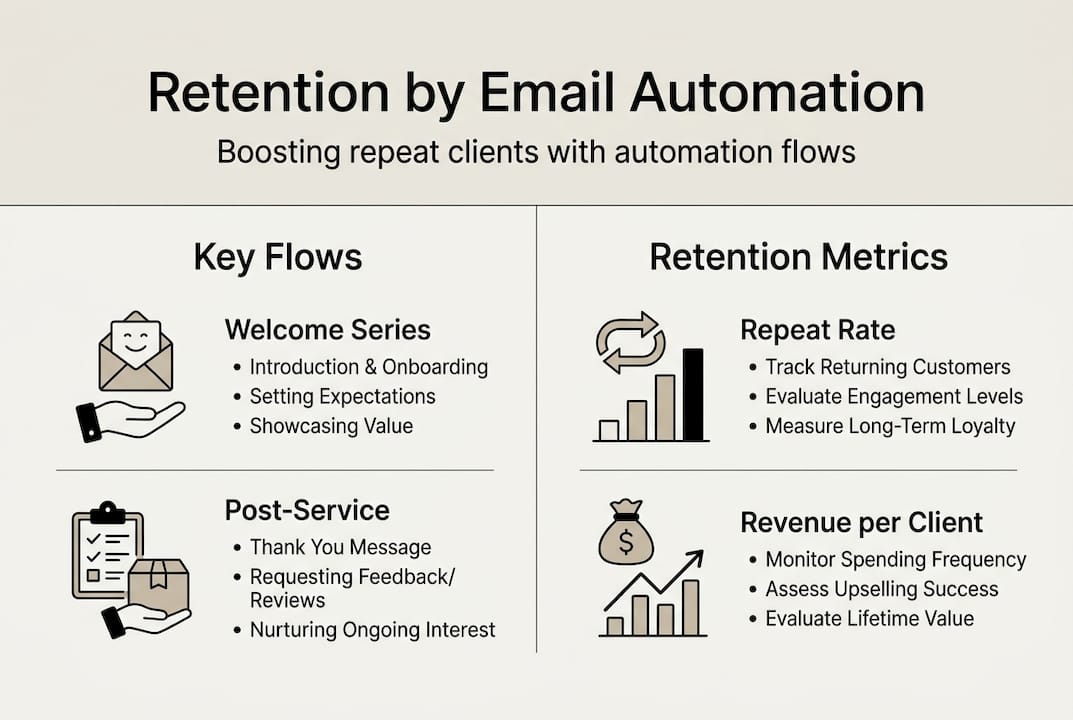
Building flows and setting them live is only the beginning. The brands that consistently grow their email revenue are the ones that treat their automations as living systems, reviewing performance regularly and making data-driven adjustments.
The metrics that matter most for service provider retention include:
- Revenue per recipient (RPR): The clearest measure of how efficiently your flows are generating income
- Repeat booking or purchase rate: Tracks whether your retention flows are actually driving return visits
- Flow conversion rate: Measures how many recipients complete the desired action, such as rebooking or renewing
- Unsubscribe and churn rate by segment: Reveals which audience groups are disengaging and why
- Proportion of total revenue from automations: Benchmarks how much of your email revenue is passive vs. manually driven
The Grind coffee subscription case study is one of the most instructive examples available. Grind achieved 34x year-over-year email revenue growth, with 71% of their email revenue coming from repeat customers and 41% driven specifically by automated flows including abandoned cart. That ratio, where automations carry nearly half the revenue load, is the target benchmark for a mature service email program.
| Metric | What to track | Why it matters |
|---|---|---|
| RPR | Per flow and per segment | Identifies highest-value touchpoints |
| Repeat rate | Monthly cohort comparison | Measures retention health |
| Flow conversion | Per automation type | Guides optimization priorities |
| Revenue from automations | % of total email revenue | Shows program maturity |
Use Klaviyo’s built-in analytics to run cohort analysis. Compare clients acquired in different months and track how their behavior evolves over time. This reveals whether your onboarding and nurture flows are building lasting relationships or just driving one-time transactions.
For a broader view of how marketing strategy for retention connects to long-term growth, and how ecommerce analytics for ROI inform smarter decisions, the pattern is consistent: brands that measure retention metrics improve them faster.
Beyond the template: Expert secrets for retention-driven service email
The numbers reveal what’s working, but mastering email for services means seeing beyond the obvious tactics.
Most service providers copy e-commerce playbooks and wonder why results are flat. Product brands optimize for cart recovery. Service brands need to optimize for trust, education, and long-term client value. Those are different problems requiring different solutions.
The biggest missed opportunity we see is using post-purchase flows purely for transactional updates. Confirmation emails, receipts, and reminders are table stakes. What actually builds retention is post-service education: tips for getting more from the service, resources that reinforce the client’s decision, and content that positions you as a long-term partner rather than a one-time vendor.
Borrowing SaaS retention thinking means being proactive rather than reactive. Use Klaviyo’s AI-powered predictive analytics to identify clients showing churn signals before they cancel. Collect zero-party data inside your flows so personalization improves over time without requiring manual list management.
The contrast is sharp: while e-commerce brands chase discount-driven cart recovery, service brands that prioritize educational nurturing build clients who stay longer, spend more, and refer others. That is the compounding advantage of retention-first email strategy, and it is available to any service provider willing to rethink the template.
For more email marketing tips that apply directly to service-based growth, the core principle holds: relationships built through email outlast any single campaign.
Take action: Accelerate your service business’s retention
Retention-focused automation is not a nice-to-have. For service providers, it is the difference between a client base that grows and one that constantly churns. The strategies covered here, from essential flows and smart segmentation to measurement and educational nurturing, are proven to drive repeat business and long-term revenue.
At Take Action, we specialize in building Klaviyo automation systems tailored specifically to service and e-commerce brands that want measurable, scalable growth. Our team at Take Action agency will map out your retention gaps, design the right flows for your model, and set up the analytics to prove ROI. If you are ready to turn email into your most reliable growth channel, let’s build your retention strategy together.
Frequently asked questions
What email flows are essential for service providers using Klaviyo?
Key flows include lead capture and nurture, appointment reminders, post-service follow-up, cancellation win-backs, and tailored re-engagement sequences. Each flow targets a specific moment in the client lifecycle to reduce churn and drive repeat bookings.
How can segmentation improve my service email marketing results?
Segmentation lets you send the right message to the right client at the right time, improving relevance and response rates. Champion customer segmentation alone can unlock a group that spends 4 to 10 times more than your average client.
How do I measure the impact of my automations?
Track revenue per recipient, repeat booking rate, and flow conversion rates inside Klaviyo’s analytics dashboard. Brands like Grind achieved 41% of email revenue from automations alone, which is a strong benchmark to work toward.
What’s the difference between campaign and automation email performance for services?
Automated flows consistently outperform campaigns in revenue efficiency, with up to 30x higher revenue per recipient. Campaigns require manual effort and deliver inconsistent results, while automations run continuously based on real client behavior.
Recommended
- Managing Business Growth with Automated Email Retention | Take Action Blog | Take Action
- 7 Innovative Ecommerce Newsletter Ideas for Higher Retention | Take Action Blog | Take Action
- Online Marketing Strategy: Driving Ecommerce Retention | Take Action Blog | Take Action
- How Klaviyo content marketing agencies boost retention 321% | Take Action Blog | Take Action
- Increasing User Engagement in your Marketing Message