

Email content that drives engagement and retention
TL;DR:
- Quality content covering education, UGC, and personalized recommendations is crucial for email growth.
- A balanced mix of nurturing and promotional emails aligned with customer journey stages enhances engagement.
- Effective segmentation, automation, and strategic content boost retention and revenue in e-commerce email marketing.
Email marketing drives up to 40% of total revenue for optimized e-commerce programs, yet most DTC brands still treat their email list as a broadcast channel rather than a retention engine. The gap between brands that send emails and brands that grow through email almost always comes down to one thing: content quality. Content creation for e-commerce email marketing means producing valuable, relevant, and personalized material ranging from educational guides and user-generated content to dynamic product recommendations. In this article, you’ll get the frameworks, mechanics, and methodologies to turn your email program into a genuine growth lever.
Table of Contents
- Breaking down content creation in email marketing
- Mechanics: Segmentation, personalization, and automation
- High-impact methodologies and content mix
- Benchmarks, retention, and measuring success
- The real drivers of retention: What most guides miss
- Expert help for scaling content-driven email growth
- Frequently asked questions
Key Takeaways
| Point | Details |
|---|---|
| Balance nurture and promotion | A 50/50 mix of nurturing and promotional content in email campaigns is proven to boost engagement and revenue for e-commerce brands. |
| Segment and personalize | Audience segmentation and dynamic personalization drive higher open rates, clicks, and customer retention in DTC email marketing. |
| Prioritize email flows | Automated flows like welcome, abandoned cart, and post-purchase emails deliver 17x more revenue than standard campaigns. |
| Benchmark for success | Measuring against industry standards for open rates, CTR, and revenue per recipient helps optimize overall email performance. |
| Avoid common pitfalls | Over-discounting, neglecting inactive lists, and failing to optimize for mobile can significantly reduce retention and return. |
Breaking down content creation in email marketing
Content creation in e-commerce email is not just writing subject lines and picking a hero image. It’s a deliberate system of formats, objectives, and funnel alignment that determines whether a subscriber buys again or quietly unsubscribes.
The core content types you need
For e-commerce brands and DTC startups, the primary email content formats include:
- Educational guides: How-to content, care instructions, ingredient explainers, and tutorials that help customers get more value from what they already bought.
- Product stories: Founder narratives, sourcing stories, and behind-the-scenes content that build brand equity and emotional connection.
- User-generated content (UGC): Customer photos, reviews, and testimonials that act as social proof and reduce purchase anxiety for new buyers.
- Dynamic recommendations: Personalized product suggestions based on browsing history, past purchases, and predicted preferences.
- Promotional content: Flash sales, new arrivals, limited-time offers, and urgency-driven campaigns.
Each of these serves a different psychological function. Educational guides build trust. UGC reduces risk perception. Dynamic recommendations increase relevance. Promotional content drives immediate action.
Nurture versus promotional: What each delivers
A critical mistake brands make is defaulting to promotional-only emails. Pure promo content trains your audience to expect discounts and ignore value-driven messages. A 50/50 mix of nurturing and promotional content mapped to customer funnel stages consistently outperforms discount-heavy approaches in both revenue and long-term engagement.
Here’s how that split plays out across the funnel:
| Funnel stage | Content focus | Primary goal |
|---|---|---|
| Awareness | Brand story, educational content | Build trust and recognition |
| Consideration | UGC, product comparisons, guides | Reduce friction, answer objections |
| Decision | Offers, urgency, social proof | Convert to purchase |
| Retention | Post-purchase tips, loyalty content | Drive repeat purchase |
Mapping your content pillar strategy to each stage prevents your email program from becoming a random series of sends. Instead, every email has a purpose tied to where the customer is in their journey.
Why content richness directly affects engagement
Subscribers who receive a mix of educational, inspirational, and promotional emails show significantly higher click-through rates than those who only receive offers. The reason is straightforward: people open emails they expect to learn from, not just buy from. When your user generated content flows naturally alongside product recommendations, you create a reading experience that mirrors what people enjoy on social media, scrollable, relatable, and useful. That’s the foundation of content-driven email marketing.
Mechanics: Segmentation, personalization, and automation
Once you understand the content formats and objectives, mastering the mechanics is essential for amplifying your results.
Audience segmentation: The backbone of relevance
Sending the same email to every subscriber is like putting the same ad in front of every demographic. It feels generic and converts poorly. Effective email segmentation strategies split your audience by demographic data (location, age, gender) and behavioral signals (purchase history, browse activity, engagement recency). A customer who bought twice in 90 days should receive very different content from someone who opened once and never clicked.
Audience segmentation and personalization tactics are among the most impactful levers available, covering everything from first-name personalization to lifecycle milestone triggers like anniversary emails and loyalty tier upgrades.
Personalization tactics that go beyond first names
Real personalization means:
- Inserting dynamic product recommendations based on last purchase category.
- Sending birthday or anniversary flows with exclusive rewards.
- Triggering re-engagement sequences when engagement drops for 60 or 90 days.
- Customizing content blocks based on geographic location (winter gear to cold climates, swimwear to warm ones).
- Adjusting send frequency based on individual open cadence rather than a fixed schedule.
Automation flows: Where the revenue actually lives
Automated workflows like welcome sequences, abandoned cart reminders, and post-purchase flows are where most brands unlock disproportionate returns. The numbers validate this clearly: flows outperform campaigns by 17x in revenue, making them the single highest-ROI investment in your email program.

| Automation flow | Primary purpose | Average revenue impact |
|---|---|---|
| Welcome series | Onboarding, brand story | High open rates, first purchase conversion |
| Abandoned cart | Recover lost revenue | 5-15% cart recovery rate |
| Post-purchase | Retention, upsell, reviews | Increases LTV significantly |
| Win-back | Re-engage dormant buyers | Recovers 10-20% inactive segment |
Testing and optimization
Subject line testing, CTA button copy, preview text, and mobile layout all affect whether content gets seen and acted on. Run A/B tests on one variable at a time to build a clean data picture. Tools like automated discount tracking workflows can integrate with your email flows so that offers remain accurate and timely without manual updates.
Pro Tip: Always prioritize building out your automation flows before scaling campaign frequency. One well-built abandoned cart flow that runs 24/7 will outperform ten manual campaigns. Also suppress inactive subscribers (no opens in 90 plus days) to protect your sender reputation and deliverability.
High-impact methodologies and content mix
With the mechanics in place, the next step is deploying proven methodologies and balancing your content mix for growth.
Getting the content mix right
The 50/50 ratio of nurturing and promotional content is a proven starting point, but the exact mix will shift based on your brand’s stage and subscriber behavior. A new brand building its list needs more nurture content to establish trust. A mature brand with an engaged list can push promotional content more frequently without seeing disengagement.
Your nurture content bucket should include:
- How-to guides and tutorials related to your product category
- Behind-the-scenes content showing your manufacturing, team, or sourcing
- Customer spotlights and UGC galleries
- Educational series (ingredient benefits, sustainability practices, product comparisons)
- Community-building content that invites replies and conversations
Your promotional content bucket should include:
- New product launches with early access for subscribers
- Limited-time sales with genuine urgency (not fake countdowns)
- Bundle deals and loyalty reward redemptions
- Personalized restock alerts for previously viewed items
Repurposing content across channels
One of the most efficient practices in ecommerce content marketing is treating each piece of content as a multi-channel asset. An educational blog post becomes the body of a nurture email. A customer testimonial used in an email becomes an Instagram story. An FAQ from a product page becomes a post-purchase email sequence. This approach dramatically reduces production time while keeping messaging consistent across touchpoints.
Using AI to scale without losing brand voice
AI tools accelerate content creation for subject lines, body copy, and product descriptions. Personalization and segmentation powered by AI can boost engagement by 15 to 35%, and the efficiency gains are real. However, AI-generated copy that bypasses your brand’s tone guidelines produces generic emails that feel like they could belong to any store. The fix is establishing a brand voice document and reviewing AI outputs against it before every send.
Check out AI scaling benefits in retail contexts for a broader picture of where automation delivers the most leverage without compromising authenticity.
Pro Tip: Use zero-party data collected from pop-ups and quizzes (preferences, skin type, size, goals) to power dynamic content blocks. When a subscriber tells you they prefer minimalist styles, every recommendation email should reflect that. This kind of hyper-personalization consistently outperforms generic “top sellers” blocks.
For brands serious about content creation for retention, the methodology is clear: lead with value, follow with offers, and let automation handle consistency.
Benchmarks, retention, and measuring success
To refine your strategy, it’s vital to compare against industry benchmarks and focus on retention-centric metrics.
Email marketing benchmarks for DTC brands
Knowing whether your numbers are good requires context. Here are the key benchmarks to track:
| Metric | Benchmark range | Notes |
|---|---|---|
| Open rate (segmented) | 30-45% | Higher with strong segmentation |
| Click-through rate | 2-5% | Improves with personalized CTAs |
| Revenue per recipient/month | $0.50-$1.50 | $2-$6 for engaged segments |
| List-driven revenue share | 25-40% | For fully optimized programs |
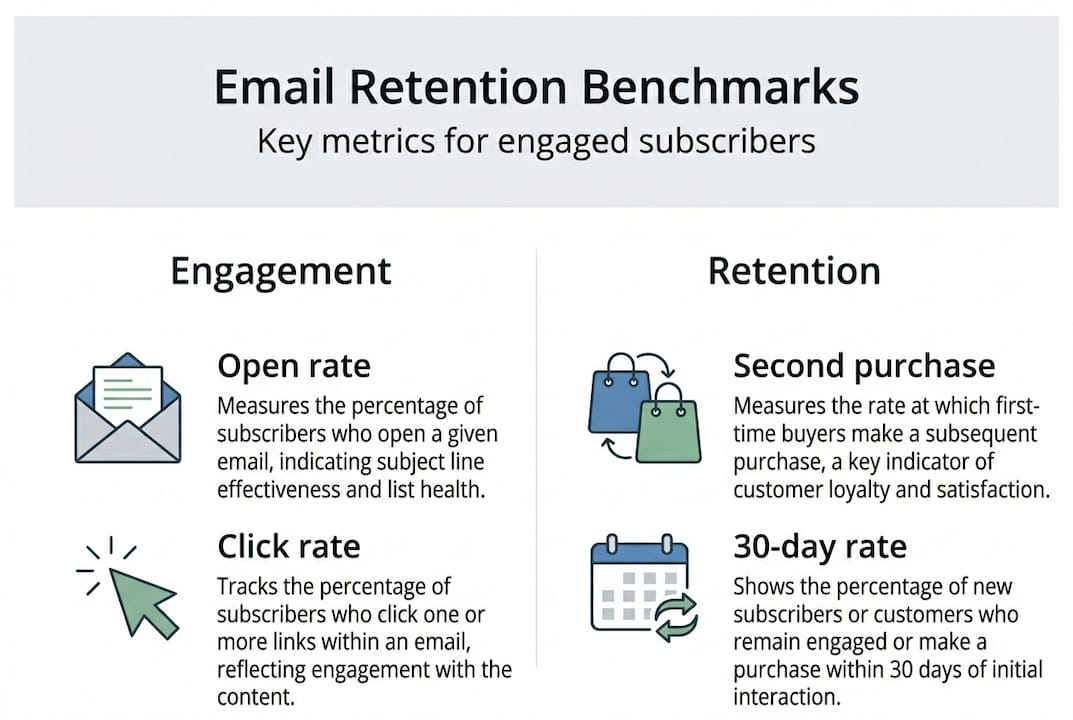
Segmented open rates of 30 to 45%, CTRs of 2 to 5%, and monthly revenue per recipient of $0.50 to $1.50 are the numbers to benchmark against. If you’re below these, your segmentation or content quality needs attention before you increase send frequency.
The retention picture: Why second purchases matter most
Retention is where DTC brands either build sustainable businesses or burn out on constant acquisition costs. The data is stark: only 21.2% of first-time buyers make a second purchase, meaning 78.8% of your customers buy exactly once. That single purchase represents 51% of your total revenue base. Customers who reach five or more purchases are worth 7x the lifetime value of one-time buyers, with an LTV of $1,553 compared to $211.
This is precisely why the post-purchase email sequence is the most strategically valuable flow you can build.
“Flows outperform campaigns by 17x in revenue, making automation the highest-leverage investment in your email program.”
Key post-purchase content that drives second purchases:
- Product care and usage guides sent within 48 hours of delivery
- Personalized cross-sell recommendations at the 14 and 30-day mark
- Review request emails that double as UGC collection tools
- Loyalty program enrollment with tangible incentives
- Educational content that reinforces why the purchase was the right decision
Measuring content effectiveness and iterating
Beyond open and click rates, track revenue per flow, second-purchase conversion rate, and 30-day retention rates. Thirty-day retention typically sits at 8 to 10% for most DTC brands. Consistent post-purchase content programs reliably push this number higher.
Use benchmarking price strategies alongside email performance data to ensure your offers are competitive at the moments when content is already driving high intent. Also review your agency marketing impact and retention pillars to align your email program with a broader retention strategy.
The real drivers of retention: What most guides miss
Most guides focus on the mechanics and miss the psychology. After working with e-commerce brands across categories, the patterns that actually move retention numbers are surprisingly consistent and often counterintuitive.
The second purchase is the most critical retention lever you have, and brands consistently underinvest in the post-purchase window. Educational how-to content and UGC sent after the first purchase can lift repeat purchase rates by up to 70%. Customers who feel supported after buying don’t need discounts to come back. They come back because they trust you.
AI-assisted content is genuinely useful, but it requires guardrails. Brands that hand everything to AI without a brand voice framework end up with email programs that sound like a press release. Subscribers can feel the difference between a human-crafted email and a templated output.
The pitfalls that quietly erode results are over-discounting, inactive list neglect, and poor mobile optimization. Over-discounting teaches customers to wait for sales, compressing your margins permanently. Inactive subscribers drag down your sender reputation and reduce deliverability for everyone else on your list. And failing to optimize for mobile means up to 42% of your emails get deleted before they’re read. These aren’t edge cases. They are common failures that preventable strategy work from a dedicated strategy agency can avoid entirely.
Expert help for scaling content-driven email growth
If the frameworks in this article made you realize your email program has untapped potential, you’re not alone. Most e-commerce brands are leaving significant revenue on the table because their flows are incomplete, their segmentation is shallow, or their content mix skews too promotional.
Take Action is a specialized email marketing and retention agency that builds exactly the kind of content-driven systems described here, from welcome and abandoned cart flows to full segmentation strategies and campaign calendars. We work primarily with Klaviyo and bring both human expertise and data-driven precision to every program we build. If you’re ready to turn email into your primary retention solutions engine, our team at Take Action is ready to help you scale with strategy, not guesswork.
Frequently asked questions
What types of content work best for DTC email marketing?
Educational guides, UGC, dynamic recommendations, and testimonials consistently drive the highest engagement and repeat purchase rates in e-commerce email programs.
How should brands balance nurturing and promotional emails?
A 50/50 mix of nurturing and promotional content mapped to customer funnel stages is most effective, preventing subscriber fatigue while maintaining consistent revenue generation.
What benchmarks should e-commerce brands aim for in email marketing?
Segmented open rates of 30 to 45%, CTRs of 2 to 5%, and monthly revenue per recipient of $0.50 to $1.50 are the core DTC benchmarks, with optimized flows capable of driving up to 40% of total store revenue.
How does AI impact content creation for email marketing?
AI can boost email revenue by up to 41% and improve subject line open rates by 22%, but strong brand guardrails are essential to prevent generic, off-brand messaging that erodes subscriber trust.
What are common pitfalls in e-commerce email content strategies?
Over-discounting erodes margins, inactive lists damage deliverability, and failing to optimize for mobile results in up to 42% of emails being deleted without being read.
Recommended
- Content Creation in Marketing: Driving Email Engagement | Take Action Blog | Take Action
- 7 Innovative Ecommerce Newsletter Ideas for Higher Retention | Take Action Blog | Take Action
- Blog - Email Marketing Insights | Take Action | Take Action
- Content Creation Agencies: Driving Retention Growth | Take Action Blog | Take Action