

Copywriting Tips for Beginners: Your Fast-Start Guide
Good copy does one thing: it moves a specific person to take a specific action. These seven copywriting tips for beginners give you a working foundation you can use today, before you’ve read a single book on the subject.
- Write to one person, not a crowd. Picture your reader and address them directly.
- Lead with the benefit, not the feature. “Lose 10 lbs” beats “12-week program.”
- Write your headline last. Draft the body first so you know what you’re actually promising.
- Use short sentences. If you need a breath mid-sentence, split it.
- End every piece with one clear call to action (CTA). One ask, not three.
- Read your draft aloud before sending. Your ear catches what your eye misses.
- Study copy that already works. Collect subject lines, ads, and landing pages that made you click.
Pro Tip: Don’t start with a blank page. Open a competitor’s email or ad, rewrite it from scratch in your own words, then delete their version. You’ll learn more in 20 minutes than in an hour of reading theory.
Key Takeaways
Strong copy comes down to one principle: write for one person, make one offer, and drive one action — everything else is execution.
| Point | Details |
|---|---|
| Start with frameworks | Use AIDA for long-form and PAS for short-form copy to stop guessing and write with intent. |
| Headline skill first | Strong headlines determine whether anyone reads further — practice writing 10 per session. |
| Edit and test every piece | Personalized CTAs perform 202% better than generic ones; always run at least one A/B test per send. |
| Build a minimal portfolio fast | Three case-style examples (problem, solution, result) are enough to land a first client. |
| Publish before you feel ready | Real feedback from a live piece beats a month of theory every time. |
Table of Contents
- Your 10-step quickstart checklist to write and ship copy this weekend
- How the main copy frameworks work (AIDA, PAS, FAB, and the Rule of One)
- A practical writing process: research, draft, refine
- How to adapt your copy for ads, landing pages, social, and email
- Editing checklist, A/B testing basics, and metrics to track
- How to practice, build a portfolio, and land your first clients
- An annotated email template you can swipe and adapt
- Common beginner mistakes and how to fix them fast
- What I’d do if I were starting copywriting today: a 30-day plan
- Useful resources and tools to study next
- Sources
Your 10-step quickstart checklist to write and ship copy this weekend
Most beginners stall because they try to learn everything before writing anything. This sequence gets you from zero to published copy in two days. Study examples, practice, build a portfolio, and get feedback — that cycle is how beginners become dependable writers fast.
- Research one audience (20 min). Go to Reddit, Amazon reviews, or a brand’s comment section. Copy exact phrases real people use to describe their problem. These are your raw materials.
- Pick one offer. A single product, service, or idea. Not two. Not “our full range.” One.
- Define one outcome. What does your reader walk away with? Write it in one sentence before you write anything else.
- Choose a framework. AIDA for landing pages and emails. PAS for ads and short social posts. (Full breakdown in the next section.)
- Write three headline options (15 min). Don’t judge them yet. Just write three versions: one curiosity-driven, one benefit-driven, one question.
- Draft three body variations (30 min). Keep each under 150 words. Speed matters more than polish at this stage.
- Pick one CTA. “Shop now,” “Get the guide,” “Start your free trial.” One verb, one destination.
- Polish for clarity (15 min). Cut every sentence that doesn’t move the reader toward the CTA. If a sentence is just filler, delete it.
- Test on a real channel. Post a social caption, send an email to a small list, or run a $5 ad. Real feedback beats imagined feedback every time.
- Publish and note what you’d change. Write one sentence about what you’d do differently. That note is your next lesson.
Low-cost practice grounds: your own email drafts, Instagram captions for a local business, or free landing page builders like Carrd. The medium matters less than the repetition.
How the main copy frameworks work (AIDA, PAS, FAB, and the Rule of One)
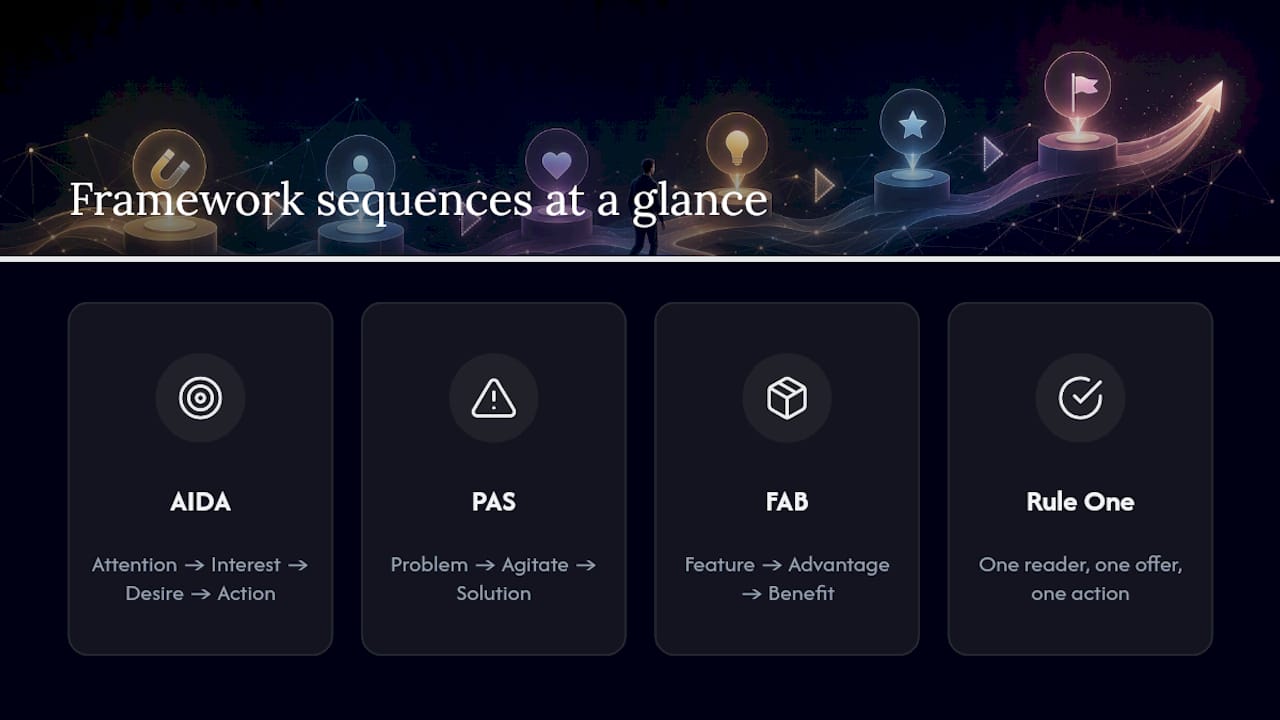
Frameworks are not crutches. They’re the reason experienced copywriters can produce clean, persuasive copy quickly. AIDA and PAS guide readers through a logical decision-making process in a way that guessing never will.
AIDA (Attention, Interest, Desire, Action) Best for: landing pages, promotional emails, long-form ads.
Attention: Hook with a bold claim or question. Interest: Explain why this matters to them specifically. Desire: Show the transformation or outcome. Action: One clear CTA.
Example line (Desire stage): “Imagine waking up to 30 new orders — without touching a single ad.”
PAS (Problem, Agitate, Solution) Best for: short ads, social posts, email subject lines.
Problem: Name the pain plainly. Agitate: Make the cost of inaction real. Solution: Position your offer as the fix.
Example line (Agitate stage): “Every day you wait, your competitors are capturing the customers you’re ignoring.”
FAB (Feature, Advantage, Benefit) Best for: product descriptions, bullet points, comparison pages.
Feature: What it is. Advantage: What it does better. Benefit: What that means for the reader’s life.
Example line: “Automated segmentation [Feature] means the right message reaches the right person [Advantage], so you stop burning budget on people who’ll never buy [Benefit].”
Before-After-Bridge Best for: testimonials, case studies, email intros.
Before: Where the reader is now. After: Where they want to be. Bridge: Your offer as the path between the two.
The Rule of One Conversion-focused copy works best when it targets one reader, makes one offer, and drives one action. Every time you add a second CTA or a second audience, you dilute both. Before you publish anything, ask: “Is this written for one specific person?” If the answer is no, cut until it is.
A practical writing process: research, draft, refine
Consistent output comes from a repeatable process, not inspiration. Here’s a workflow you can follow every time you sit down to write.
Phase 1: Research (20–30 minutes)
- Find where your audience talks: Reddit threads, product reviews, YouTube comments, support tickets.
- Copy their exact language into a doc. Don’t paraphrase. Their words become your headlines.
- List their top three objections. Your copy needs to address at least one of them directly.
- Identify the single outcome they want most. That outcome is your headline’s job.
Headline skill is the most important copywriting skill — strong headlines determine whether anyone reads the rest. So before you draft a single body paragraph, write five headline options using the language you collected.
Phase 2: Draft (30 minutes)
- Write fast. Don’t edit while you draft. Turn off spell-check if it slows you down.
- Write three short variations of the same piece. Different angles, same offer.
- Try headline-first on landing pages (it anchors the whole argument). Try headline-last on emails (the body often reveals the real hook).
Phase 3: Refine (15–20 minutes)
- Clarity first. Read each sentence and ask: “Could a 14-year-old understand this?” If not, simplify.
- Shorten. Cut the first sentence of every paragraph. It’s usually a warm-up you don’t need.
- Tighten the CTA. Replace “Click here to learn more about our services” with “See how it works.”
- Format for skimmers. Short paragraphs (2–3 lines max), bold key benefits, one idea per bullet.
Weak → strong rewrite example:
- Weak: “Our platform provides users with a comprehensive suite of tools designed to help them manage their email marketing more effectively.”
- Strong: “One dashboard. Every email metric you need. Nothing you don’t.”
Clarity, audience-first messaging, and benefit-led writing are the three principles that separate copy that converts from copy that just fills space.
How to adapt your copy for ads, landing pages, social, and email
The same message needs a different shape depending on where it lives. Repurposing copy verbatim across channels is one of the fastest ways to underperform on all of them.
Ads (paid social, search)
- Lead with the hook in the first line. Readers scroll fast.
- One benefit, one CTA. No room for nuance.
- Match the ad’s language to the landing page headline exactly. Mismatched messaging kills conversions.
- Don’t: write a clever pun that obscures what you’re selling.
Landing pages
- The headline carries 80% of the weight. Spend most of your time there.
- Body copy answers objections in order of importance, not in the order you thought of them.
- CTA placement matters: above the fold for warm traffic, after the proof for cold traffic.
- Landing pages and homepages serve different purposes — a landing page has one goal and one audience; a homepage serves many.
Social media
- Short-form (TikTok, Instagram): hook in line one, payoff in the last line, CTA in the caption or bio link.
- Long-form (LinkedIn): the first two lines determine whether anyone clicks “see more.” Treat them like a subject line.
- Don’t copy a LinkedIn post onto TikTok. The register, rhythm, and expectations are completely different.
- The subject line is the headline. It gets opened or it gets ignored.
- Preheader text is your second headline. Use it, don’t waste it on “View in browser.”
- Body copy should feel like a message from a person, not a press release.
- One email, one goal. If you’re promoting a sale AND announcing a new product, pick one.
Statistic callout: A large majority of consumers ignore marketing messages they find irrelevant. Relevance isn’t a nice-to-have — it’s the price of entry.
Editing checklist, A/B testing basics, and metrics to track
Writing the draft is the easy part. The editing and testing phase is where copy actually improves.
Editing checklist
- Rest the draft. Walk away for at least an hour. Returning with fresh eyes catches mistakes that slipped past initial edits — this is one of the most reliable proofreading moves a beginner can make.
- Read aloud. If you stumble, the reader will too. Rewrite the stumble.
- Eliminate jargon. Replace every industry term with the plainest word that works.
- Check CTA clarity. Can a stranger tell exactly what happens when they click? If not, rewrite it.
- Proofread last. Grammar and spelling checks come after structural edits, not before.
A/B testing basics
Testing one element at a time is the only way to know what actually moved results. Start with the highest-leverage elements:
- Test the headline or subject line first. It has the biggest impact on whether anyone reads further.
- Form a hypothesis. “A curiosity-driven subject line will get a higher open rate than a benefit-driven one for this audience.”
- Run one variable at a time. Change the subject line OR the CTA, never both in the same test.
- Wait for enough data. A sample of fewer than a few hundred recipients produces unreliable results.
- Record what you learn. A simple spreadsheet beats memory every time.
Metrics to track
| Metric | What it tells you | When to act |
|---|---|---|
| Open rate | Whether your subject line works | Below your list’s baseline |
| Click-through rate (CTR) | Whether your body copy and CTA work | Dropping after subject line tests improve |
| Conversion rate | Whether the full funnel works | Low despite good CTR |
Personalized CTAs perform 202% better than generic ones, according to a HubSpot analysis. That gap alone makes personalization the first variable worth testing once you have baseline data.
Tools worth using: Hemingway Editor for readability, Grammarly for proofreading, and Mailchimp or Klaviyo’s built-in A/B testing for email. For landing pages, Google Optimize alternatives like VWO or Convert work for basic split tests.
How to practice, build a portfolio, and land your first clients
Practice without feedback is just repetition. Structure your practice so each session teaches you something.
Practice exercises that build real skill:
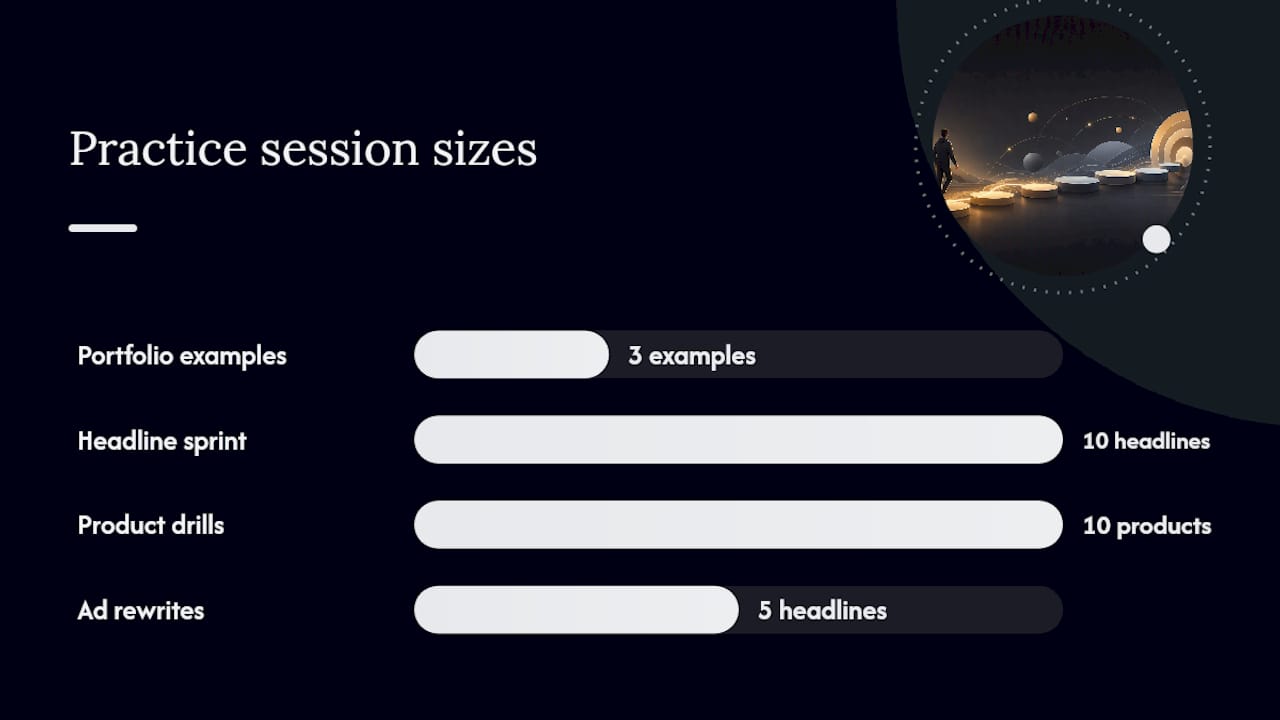
- Rewrite five ad headlines from a brand you admire. Then write five more for a brand you find boring. The boring ones teach you more.
- Take a product feature and rewrite it as a benefit in one sentence. Do this for 10 products in 15 minutes. Speed builds instinct.
- Run daily headline sprints: set a timer for 15 minutes and write 10 headlines for the same offer. Timed drills build the speed and instincts that separate beginners from dependable freelancers.
- Study swipe files. High-performing landing pages and proven headline formulas are the fastest shortcut to understanding what works and why.
Minimal portfolio template (3 case-style examples):
Each example needs three things: the problem, your copy solution (even if hypothetical), and the result or a plausible benchmark. You don’t need paid client work to start. Rewrite a real brand’s underperforming email, note what you changed and why, and that’s a portfolio piece.
Finding first clients:
- Warm outreach first. Tell five people in your network you’re writing copy and offer a free or discounted test project.
- Cold email with a value-first hook. Don’t pitch your services — pitch a specific observation about their copy and one concrete fix.
- Micro-offers work. A $50–$150 “email audit” or “headline rewrite” lowers the risk for a first-time client and gives you a paid sample to show.
- Platforms like Contra, Fiverr, and LinkedIn ProFinder are low-friction places to post a beginner offer.
Sample outreach snippet:
“Hi [Name], I noticed your welcome email doesn’t mention [specific benefit your product delivers]. I rewrote the first paragraph — happy to share it if you’d like a second opinion. No strings attached.”
On pricing: charge something, even on your first project. Free work attracts clients who don’t value the work. A small fee signals you’re a professional, not a hobbyist.
An annotated email template you can swipe and adapt
Here’s a short promotional email template with annotations explaining the conversion logic behind each line. Use it as your primary swipe file.
Subject line options (test these against each other):
- A: “You’re leaving [outcome] on the table” (curiosity + loss aversion)
- B: “[First name], here’s what changed for [similar customer type]” (personalization + social proof)
- C: “The [timeframe] fix for [specific problem]” (specificity + urgency)
Preheader: “Here’s exactly what to do next.” (Extends the subject line’s promise — never repeat the subject line verbatim.)
Body:
Paragraph 1 (Problem — PAS opener): “If your emails are getting opened but not clicked, the problem usually isn’t your design. It’s your first sentence.”
Paragraph 2 (Agitate + Solution — AIDA transition): “Most email copy tries to do too much. It promotes three products, mentions a sale, and asks readers to follow on Instagram — all in 200 words. The result? Readers do nothing. One email, one goal, one CTA changes that.”
Paragraph 3 (Benefit + Proof): “Brands that [specific outcome, e.g., ‘segment their list by purchase behavior’] consistently see higher click rates than those sending the same message to everyone. Relevance is the mechanism.”
CTA: “See how it works →” (Active verb, specific destination, no ambiguity.)
Testing checklist for this template:
- Week 1: Test subject line A vs. B (same body, different subject).
- Week 2: Test CTA wording (“See how it works” vs. “Get the breakdown”).
- Week 3: Test send day/time.
- Track open rate for subject line tests. Track CTR for CTA tests.
Pro Tip: Add the recipient’s first name to the subject line only when your list data is clean. A wrong name or a blank field (“Hi ,”) destroys trust faster than a generic subject line ever would.
Ecommerce email content that drives retention follows the same one-goal principle — one message, one audience segment, one action.
Common beginner mistakes and how to fix them fast
- Feature-first copy. Fix: rewrite every feature as an outcome. “12 templates” becomes “launch in 20 minutes.”
- Vague headlines. Fix: add a number, a name, or a specific result. “Better emails” becomes “Emails that get clicked.”
- Long paragraphs. Fix: break any paragraph over four lines into two. Readers scan before they read.
- Weak CTAs. Fix: replace “click here” with a verb that names the outcome. “Get the guide” beats “learn more” every time.
- Ignoring tests. Fix: run one A/B test per send. Even a small list teaches you something.
- Copying AI output without editing. Fix: AI is useful for breaking blank-page paralysis, but it lacks the emotional judgment to consistently convert. Always rewrite AI drafts in your own voice.
- Writing for everyone. Fix: name one specific reader at the top of your doc before you write a word.
- Skipping proofreading. Fix: step away, then read aloud. Errors you missed on screen become obvious when spoken.
- Burying the CTA. Fix: put your CTA above the fold on landing pages. Don’t make readers hunt for it.
- Treating copy as permanent. Fix: every piece of copy is a hypothesis. Publish, measure, revise.
What I’d do if I were starting copywriting today: a 30-day plan
Most beginners spend the first month reading. The ones who improve fastest spend it writing.
Week 1: Foundation Pick one medium — email, social captions, or ad copy. Not all three. Write something every day, even if it’s just three headline variations for a product you use. Study one piece of high-performing copy each morning and annotate why it works. Building a brand voice starts with understanding how other brands sound before you develop your own.
Week 2: Frameworks and feedback Apply AIDA to one full piece. Apply PAS to another. Share both with one person and ask a single question: “What would stop you from clicking?” Their answer is your next edit.
Week 3: Publish and measure Post or send something real. A social caption, an email to a small list, a landing page headline. Note the open rate, CTR, or engagement. You need a baseline before you can improve anything.
Week 4: Outreach and iteration Send five warm outreach messages. Offer a free headline rewrite or email audit. Take whatever feedback you get and apply it to your next draft. By day 30, you should have at least three published pieces, one piece of real feedback, and one paid or unpaid client conversation.
On balancing learning and billing: take paid work as soon as someone offers it, even if you feel unready. Paid work teaches you things no course will. Charge a small fee, deliver more than you promised, and ask for a testimonial.
The biggest mistake beginners make isn’t writing bad copy. It’s waiting until they feel ready to write any copy at all.
Useful resources and tools to study next
Blogs and references:
- Copyblogger’s Copywriting 101 — the clearest explanation of outcome-driven copy online. Start here.
- WordStream’s copywriting guide — strong on clarity principles and benefit-led writing.
- Erika Fitzgerald’s beginner foundations — practical swipe-file guidance and headline formula references.
- Crazy Egg’s copywriting breakdown — experience-backed perspective on headline skill and what actually moves results.
Tools:
- Hemingway Editor — paste your draft and it flags sentences that are too long or too passive. Free in the browser.
- Grammarly — catches grammar and spelling errors before they reach a client or a live audience.
- CoSchedule Headline Analyzer — scores your headlines and suggests improvements. Useful for daily headline drills.
- Klaviyo or Mailchimp — both have built-in A/B testing for email subject lines and CTAs. Start with whichever your client uses.
Swipe file starting point:
The annotated email template in the EEAT example section above is your first swipe file. Adapt the subject line options, rewrite the body for a real offer, and test it. That’s one complete learning cycle in under an hour.
For deeper content strategy and ecommerce content creation guidance, the Take-action blog covers email copy, retention, and channel-specific strategy in practical detail. If you’re writing for an ecommerce brand or want to specialize in email, it’s worth bookmarking.
Sources
- Ultimate guide to copywriting - Neil Patel
- Copywriting 101: The Beginner’s Guide to Writing Copy That Converts - WordStream
- Getting started with copywriting for conversions | KickoffLabs
- One
- Copywriting 101 - Copyblogger
- Everything I Know About Copywriting After Making $500K - Crazy Egg