

Content Syndication Best Practices That Actually Drive ROI
TL;DR:
- Most effective content syndication combines technical precision, partner quality, and buyer intent alignment to extend reach, protect SEO, and generate pipeline growth.
- Regular monitoring of canonical tags, attribution, and performance metrics is essential to avoid SEO pitfalls and ensure sustained success.
- Integrating syndication with ABM strategies enhances lead quality, enabling targeted, intent-driven campaigns that accelerate pipeline development.
Most marketers treat content syndication as a volume play: publish everywhere, hope for the best, and count the clicks. That approach explains why so many syndication programs deliver thin leads, eroded search rankings, and frustrated sales teams. The real opportunity in content syndication best practices lies at the intersection of technical precision, partner quality, and buyer intent alignment. Done right, syndication extends your content’s reach to audiences you’d never capture organically while keeping your SEO intact and your pipeline full. This guide breaks down exactly how to do that, from selecting the right assets to measuring downstream revenue impact.
Key Takeaways
| Point | Details |
|---|---|
| Choose assets strategically | Syndicate your top-performing organic pages, not your entire content catalog. |
| Negotiate technical terms upfront | Canonical tags and noindex policies must be agreed upon before a single piece goes live. |
| Delay syndication by days | Publish original content first and wait at least 24 to 72 hours before syndicating anywhere. |
| Measure beyond clicks | Track MQLs, pipeline influence, and account engagement to understand real syndication ROI. |
| ABM alignment multiplies results | Intent data combined with targeted syndication platforms dramatically improves lead quality. |
Content syndication best practices start with preparation
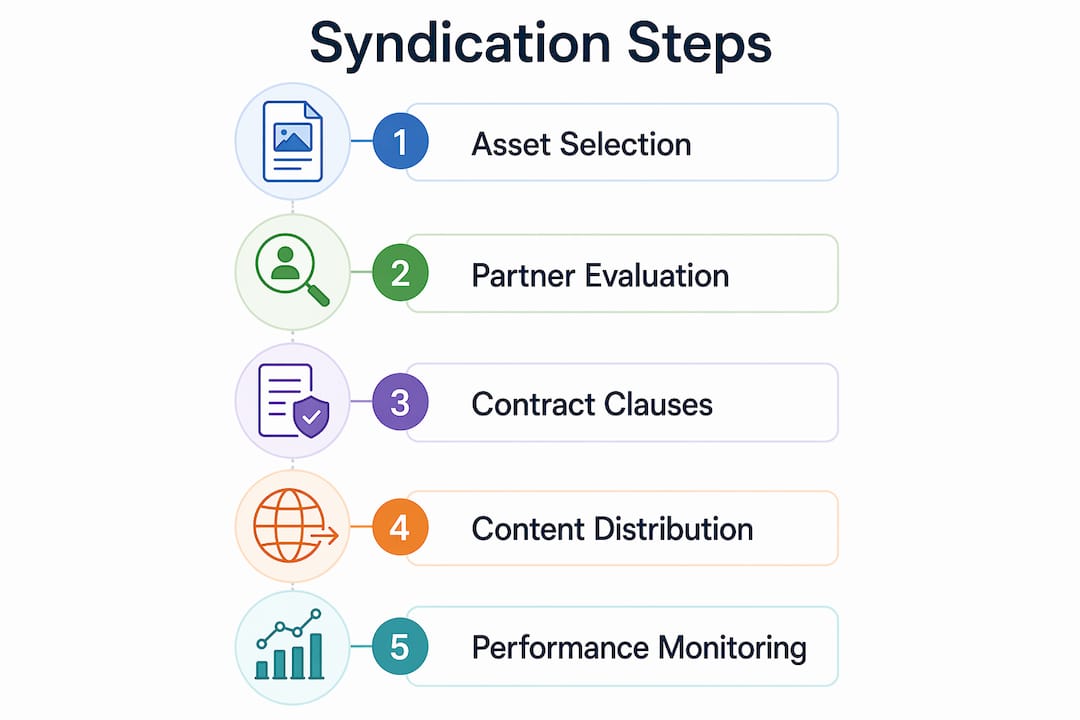
The single biggest reason syndication campaigns underperform is poor asset selection. Most teams grab whatever content they produced last month and push it out. A smarter approach starts by identifying which pieces already have proven traction. Top organic pages by session volume, backlink strength, and AI/LLM citation frequency are your best syndication candidates because they’ve already earned trust from search engines and readers alike.

Pull your data from Google Analytics 4 and Google Search Console. Sort pages by organic sessions and look for content sitting in positions 4 through 15 in search results. Those pieces have demonstrated relevance but haven’t maxed out their reach yet. They’re ideal for syndication because wider distribution can build topical authority without threatening your top-ranked pages. Also check whether any of your content is being cited in AI-generated answers. If it is, that’s a strong signal the piece carries enough credibility to perform in new contexts.
Evaluating potential syndication partners deserves just as much rigor as asset selection. Three things matter most: domain authority relative to your own, technical capabilities (specifically whether they can implement crawlable canonical tags), and audience fit. A site with a DA of 60 and a readership that overlaps with your buyer persona is worth far more than a DA 90 network that sends you unqualified traffic.
Pro Tip: Before signing any syndication agreement, ask for a sample of a syndicated post on the partner’s site and run it through Google Search Console’s URL Inspection tool to confirm their canonical implementation actually works the way they claim it does.
Syndication agreements should include specific contract clauses covering four things: canonical tag placement, noindex fallback options, attribution link policies, and editorial controls. This prevents partners from quietly updating their version of your content in ways that conflict with your brand or SEO strategy months down the line.
Execution tactics that protect SEO and generate leads
Getting the mechanics right is where most syndication programs either win or lose. The sequence matters enormously. Publish your original first and wait at least 24 to 72 hours before syndicating. For high-value pieces, a 7 to 14 day delay gives Google enough time to index and attribute your original correctly. Skipping this step is how partner sites end up outranking you on your own content.
Here’s the step-by-step execution framework that actually holds up at scale:
- Publish the original on your own domain and submit it to Google Search Console for immediate indexing.
- Wait for confirmed indexing before reaching out to any partner with the final content file.
- Require crawlable canonical tags in every partner’s CMS pointing back to your original URL. Canonical tags blocked by a partner’s robots.txt file are completely ineffective and create the same duplicate content risk as having no tag at all.
- Use noindex as a fallback when a partner’s technical setup cannot support canonical tags correctly. Noindex with follow prevents duplicate indexing while still allowing link equity to pass through attribution links in the body.
- Tag all attribution links with UTMs so you can track referral traffic, session quality, and conversion behavior separately for each partner.
- Align gated content placement with where your buyer sits in their journey. Top-of-funnel syndicated pieces should carry light-touch lead capture forms. Mid-funnel pieces warrant more qualification fields.
The choice between full republication and excerpt syndication is a strategic one, not a default. Full republication works well when your goal is brand exposure and the partner has a large, relevant audience. Excerpts with a “read the full piece” link drive more qualified traffic back to your site and work better when your goal is capturing intent.
Pro Tip: When handing syndication leads to sales, include the content title, the partner platform it came from, and the specific CTA the lead engaged with. This context dramatically shortens the sales cycle because reps can open with a relevant conversation instead of a cold qualification script.
The table below shows how to approach format selection based on your campaign objective:
| Campaign goal | Recommended format | Best for |
|---|---|---|
| Brand awareness | Full republication | Large-audience partner sites |
| Lead generation | Gated excerpt with form | Intent-matched platforms |
| Pipeline acceleration | Full piece with inline CTA | ABM-targeted networks |
| SEO authority building | Excerpt with backlink | High-DA editorial partners |
Verifying performance and fixing what breaks
Syndication is not a one-time setup. The verification phase is where most of the long-term value gets built or destroyed. Start with referral traffic and MQLs as your primary success indicators. Clicks alone tell you very little. What matters is whether the traffic converts into qualified pipeline activity.
Here’s what to track consistently:
- Referral sessions per partner: Are they growing, flat, or declining over time?
- Ranking stability for syndicated pages: Check your original pages weekly for position shifts. A sudden drop often signals a canonical problem on a partner’s site.
- MQLs sourced or assisted by syndication: Use multi-touch attribution in your CRM to see where syndicated content appears in the conversion path.
- Pipeline influence: Track how often syndicated-source leads move through deal stages, not just how many enter the funnel.
Auditing syndicated pages after launch using Google Search Console’s URL Inspection tool is non-negotiable. CMS updates, template changes, and plugin conflicts on a partner’s site can silently break a canonical tag weeks after it was confirmed working. A monthly audit cadence catches these issues before they damage your rankings.
The most common syndication mistakes share a pattern: assuming the technical setup will hold without monitoring. Partners add robots.txt rules that block crawlers. Someone on their team updates a page template and strips the canonical. A CMS migration swaps canonical paths. All of this happens without anyone notifying you.
“The biggest operational risk in content syndication is assuming SEO will sort itself out. Negotiating canonical and attribution policies upfront is non-negotiable, but so is auditing them continuously.” — Content Syndication: What It Is and How to Get Started
Pro Tip: Set a Google Search Console alert for any significant impressions drop on your top syndicated pages. A 20% week-over-week drop is a signal to immediately inspect partner canonicals, not wait for your next scheduled audit.
Advanced ABM integration for higher-quality leads
Once your foundational syndication program is running cleanly, the next level is aligning it with account-based marketing principles. This is where effective content distribution strategies stop looking like broadcasting and start looking like precision targeting.
ABM-aligned syndication works by building a clean target account list, layering intent data on top, and syndicating content specifically to the platforms and networks where those accounts are actively consuming information. Here’s the sequence that produces the best results:
- Build your target account list from CRM data, ideal customer profiles, and firmographic filters. Quality over volume applies here more than anywhere else in B2B marketing.
- Overlay intent data from tools that track which accounts are actively researching topics related to your product category. Intent-driven syndication dramatically outperforms spray-and-pray campaigns because you’re reaching buyers who are already in a consideration mindset.
- Select platforms that support audience targeting by company, industry, or job title. Not every content syndication platform offers this, so vet capabilities during partner evaluation.
- Gate content with minimal friction. A two-field form (name and work email) combined with progressive profiling on return visits outperforms a six-field gate every time. You want leads, not form abandonment.
- Match content to buyer stage. An early-stage account should receive an awareness-level guide. An account that’s been visiting your pricing page needs a comparison piece or a case study, not another introductory blog post.
- Test messaging and format combinations. Rotate subject matter, content type (article vs. report vs. checklist), and distribution timing every 60 to 90 days. Downstream funnel metrics like MQLs and pipeline movement tell you which combinations are actually working.
Pro Tip: Treat your target account list as a living document. Review it quarterly and remove accounts that have shown no intent signals after 90 days of syndication exposure. Keeping them in inflates your reach numbers while diluting actual results.
You can also explore repurposing high-performing content into formats that work specifically on the syndication platforms your target accounts frequent. A long-form guide that performs well on your site might convert better as a structured checklist on a syndication network.
My honest take on what makes syndication actually work
I’ve seen teams spend months building syndication partnerships, getting all the technical pieces right, and still end up disappointed. In almost every case, the reason wasn’t the SEO setup or the platform choice. It was the assumption that syndication is a distribution channel you configure once and forget.
What I’ve found is that the programs generating real pipeline treat syndication like a relationship, not a contract. The best partnerships I’ve observed involve monthly check-ins with the partner, shared performance data, and regular content refreshes. Partners are more likely to prioritize your content’s technical requirements when they see you’re genuinely invested in the relationship.
The other thing I’d push back on is the instinct to syndicate as many pieces as possible. Over-syndicating without quality controls creates SEO cannibalization risk and floods the funnel with low-intent leads that frustrate your sales team. Selective, high-quality distribution with rigorous canonical standards beats volume every time.
My final observation: most marketers focus entirely on traditional search when thinking about syndication and SEO. In 2026, you also need to think about AI visibility. Content cited in LLM-generated answers carries real distribution weight. When evaluating whether a piece is syndication-ready, check its AI citation profile alongside its organic traffic. The two signals together give you a much clearer picture of an asset’s authority.
— Take
Let Take-action help you scale your syndication program

Executing a syndication program that protects your SEO, generates quality leads, and integrates with your ABM strategy requires more than a checklist. It requires ongoing monitoring, partner management, and funnel alignment that most marketing teams simply don’t have the bandwidth to maintain alone. Take-action works with brands to build multi-channel distribution strategies grounded in data, technical precision, and measurable outcomes. Whether you need help auditing your current syndication setup, vetting new partners, or connecting syndication performance to email marketing and retention workflows that convert those leads downstream, the team at Take-action is built for exactly this kind of execution. Reach out to discuss a plan tailored to your content assets and growth goals.
FAQ
What is content syndication?
Content syndication is the practice of republishing your original content on third-party platforms to reach broader audiences. It differs from guest posting because the content already exists on your site before it’s distributed elsewhere.
Does content syndication hurt SEO?
It does not hurt SEO when partners implement crawlable canonical tags pointing to your original URL or use noindex tags correctly. The risk comes from poor technical implementation or syndicating before your original is indexed.
How long should you wait before syndicating content?
Wait at least 24 to 72 hours after publishing your original before syndicating it. For high-value pieces, a 7 to 14 day delay gives Google enough time to confirm your site as the authoritative source.
What metrics actually measure syndication success?
Beyond referral clicks, the most meaningful metrics are MQLs generated or assisted, pipeline influence across deal stages, and ranking stability for your original syndicated pages.
How does ABM improve content syndication results?
ABM improves syndication by using intent data to target accounts actively researching relevant topics, selecting platforms that reach those specific accounts, and aligning content to buyer stage. This combination improves both lead quality and pipeline conversion rates.