

Content Marketing Best Practices for 2026 Success
TL;DR:
- In 2026, successful content marketing focuses on audience engagement, AI-compatible structure, and measurable contribution to revenue. Effective strategies start with clear buyer journey mapping, content audits, pillar-cluster architecture, and attribution infrastructure. Prioritizing quality, modular content, multi-channel distribution, and patience enables brands to build authority and justify ROI over time.
Content marketing best practices are proven strategies that attract the right audience, build brand authority, and convert attention into measurable business results. The discipline has matured well beyond publishing blog posts and hoping for traffic. In 2026, the most effective content strategies are built around audience engagement, AI-driven relevance, and measurement frameworks tied directly to revenue. Frameworks like the CRISP model from the Content Marketing Institute, tools like Ahrefs and Semrush for keyword research, and platforms like Google Analytics 4 for attribution have redefined what “good” looks like. Marketers who still chase page views over pipeline contribution are leaving serious budget justification on the table.
What are the foundational content marketing best practices every marketer should follow?
Every effective content program starts with strategic clarity, not a content calendar. Before you write a single word, you need to know who you are writing for, what stage of the buyer’s journey they occupy, and what action you want them to take next. Audience personas built from real CRM data and customer interviews outperform demographic assumptions every time.

A content audit is the second non-negotiable. Most brands have hundreds of published pieces, many of which are outdated, duplicative, or misaligned with current business goals. Auditing existing content against buyer’s journey stages (awareness, consideration, conversion) reveals gaps and quick wins before you invest in net-new production. Tools like Ahrefs and Semrush make this process systematic rather than guesswork.
Pillar-cluster architecture is the structural backbone of any authority-building content program. Pillar pages should run 3,000 to 8,000 words and cover a topic comprehensively, while cluster articles address specific subtopics and link back to the pillar. This structure signals topical depth to both search engines and AI systems that increasingly surface content based on authority signals rather than keyword density alone.
The most common content creation mistakes include:
- Publishing without purpose. Every piece needs a defined goal, a target persona, and a specific journey stage. Content that exists to fill a calendar slot rarely builds authority.
- Ignoring internal linking. Sustained, purposeful content with strategic linking compounds over time to build domain authority and guide readers deeper into your content ecosystem.
- Judging performance too early. Content authority builds over months, not weeks. Pulling the plug on a piece after 30 days is one of the most expensive mistakes a content team can make.
- Prioritizing volume over quality. Publishing three well-researched, deeply useful articles per month consistently outperforms publishing fifteen thin pieces.
Pro Tip: Build modular content objects from the start. A single research-backed article can become a LinkedIn carousel, an email sequence, a short-form video script, and a podcast talking point. Modular thinking multiplies output without multiplying effort.
How has AI changed content marketing best practices and measurement in 2026?
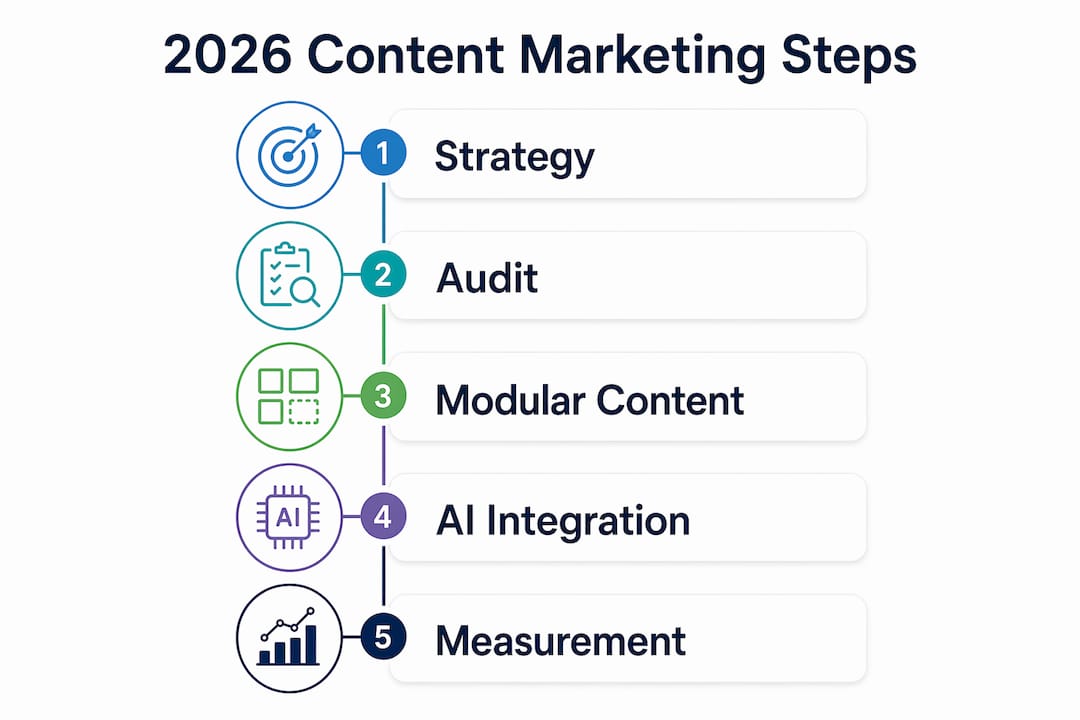
AI has not just changed content distribution. It has changed what content needs to be. The shift is from volume to gravity, from traffic to audience relevance, and from rankings to retrievability. Brands must shift from volume to gravity and build presence in the channels where buyers actually engage, including forums, LinkedIn communities, Reddit threads, and newsletters.
The CRISP framework, developed to guide AI-readiness in content operations, defines five properties every piece of content should have:
- Conversational. Content should answer questions the way a knowledgeable human would, not the way a keyword-stuffed article does.
- Retrievable. Structure matters. Clear headings, direct answers near the top of sections, and factual statements anchored to sources all increase the probability that AI engines surface your content.
- Interoperable. Content should work across formats and platforms without requiring a full rewrite for each channel.
- Structured. Modular, version-controlled content objects reduce inconsistencies and make content easier for AI systems to parse and reuse.
- Personalized. Generic content loses to content that speaks directly to a specific audience segment’s situation and goals.
“AI citation probability increases when content answers are framed as clear questions with direct, sourced answers early in sections.” — Content Marketing Strategy Guide 2026
HubSpot’s rebuilt content strategy offers the clearest proof point available. By focusing on audience relevance and multi-channel presence, including Reddit and LinkedIn, HubSpot tripled conversion rates from AI-driven traffic. The lesson is not to abandon SEO. It is to treat AI visibility as a parallel distribution channel that rewards specificity and authority.
Pro Tip: Audit your top 20 highest-value content pages against the CRISP framework before your next content sprint. Fix structure, add direct answers to section headings, and verify that factual claims are sourced. This single exercise can meaningfully improve AI citation rates within 60 days.
Which content marketing performance metrics matter most for demonstrating ROI in 2026?
The most important shift in content measurement is moving from reporting what happened to proving what it caused. Measurement should focus on revenue quality, customer lifetime value, and pipeline contribution, not raw traffic or follower counts. Executives do not fund content programs because they generate impressions. They fund them because they generate pipeline.
The five-stage measurement framework maps content performance to the full customer journey:
| Journey stage | What to measure | Example metric |
|---|---|---|
| See | Brand reach and awareness | Branded search volume, share of voice |
| Connect | Audience engagement | Email subscribers, repeat site visits, time on page |
| Trust | Authority and credibility | Backlinks earned, AI citations, community mentions |
| Choose | Pipeline contribution | Content-influenced leads, demo requests from content |
| Champion | Retention and advocacy | Repeat purchase rate, referral traffic from customers |
Tracking content-influenced pipeline, customer lifetime value, and repeat purchase rates is what justifies budget and earns a seat at the revenue table. Vanity metrics like total page views or social impressions are not useless, but they are insufficient. They describe activity, not impact.
Operational efficiency is a measurement dimension most marketing teams overlook entirely. Leadership values how hard content assets work relative to their cost, including content reuse rates, support ticket deflection driven by educational content, and time saved through modular content systems. A single well-structured FAQ article that reduces support volume by 15% is a measurable business asset, not just a content piece.
The attribution infrastructure problem is the real bottleneck. Without connecting content touches to qualified leads and conversions, programs risk budget cuts regardless of content quality. GA4, combined with CRM integration in tools like HubSpot or Salesforce, gives marketing teams the cross-functional data they need to make attribution arguments that hold up in a CFO conversation.
How can marketers implement effective content strategies that drive engagement and retention?
Effective content marketing techniques start with mapping content to specific buyer personas and lifecycle stages. A first-time visitor discovering your brand through a Reddit thread needs different content than a customer who has purchased twice and is evaluating an upsell. Treating both audiences identically is one of the fastest ways to lose them.
Multi-platform distribution is not optional in 2026. Owned channels (your blog, email list, and website) provide control and compounding returns. Earned channels (press mentions, backlinks, community shares) build credibility. Social channels (LinkedIn, Instagram, YouTube Shorts) extend reach to audiences who will never find you through search. The most effective content programs treat these as an interconnected system, not separate silos.
Content repurposing is the highest-leverage tactic most teams underuse. A single original research piece can fuel a multi-channel content strategy for weeks. The key is planning repurposing before you create the original asset, not as an afterthought. Build the research article knowing it will become an email sequence, a LinkedIn post series, and a short-form video.
Here are the top content marketing tips for sustained engagement:
- Use Ahrefs or Semrush for keyword gap analysis to find topics your audience searches for that your competitors have not covered well.
- Build content pillars around your three to five core business themes, then create cluster content that answers every meaningful question within each theme.
- Run quarterly content audits using GA4 data to identify pieces that need updating, consolidating, or retiring.
- Prioritize email as a retention channel. Organic reach on social platforms declines every year. Your email list is the only audience you own outright. Pairing strong ecommerce content with email retention creates a compounding engagement loop that social algorithms cannot disrupt.
Pro Tip: Micro-content accelerates reach without requiring new research. Take one strong data point from a long-form article and build a standalone LinkedIn post, an Instagram graphic, and a 60-second video around it. Each piece drives traffic back to the original, multiplying its reach without multiplying your workload.
Key takeaways
Effective content marketing in 2026 requires aligning every piece of content to a specific audience stage, measuring its contribution to pipeline rather than traffic, and structuring it for AI retrievability using frameworks like CRISP.
| Point | Details |
|---|---|
| Start with strategy, not output | Audit existing content and map gaps to buyer journey stages before creating anything new. |
| Structure content for AI retrieval | Apply the CRISP framework so content is conversational, modular, and directly answers questions early in each section. |
| Measure pipeline, not page views | Track content-influenced leads, customer lifetime value, and repeat purchase rates to justify budget. |
| Build pillar-cluster architecture | Comprehensive pillar pages supported by cluster articles signal topical authority to both search engines and AI systems. |
| Own your audience through email | Email remains the highest-retention distribution channel because it is immune to algorithm changes and platform volatility. |
Why most content programs stall before they compound
After working with ecommerce brands across multiple growth stages, the pattern is consistent. Teams invest in content, see modest early results, and then pull back before the compounding effect kicks in. The problem is almost never content quality. It is measurement infrastructure and patience.
The brands that win at content marketing are the ones that connect their content program to revenue data from day one. They use GA4 alongside their CRM to track which blog posts influenced a purchase decision, which email sequences drove repeat orders, and which educational content pieces reduced churn. Without that infrastructure, every content review becomes a debate about traffic numbers that no executive actually cares about.
The CRISP framework changed how I think about content creation. It reframes the question from “what should we publish?” to “how will this content be found, parsed, and cited by AI systems?” That shift in framing produces better briefs, better structure, and better outcomes. It also forces collaboration between marketing, IT, and sales, which is where the real attribution breakthroughs happen.
The uncomfortable truth is that most content programs are underfunded and over-pressured for short-term results. Quality content that builds genuine authority takes six to twelve months to compound. The brands willing to invest in content ROI with a 12-month horizon consistently outperform those chasing monthly traffic spikes. Patience is a content marketing strategy.
— Take
How Take-action helps brands turn content into retention
Content strategy only delivers results when it connects to a retention system that keeps customers coming back. Take-action is a specialized email marketing and retention agency that helps ecommerce brands build exactly that connection. From Klaviyo automation flows to segmented campaign strategy, Take-action turns content-driven traffic into repeat revenue. If your content program is generating awareness but not retention, the gap is usually in how you follow up. Explore how Take-action builds email-driven retention systems that compound alongside your content investment and convert engaged readers into long-term customers.
FAQ
What are content marketing best practices in 2026?
Content marketing best practices in 2026 center on audience-specific content mapped to buyer journey stages, pillar-cluster site architecture, AI-ready content structure using the CRISP framework, and measurement tied to pipeline contribution rather than traffic volume.
How do you measure content marketing ROI effectively?
Measure content ROI by tracking content-influenced pipeline, customer lifetime value, and repeat purchase rates across the five journey stages: see, connect, trust, choose, and champion. Vanity metrics like impressions describe activity but do not prove business impact.
How has AI changed content marketing strategy?
AI search systems favor content that is structured, specific, and directly answers questions near the top of each section. Brands like HubSpot have tripled conversion rates from AI-driven traffic by prioritizing audience relevance and multi-channel presence over raw publishing volume.
What is the CRISP framework for content marketing?
CRISP stands for Conversational, Retrievable, Interoperable, Structured, and Personalized. It is a framework developed to make content readable by both human audiences and AI retrieval systems, requiring modular, version-controlled content objects optimized for multi-channel use.
Why do content marketing programs fail to prove ROI?
The most common reason is inadequate attribution infrastructure, not poor content quality. Without connecting content interactions to qualified leads and conversions inside a CRM or analytics platform like GA4, content teams cannot make the revenue argument needed to protect and grow their budgets.
Recommended
- Content Marketing Campaign: Your 2026 Strategy Guide | Take Action Blog | Take Action
- What Is the Content Marketing Strategy in 2026 | Take Action Blog | Take Action
- Content Marketing Strategy Examples That Actually Drive Growth | Take Action Blog | Take Action
- Best SEO Digital Marketing Strategies for 2026 | Take Action Blog | Take Action