

Content for Ecommerce Websites: Your 2026 Strategy Guide
TL;DR:
- Effective ecommerce content connects product descriptions, category pages, and guides into a unified system targeted at buyer intent. Product pages with original, benefit-focused copy and multimedia elements increase conversions and engagement. Regularly updating and linking content based on intent and revenue potential improves search rankings and sales outcomes.
Content for ecommerce websites is a structured system of product descriptions, category copy, buying guides, blogs, and multimedia assets designed to meet specific buyer intents and drive sales. Most ecommerce marketers treat these as separate tasks. The ones who win treat them as one interconnected machine. 87% of online shoppers rate product descriptions as extremely or very important when finalizing a purchase. That single number explains why content quality is a revenue lever, not a marketing nicety. This guide gives you a practical framework to build that system from the ground up.
What types of content should your ecommerce website include?
Ecommerce website content falls into three intent categories: informational, commercial, and transactional. Each type serves a different buyer at a different stage, and skipping any one of them leaves money on the table.
| Content Type | Buyer Intent | Primary Goal |
|---|---|---|
| Blog posts and guides | Informational | Build awareness and organic traffic |
| Category pages | Commercial | Help buyers compare and filter |
| Buying guides | Commercial | Educate and pre-sell |
| Product pages | Transactional | Convert browsers to buyers |
| FAQs and reviews | Mixed | Build trust and reduce objections |
| Videos and infographics | Mixed | Increase engagement and time on page |
Product pages are your closers. They need original, benefit-focused copy because relying on manufacturer copy creates duplicate content that Google penalizes and shoppers ignore. Category pages are your navigational hubs. They organize your catalog and signal topical authority to search engines. Buying guides sit in the middle of the funnel, educating buyers who are close to a decision but not quite there yet.
Multimedia is not optional. Pages with video content see up to 80% more time on page than text-only pages. More time on page means lower bounce rates and higher conversion probability. User-generated content, including reviews and customer photos, adds social proof that no brand copy can replicate. Linking to your user-generated content strategy is one of the fastest ways to add credibility without writing a single word yourself.

Pro Tip: Add at least one short video and three to five customer reviews to every top-selling product page before touching anything else. The lift in engagement is immediate and measurable.
How to build a structured ecommerce content strategy
A content strategy for an ecommerce site is not a content calendar. It is a map that connects every piece of content to a buyer intent and a revenue outcome. The framework that works best is the semantic cocoon architecture: grouping content clusters so that blog posts, category pages, and product pages link to each other in a deliberate hierarchy.
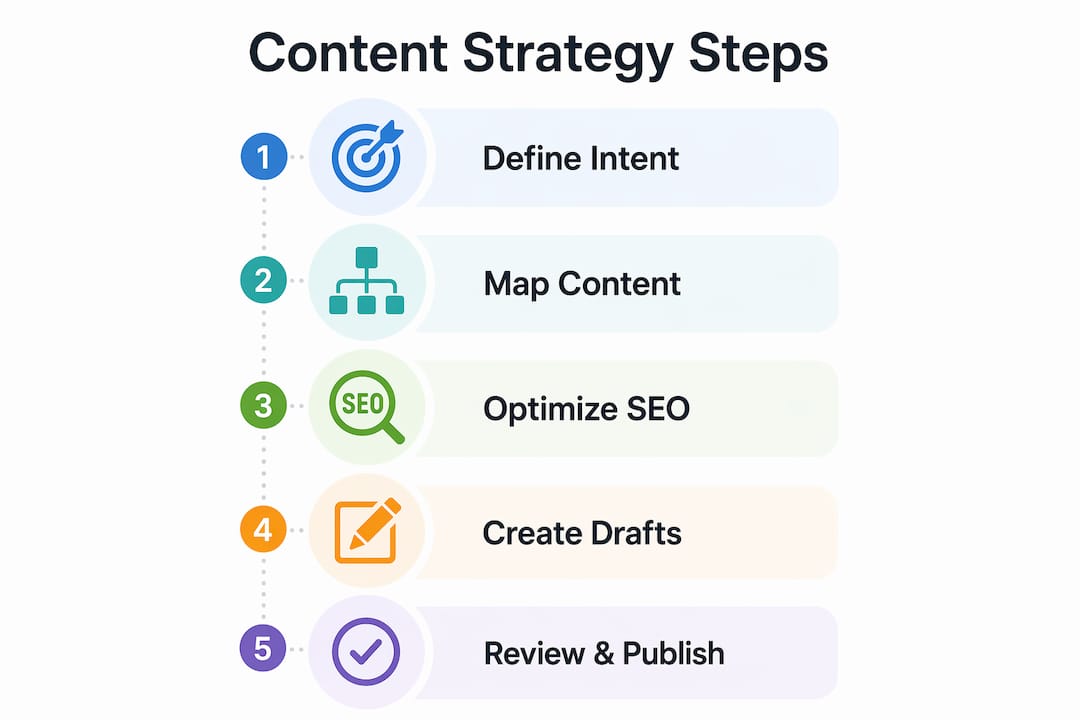
Failing to address full purchase intent misses about 85% of potential organic traffic. That means most ecommerce sites are only capturing a fraction of the buyers searching for what they sell. The fix is intent mapping: assigning every page a primary intent before you write a single word.
Here is a five-step process to build your strategy:
- Audit existing content. Identify which pages target informational, commercial, or transactional intent. Flag gaps and overlaps.
- Map keywords to intent. Use keyword research to assign each target term to the right content type. Avoid putting the same keyword on a blog post and a product page.
- Build content clusters. Group a pillar page (usually a buying guide or category page) with three to six supporting blog posts. Link them all to each other and to relevant product pages.
- Set up internal linking. Every blog post should link to at least one category page and one product page. Every category page should link to its top buying guide. This is how you build topical authority that Google rewards.
- Measure by revenue, not traffic. Track which content clusters drive the most assisted conversions and revenue per session, then double down on those formats.
Pro Tip: Use Google Search Console to find pages ranking in positions 4–15 for commercial keywords. Those pages need better internal links and a content refresh, not new pages competing against them.
Effective product description writing for ecommerce success
20% of ecommerce task failures on product pages come from incomplete or confusing product descriptions. That is one in five potential sales lost before the buyer even reaches the cart. The fix is a repeatable writing process, not longer copy.
Effective product descriptions run 50–300 words and act as condensed sales arguments. The goal is not to list specs. The goal is to answer the buyer’s unspoken question: “Why does this product make my life better?” A structured nine-section copy architecture covers the hook, key benefits, social proof, objection handling, and a clear call to action. This mirrors the psychological buyer journey and works like a 24/7 salesperson on every page.
Common mistakes that kill conversions:
- Copying manufacturer specs verbatim. Shoppers can find specs anywhere. They buy benefits.
- Writing for search engines first. Keyword stuffing reads as unnatural and destroys trust.
- Ignoring formatting. Dense paragraphs lose mobile shoppers in the first three seconds.
- Skipping social proof. Social proof influences 87% of purchase decisions and belongs on every product page.
- Weak calls to action. “Add to cart” is fine. “Get yours before stock runs out” is better.
A well-written product description takes 15–20 minutes to draft when you follow a structured process. That is a manageable investment per SKU, and it pays back every time someone lands on that page. For deeper guidance on optimizing product pages for both SEO and conversion, the technical and copy elements work together, not separately.
Pro Tip: Use AI to generate a first draft from a structured brief, then have a human editor rewrite it in your brand voice. You get scale without losing the personality that makes your brand memorable.
How to create category pages and buying guides that convert
Category pages are the most underused content asset in ecommerce. Most brands treat them as filtered product grids with no copy. That is a missed opportunity. Adding 200–400 words of keyword-rich, helpful content to category pages improves rankings and user engagement. In one documented case, nine of twelve category pages improved their ranking within six weeks after adding this content.
The copy on a category page should do three things: explain what the category covers, help the buyer understand how to choose, and link to the most relevant buying guides and products. Place the intro copy above the product grid for maximum SEO impact, and add a short FAQ below the grid to capture long-tail queries.
Buying guides are the highest-value content investment you can make. Buying guides generate 2–5 times more revenue per organic visit compared to standard blog posts. That gap exists because buying guides attract buyers in the commercial investigation phase, people who have already decided to buy and are choosing where and what.
| Content Type | Ideal Length | Key Format Elements | SEO Impact |
|---|---|---|---|
| Category page | 200–400 words | Intro copy, FAQ, internal links | High for commercial keywords |
| Buying guide | 1,500–2,500 words | Headers, comparison tables, videos | Very high for commercial intent |
| Blog post | 800–1,500 words | Subheadings, images, product links | Moderate for informational keywords |
Structured comparison tables answer key commercial queries and perform strongly in AI-generated search overviews. Adding short FAQs and videos to product and category pages also increases time on page and gives Google more signals to evaluate content quality. Use buyer intent signals to decide which categories and guides to prioritize first.
Pro Tip: Review your category page rankings every 90 days. If a page has dropped, the first fix is usually adding fresh copy and updating internal links, not rebuilding the page from scratch.
Key Takeaways
Ecommerce content works when every page type serves a specific buyer intent, connects to related pages through deliberate internal linking, and uses original copy backed by multimedia and social proof.
| Point | Details |
|---|---|
| Content is a system, not a checklist | Product pages, category pages, blogs, and guides must link to each other to build authority. |
| Intent mapping prevents wasted effort | Assign every page a primary intent before writing to avoid keyword cannibalization. |
| Product descriptions drive or kill sales | Original, benefit-focused copy with social proof reduces the 20% task failure rate on product pages. |
| Buying guides outperform blog posts | Buying guides generate 2–5 times more revenue per organic visit than generic informational posts. |
| Category page copy is a quick win | Adding 200–400 words of helpful copy to category pages improves rankings within weeks. |
What I’ve learned building ecommerce content systems
Most ecommerce brands I work with have the same problem. They have a lot of content and very little of it works together. A blog post about “how to choose a running shoe” has no link to the running shoe category page. The category page has no intro copy. The product pages use manufacturer descriptions word for word. Every piece exists in isolation, and the result is a site that Google cannot understand and buyers cannot navigate.
The shift that changes everything is treating content as a unified system. When a blog post links to a category page, which links to a buying guide, which links to three product pages, you create a path that mirrors how real buyers think. They start with a question, narrow to a category, compare options, and then buy. Your content should walk them through that path, not make them figure it out alone.
The other thing I push hard on is prioritizing by revenue potential, not keyword volume. A buying guide targeting “best standing desks under $500” will almost always outperform a blog post targeting “standing desk benefits” in terms of actual revenue generated. High intent beats high volume every time. Pair that with a disciplined refresh schedule, updating your top commercial pages every 90 days, and you build a content asset that compounds in value over time.
— Take
How Take-action helps ecommerce brands turn content into revenue
Building a content system that actually converts takes more than good writing. It takes a clear strategy, consistent execution, and the ability to connect on-site content to off-site retention channels like email.
Take-action works with ecommerce brands to align content strategy with email marketing and retention. From ecommerce email content that keeps buyers coming back to full campaign strategy built on Klaviyo automation, the agency connects every content touchpoint to measurable revenue. If your product pages, category content, and email flows are not working as one system, Take-action can help you build one that does.
FAQ
What is the most important content type for ecommerce sites?
Product pages are the most critical content type because they directly drive purchase decisions. 87% of shoppers rate product descriptions as extremely or very important when finalizing a purchase.
How long should ecommerce product descriptions be?
Effective product descriptions run 50–300 words and focus on benefits over specs. Formatting with short paragraphs and bullet points improves scannability on mobile devices.
What is semantic cocoon architecture in ecommerce SEO?
Semantic cocoon architecture groups related content into clusters where blog posts, category pages, and product pages link to each other by intent. This structure builds topical authority and helps search engines understand your site’s relevance.
How often should I update category pages and buying guides?
Review and refresh category pages and buying guides every 90 days. Check rankings, update internal links, and add new product mentions or data to maintain search visibility.
Do buying guides really outperform blog posts for revenue?
Yes. Buying guides generate 2–5 times more revenue per organic visit than standard blog posts because they attract buyers in the commercial investigation phase who are ready to purchase.