

Branding in Commerce: The Ecommerce Growth Edge
TL;DR:
- Branding in ecommerce is the overall impression customers form after every interaction, beyond logos or colors. Strong omnichannel consistency and strategic alignment significantly improve customer retention, loyalty, and lifetime value. Success depends on organizational discipline, shared data, and authentic brand coherence across all touchpoints.
Branding in commerce is not your logo, your color palette, or your tagline. It’s the cumulative impression customers carry about your business after every interaction, and in ecommerce, those interactions happen fast, across multiple channels, and without the benefit of a salesperson to smooth things over. Most ecommerce brands underinvest in brand strategy while overspending on paid acquisition, which creates a leaky bucket problem. This article breaks down what serious branding actually looks like for ecommerce professionals, covering strategy, omnichannel consistency, practical techniques, measurement, and where things are heading.
Table of Contents
- Key takeaways
- Branding in commerce: what it actually means strategically
- Omnichannel consistency and its real impact on customers
- Practical branding techniques for ecommerce professionals
- Measuring branding impact in ecommerce
- Future trends in commerce branding
- What I’ve learned about branding that most articles won’t tell you
- Ready to turn your brand strategy into measurable retention?
- FAQ
Key takeaways
| Point | Details |
|---|---|
| Brand strategy comes first | Strategy defines your positioning and audience before identity or messaging can work effectively. |
| Omnichannel consistency drives retention | Companies with strong omnichannel engagement retain 89% of customers versus 33% for weaker programs. |
| Small moves compound loyalty | Personalized packaging, consistent voice, and timely communication build brand equity over time. |
| Measure retention, not just awareness | Customer lifetime value and repeat purchase rates reveal true brand health better than impressions. |
| Org structure beats technology | Most omnichannel branding failures are governance and ownership problems, not software problems. |
Branding in commerce: what it actually means strategically
Most ecommerce teams conflate three distinct things: brand strategy, brand identity, and brand guidelines. Mixing them up is where the waste begins.
Brand strategy defines your differentiation, positioning, audience, and personality. It answers the question of why someone should choose you over every available alternative. Brand identity executes that strategy visually and verbally, your logo, typography, color usage, and tone of voice. Brand guidelines document both so every team and vendor applies them consistently. These are not the same thing, and you cannot build the second without the first.
For ecommerce specifically, this distinction matters because you operate across more touchpoints than most businesses. A customer might discover you through a social ad, visit your product page, read your emails, check your reviews on a third-party site, and then unbox your package. Each of those moments is a branding moment, and without a defined strategy upstream, each one gets handled by whoever owns that channel, in whatever way feels right to them that week.
The framework worth understanding here is Keller’s Customer-Based Brand Equity model. According to it, brand resonance builds from consistent voice, message, and experience across channels, ultimately integrating the brand into the customer’s identity. That’s the goal: not awareness, but resonance. Loyalty so deep that your brand becomes part of how customers think about themselves.
- Positioning statement: Define the one thing you want to own in the customer’s mind, and make it defensible in your category.
- Audience specificity: Resist the temptation to target broadly. The more precisely you understand your buyer, the sharper every brand decision becomes.
- Personality and tone: Document not just what you say but how you say it, and what you never say. Consistency in voice builds recognition faster than any visual element.
- Touchpoint mapping: Identify every moment a customer interacts with your brand and assign ownership for brand consistency at each one.
Pro Tip: Write your positioning statement as a constraint, not an inspiration. It should rule things out. If your positioning statement is compatible with every possible decision, it’s not strategic.
Omnichannel consistency and its real impact on customers
There’s an important distinction between multichannel and omnichannel that gets glossed over constantly. Multichannel means you’re present in multiple places. Omnichannel means those places behave as one coherent brand experience. The difference in business outcome is significant.

Companies with strong omnichannel engagement retain 89% of customers compared to just 33% for brands with weaker strategies. That gap is not a marketing metric. It’s a revenue and survival metric. Multi-channel customers also spend 38.4% more per transaction, and omnichannel loyalty programs lift customer lifetime value by 3.5x in ecommerce. These numbers explain why omnichannel branding deserves serious operational investment, not just a style guide.
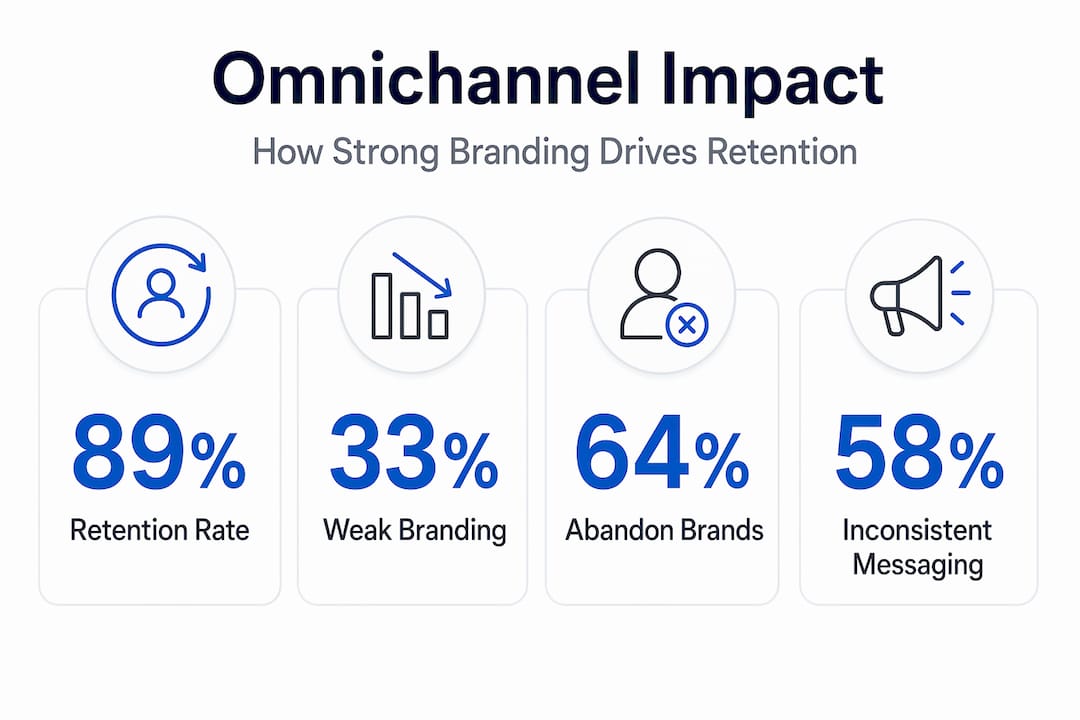
The challenge is that 64% of customers abandon brands due to inconsistent messaging, and 58% of mid-market brands currently operate with customer data silos that prevent unified experiences. Customers today conduct what researchers call real-time trust audits: they’re checking your website on their phones while standing in a store, comparing your stated price against your online price, reading your reviews while your ad runs above them. Mismatched experiences across digital and physical channels increase perceived risk and erode trust faster than almost any other brand failure.
| Channel comparison | Multichannel approach | Omnichannel approach |
|---|---|---|
| Customer data | Siloed by platform | Unified customer record |
| Brand messaging | Varies by channel team | Consistent across all touchpoints |
| Retention outcome | 33% average retention | 89% retention for strong programs |
| Revenue per customer | Standard transaction value | 38.4% higher per transaction |
| Loyalty program impact | Incremental lift | 3.5x CLV improvement |
Pro Tip: Before investing in a new commerce channel, audit whether your current channels share a unified customer record. Adding channels without shared data makes the consistency problem worse, not better.
Practical branding techniques for ecommerce professionals
Knowing the theory is one thing. Executing it in an operation with SKUs to manage, ad spend to justify, and customer service queues to clear is another. Here’s where effective branding methods translate into day-to-day practice.
Brand equity builds from layered positioning, consistent identity, and customer experience. The last layer, customer experience, is where most ecommerce brands have the most leverage and spend the least time. Small, consistent operational moves compound over time: personalized packaging, a distinct and recognizable email voice, response speed on social, and post-purchase communication that feels like a relationship rather than a transaction.
The practical moves that actually move the needle are often unglamorous:
- Packaging as a brand moment: The unboxing experience is one of the few purely physical touchpoints in ecommerce. Brands that treat it as a branding opportunity, through a consistent aesthetic, a handwritten note, or a branded insert, create a disproportionate share of organic social sharing and word-of-mouth.
- Verbal identity in customer service: Your support team’s tone is your brand’s tone under pressure. If your brand voice is warm and witty in marketing emails but robotic and formulaic in support tickets, customers notice the gap. Train for voice consistency, not just issue resolution.
- Storytelling in product descriptions: Generic copy describes features. Brand-led copy describes the world your customer enters when they own this product. That’s a positioning move, not a copywriting upgrade.
- Personalized communication: Customers who receive personalized email strategies based on their behavior and history experience a brand that feels like it knows them, which is a direct driver of loyalty and repeat purchase.
One important timing decision: know when to invest heavily in brand assets versus operational improvements. Early-stage brands that spend heavily on brand photography and creative production before nailing their positioning statement and customer experience are misallocating resources. Get the strategy right first, then build the expression of it.
Measuring branding impact in ecommerce
Most brand measurement frameworks were built for mass market consumer goods, not ecommerce. They track awareness, recall, and sentiment. Those are presence metrics. What ecommerce professionals need are performance metrics tied to commercial outcomes.
Measuring omnichannel success requires focusing on retention and lifetime value rather than engagement activity alone, because activity metrics can be misleading. High open rates and follower counts don’t pay for inventory. Repeat purchase rate, customer retention rate, and shift from single-channel to multi-channel engagement are the metrics that reveal whether your brand is actually building something durable.
| Metric type | Presence metrics | Performance metrics |
|---|---|---|
| What it measures | Brand visibility | Commercial outcomes |
| Examples | Impressions, followers, awareness | Retention rate, CLV, repeat purchase rate |
| Risk | Can look good while revenue stagnates | Requires cross-functional data access |
| Recommended use | Benchmarking and tracking | Evaluating brand program effectiveness |
A connected data infrastructure matters here. If your email platform, your storefront, and your customer service tool don’t share a unified customer view, you’ll measure each channel in isolation and mistake channel performance for brand health. Building ecommerce brand awareness is only meaningful if you can trace that awareness through to conversion and retention.
The practical approach is to identify your existing retention rate and repeat purchase rate as baseline numbers, then track how they move as you implement brand strategy changes. That correlation won’t be perfect, but it will be directional and real.
Future trends in commerce branding
Several converging forces are reshaping how branding operates inside ecommerce over the next few years.
- Retail media complexity: Selling on third-party marketplaces means operating inside someone else’s brand experience. Your product listing competes with sponsored placements and platform-native recommendations that dilute your brand’s distinctiveness. Brands need a direct channel strategy to maintain relationship ownership with customers.
- AI as an execution tool: Generative AI is changing the speed at which brand content gets produced, but it does not replace brand strategy. Organizational alignment and governance over technology is still the determining factor in whether AI-assisted content actually reinforces or dilutes brand coherence.
- Real-time trust audits intensifying: As smartphones become more capable and consumers more skeptical, the gap between what a brand claims and what it delivers closes faster. Brand coherence at the moments between channels (the ad to the landing page, the email to the checkout, the checkout to the delivery) is where trust is built or lost.
- Governance over tools: Most omnichannel failures stem from data ownership and accountability gaps, not from lacking the right software. The brands that will lead in the next few years are the ones that solve the organizational problem first.
What I’ve learned about branding that most articles won’t tell you
I’ve worked with enough ecommerce brands to see a pattern that repeats constantly. They invest in a rebrand, launch a beautiful new visual identity, and then wonder why customer behavior doesn’t change. The answer is almost always that the rebrand addressed expression without addressing strategy. You can redesign a logo and leave the underlying positioning completely untouched.
The brands I’ve seen actually transform their customer relationships share one trait: they treat consistency as a discipline, not a design project. That means the warehouse team understands the brand promise. The customer service rep knows what tone to use when a customer is frustrated. The post-purchase email sequence reflects the same personality as the paid ad that brought the customer in. That kind of consistency doesn’t come from a style guide. It comes from organizational commitment.
What I find most underappreciated is the connection between brand coherence and email performance specifically. When the email you send matches the brand experience a customer just had on your site or in your packaging, open rates and click rates improve because the brand feels trustworthy. Branding and retention are not separate workstreams. One directly fuels the other, and the measurement is right there in your customer lifetime value data.
— Take
Ready to turn your brand strategy into measurable retention?
Strong branding in commerce creates the conditions for email marketing to perform at its highest level. When your brand voice, visual identity, and customer experience are aligned, every campaign and automation you send carries that trust forward.

At Take-action, we specialize in building email programs that reflect and reinforce your brand at every customer touchpoint, from welcome flows to post-purchase sequences and beyond. Using Klaviyo automation and deep segmentation, we help ecommerce brands convert first-time buyers into loyal customers who buy again and again. If you’re ready to make email a primary growth channel that works with your brand strategy, not against it, explore what we do or visit Take-action to get started.
FAQ
What is branding in commerce?
Branding in commerce is the strategic management of every customer perception point across all channels where a business operates. It encompasses positioning, identity, voice, and customer experience working together to build trust and loyalty.
Why does brand consistency matter in ecommerce?
Consistent branding directly impacts retention. Companies with strong omnichannel branding retain 89% of customers, compared to 33% for brands with fragmented or inconsistent channel strategies.
What metrics actually measure brand effectiveness in ecommerce?
Customer retention rate, repeat purchase rate, and customer lifetime value are the most reliable indicators of brand health in ecommerce. Presence metrics like impressions and follower counts don’t reliably connect to commercial outcomes.
What’s the difference between brand strategy and brand identity?
Brand strategy defines your positioning, differentiation, and audience. Brand identity executes that strategy visually and verbally through logos, color, typography, and tone. Strategy must come first; identity is how you express it.
Why do most omnichannel branding programs fail?
Most omnichannel failures come from organizational and data governance gaps, not technology shortcomings. Without clear ownership of the customer record and aligned cross-functional metrics, even the best tools produce fragmented brand experiences.