

How to Adjust Marketing Plans for Max Retention with Klaviyo
TL;DR:
- A 1-2% improvement in repeat purchase rate can add over $20,000 annually for $1 million revenue brands.
- Evaluating key metrics, optimizing segmentation, and regularly updating flows are essential for sustained retention growth.
- Partnering with experts helps implement data-driven strategies efficiently and drive consistent email revenue improvements.
A 1-2% improvement in repeat purchase rate can add $20K+ annually for brands doing $1M per year in revenue. That number is not theoretical. It is the direct result of ecommerce brands that stop guessing and start making deliberate, data-driven adjustments to their email marketing plans. Most brands leave this money on the table by running the same flows and campaigns month after month without ever auditing what is actually working. This guide gives you a step-by-step framework to assess, optimize, and scale your Klaviyo retention strategy so you can turn existing customers into a compounding revenue engine.
Table of Contents
- Assessing your current marketing plan and data
- Optimizing segmentation: RFM analysis and targeting
- Adjusting email flows for superior retention results
- Testing, auditing, and troubleshooting for continuous improvement
- Proven tactics for win-backs and steady revenue growth
- Why perfect marketing plans are overrated—and what actually works
- Let Take Action help scale your retention success
- Frequently asked questions
Key Takeaways
| Point | Details |
|---|---|
| Flows outperform campaigns | Automated, segmented email flows deliver far higher retention and revenue per send than bulk campaigns. |
| Segment strategically | RFM analysis and zero-party data unlock deeper personalization, driving repeat purchases efficiently. |
| Continuous optimization wins | Regular audits, A/B testing, and quarterly adjustments ensure your plan stays aligned with real customer behavior. |
| Targeted win-backs boost growth | Well-designed win-back flows can recover a significant share of lost customers and compound long-term revenue. |
| Action beats perfection | Taking consistent, data-driven steps matters more than getting your plan perfect from the start. |
Assessing your current marketing plan and data
With the stakes clearly established, the first step is evaluating where your marketing stands today. You cannot fix what you have not measured, and most brands are surprised by how much revenue is quietly leaking through poor retention.
Start by pulling your core retention metrics inside Klaviyo Analytics. The three numbers that matter most are your repeat purchase rate (RPR), your cohort analysis (which shows how customer groups behave over time), and your revenue per recipient across flows versus campaigns. These three together give you a real picture of retention health.
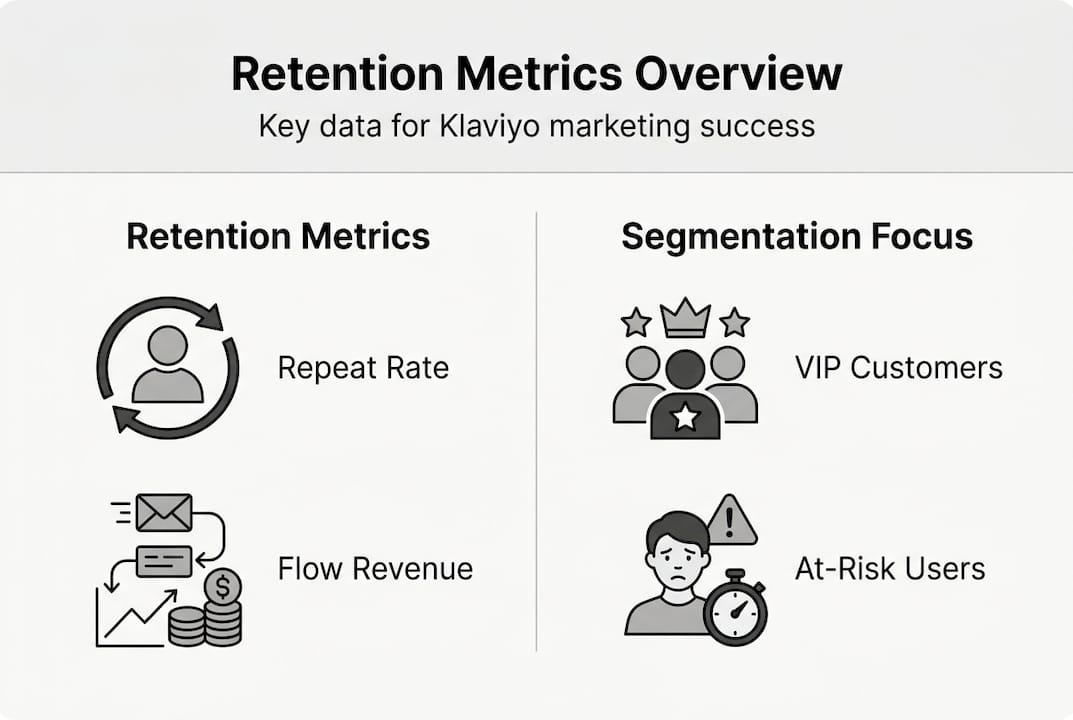
Here is a baseline snapshot to benchmark yourself against:
| Metric | Underperforming | Average | High Performing |
|---|---|---|---|
| Repeat purchase rate | Below 20% | 20-30% | Above 30% |
| Flow revenue share | Below 25% | 25-35% | Above 40% |
| Revenue per recipient | Below $0.10 | $0.10-$0.50 | Above $0.50 |
| Flow open rate | Below 30% | 30-45% | Above 45% |
The data tells a clear story. Email flows generate nearly 41% of total email revenue from only 5.3% of sends, with an RPR 18x higher than broadcast campaigns. That gap is enormous, and it shows exactly where to focus your energy.
“Flows beat campaigns for retention every time because they reach the right customer at the right moment with relevant context, not just when you have something to announce.”
Before you touch a single flow, run through this quick audit checklist:
- Are your automated email retention flows live and actively sending?
- Is your suppression list current and removing unengaged contacts?
- Are you tracking RPR separately for flow-sourced versus campaign-sourced customers?
- Have you reviewed your customer retention importance metrics in the last 90 days?
- Do you have a post-purchase flow with at least three touchpoints?
This baseline audit is not glamorous, but it is the foundation everything else is built on. Skipping it means optimizing in the dark.
Optimizing segmentation: RFM analysis and targeting
Once you have your retention baseline, it is time to target your efforts by identifying exactly who your customers are and how they behave.
RFM analysis segments customers by three dimensions: Recency (how recently they purchased), Frequency (how often they buy), and Monetary value (how much they spend). In Klaviyo, you can build these segments using property filters and purchase history data to score every customer on a 1 to 5 scale across all three dimensions.
Here is how to build RFM segments step by step:
- Define your recency windows: 0 to 30 days, 31 to 90 days, 91 to 180 days, and 180 days or more.
- Set frequency thresholds based on your average order cadence (for example, 1 order, 2 to 3 orders, 4 or more orders).
- Score monetary value using Klaviyo’s predicted lifetime value or total spend tiers.
- Create named segments in Klaviyo combining these scores (example: R5 F5 M5 = VIP customer).
- Map each segment to a specific flow path or campaign strategy.
Here is how segment types translate into tactical decisions:
| Segment | Profile | Recommended tactic |
|---|---|---|
| VIP | High R, F, M | Early access, loyalty rewards, referral asks |
| At-risk | Low R, medium F | Win-back sequence, survey, limited offer |
| Promising | High R, low F | Education series, cross-sell, social proof |
| Low value | Low R, low F | Suppression or re-engagement before removal |
Once your segments exist, use conditional splits inside your flows to route customers dynamically. For example, a post-purchase flow can branch: VIP customers receive a referral ask at day 7, while first-time buyers get a product education email instead. This is where automated workflow examples show their real power.
Pro Tip: Add a zero-party data collection step (a simple preference quiz or survey) inside your welcome flow. Customers who self-identify their preferences convert at significantly higher rates because every email they receive feels personally relevant.
Adjusting email flows for superior retention results
With segments in place, let us translate that strategy into action by dialing in your email flows for consistent, predictable retention gains.

Flows win because they operate on customer behavior, not your publishing calendar. A campaign goes out when you send it. A flow fires when a customer does something meaningful, which is why the revenue gap between the two is so dramatic. High-performing flows achieve click rates above 10% and up to $7.79 RPR, which is the benchmark to aim for when auditing your own.
When adjusting any flow, focus on four elements:
- Triggers: Are they firing on the right events? Purchase, browse abandon, and cart abandon are non-negotiable starting points.
- Timing: Does your send cadence match your product lifecycle? A coffee brand should follow up in 25 days. A furniture brand might wait 90 to 180 days before a replenishment nudge.
- Exclusions: Are recent buyers excluded from win-back flows? Are active subscribers excluded from re-engagement campaigns?
- Content: Is each email doing one job? One CTA, one message, one clear next step.
Common flow adjustment mistakes to avoid:
- Sending too many emails too fast and burning out new subscribers
- Using the same subject line style across every touchpoint
- Forgetting to suppress unsubscribes from all active flows
- Skipping the browse abandon flow because it feels “too aggressive”
- Never updating flows after the initial setup
Pro Tip: Audit flows quarterly and update them two to three times per year. Flows are not set-and-forget. Seasonal shifts, product catalog changes, and audience behavior all require you to revisit timing, copy, and logic regularly.
For retention email ideas that keep customers engaged between purchases, think beyond discounts. Educational content, behind-the-scenes stories, and user-generated content all drive clicks without eroding your margins.
Testing, auditing, and troubleshooting for continuous improvement
Making changes is just the beginning. Here is how to ensure each adjustment is actually driving results you can measure.
A/B testing inside Klaviyo is your most reliable tool for improvement, but most brands test the wrong things or test too many variables at once. Test one variable at a time for two to four weeks before declaring a winner. Klaviyo’s AI can automatically select winners based on your chosen metric, which removes the guesswork from timing.
Here is a practical testing framework:
| Variable | What to test | Expected impact |
|---|---|---|
| Subject line | Curiosity vs. direct benefit | Open rate change of 5-15% |
| Send timing | Morning vs. evening | Click rate shift of 2-8% |
| Offer type | Discount vs. free shipping | Conversion rate and margin impact |
| Email length | Short vs. long form | Click-through and unsubscribe rate |
When results underperform, follow this troubleshooting sequence:
- Check deliverability first: Are emails landing in spam? Review your sender score and authentication settings.
- Audit your segment size: A flow targeting 50 people cannot produce statistically meaningful data.
- Review trigger logic: Are the right customers entering the flow at the right time?
- Analyze drop-off points: Which email in the sequence loses the most engagement?
- Compare against benchmarks: Use Klaviyo’s industry data to set realistic expectations.
“Open rates tell you about curiosity. Revenue per recipient tells you about impact. Optimize for the metric that pays your bills.”
For repurposing content for email, your best-performing blog posts and social content are already proven. Adapt them into flow emails to reduce production time while maintaining quality.
Red flags that need urgent attention: RPR dropping month over month, flow revenue share falling below 25%, unsubscribe rates above 0.5% per email, and zero engagement in your first post-purchase touchpoint.
Proven tactics for win-backs and steady revenue growth
Targeted win-back campaigns put it all together, transforming at-risk customers into loyal repeat buyers.
A well-structured win-back flow looks like this:
- Day 0: Trigger when a customer passes their expected repurchase window
- Day 3: Send a “We miss you” email with a soft reminder of what they bought
- Day 10: Follow up with social proof or new arrivals relevant to their purchase history
- Day 17: Introduce a time-limited incentive (free shipping or a small discount)
- Day 25: Final email with a clear “last chance” message before suppression
Win-back flows recover 10 to 15% of churning customers, and a revenue per recipient of $2 to $4 is considered a solid benchmark for this flow type. That number compounds fast when you have thousands of lapsing customers cycling through every quarter.
The compounding effect is real. The Beauty Crop increased year-over-year flow revenue by 84x, while Laura James grew by 254% and ZUS by 107% using systematic Klaviyo optimization. These are not outliers. They are the result of consistent, incremental improvements applied over time.
“Brands that treat every flow adjustment as a permanent experiment, not a one-time fix, are the ones that see compounding retention gains year after year.”
To boost email-driven sales beyond win-backs, layer in cross-sell and upsell flows triggered by purchase category. A customer who buys a starter kit is a natural candidate for a premium upgrade flow 60 days later.
Why perfect marketing plans are overrated—and what actually works
Most brands waste months trying to build the perfect retention plan before sending a single email. The irony is that the brands generating the most consistent revenue growth are not the ones with the most detailed plans. They are the ones who launch fast, analyze honestly, and adjust constantly.
The real competitive advantage in ecommerce retention is iteration speed. Every quarter, you should be running at least one meaningful test, reviewing your RFM segments, and updating at least one flow based on what the data shows. Generic best practices are a starting point, not a destination.
Your real-world retention strategy should be built on your own customer behavior data, not industry averages. What works for a skincare brand may completely fail for a home goods brand. The framework is universal. The execution must be specific.
Treat every adjustment as an experiment. Document what you changed, why you changed it, and what happened. Over time, this creates an institutional knowledge base that no competitor can copy. Launch, analyze, pivot, repeat. Every quarter. That is the actual playbook.
Let Take Action help scale your retention success
Ready to see sustained retention growth without guesswork? Here is how you can get help from experts who have driven proven email results.
Applying everything in this guide takes time, expertise, and ongoing attention that most ecommerce teams simply do not have in-house. That is where working with email marketing experts makes a measurable difference.
At Take Action, we specialize in exactly this: auditing your current Klaviyo setup, building RFM-driven segmentation, designing high-converting flows, and delivering monthly performance reporting so you always know what is working. Our Klaviyo retention consulting is built around your brand’s data, not templates. If you are ready to turn your email list into a reliable, scalable revenue channel, let us build your custom retention plan together.
Frequently asked questions
How often should I adjust my Klaviyo marketing plan?
Review and adjust your marketing plan at least quarterly, updating flows two to three times per year based on performance data and seasonal shifts.
What is the quickest way to improve retention if my current plan isn’t working?
Deploy automated win-back and post-purchase flows targeted by RFM segment immediately, since win-back flows recover roughly 10 to 15% of churning customers with minimal setup time.
Which metrics matter most when adjusting email marketing plans in 2026?
Focus on repeat purchase rate and revenue per recipient, as revenue metrics outperform open rates for measuring true retention effectiveness, especially after privacy updates reduced open rate reliability.
How can I personalize flows without over-discounting?
Use conditional splits by cart value and customer segment to reserve discounts for lower-value or at-risk customers while offering VIP segments early access or exclusive content instead.
Recommended
- Top marketing funnels for Klaviyo in 2026: Boost retention | Take Action Blog | Take Action
- How Klaviyo content marketing agencies boost retention 321% | Take Action Blog | Take Action
- Online Marketing Strategy: Driving Ecommerce Retention | Take Action Blog | Take Action
- Marketing Budget: 25% to Klaviyo = 45% Revenue Boost | Take Action Blog | Take Action
- Amazon-Marketing-Checkliste: 30% Mehr Umsatz Priorisieren