

2025 digital marketing trends for ecommerce success
TL;DR:
- Automated email flows drive 41% of ecommerce revenue with high efficiency, outperforming campaigns.
- Segmentation and AI personalization enhance relevance and engagement, boosting click and conversion rates.
- Omnichannel coordination and data-driven measurement are crucial for peak season success in 2025.
Email is not dying. It never was. While paid social costs keep climbing and algorithm changes keep brands guessing, automated email flows are quietly generating more ecommerce revenue than most teams realize. Flow-based email materially outperforms campaign email on engagement and revenue efficiency, yet many brands still treat their Klaviyo account like a newsletter tool. This guide breaks down the digital marketing trends reshaping ecommerce in 2025, with concrete frameworks you can apply to your lifecycle flows, segmentation strategy, AI personalization, and peak-season planning starting today.
Table of Contents
- Why email-driven lifecycle flows lead 2025’s digital marketing trends
- Segmentation: The engine behind personalized revenue growth
- AI-powered personalization: The game changer for 2025 email engagement
- Preparing for 2025 peak: Omnichannel orchestration and measurement
- Our take: What seasoned marketers miss about digital marketing trends in 2025
- Drive retention and revenue with expert email strategy
- Frequently asked questions
Key Takeaways
| Point | Details |
|---|---|
| Flows beat campaigns | Automated lifecycle flows drive more engagement and revenue than traditional email blasts. |
| Segmentation boosts results | Precise customer segments ensure emails are relevant and high-performing. |
| AI powers personalization | AI-driven recommendations significantly increase click rates and conversion. |
| Measurement matters | Clicks and orders are more reliable metrics than open rates in 2025. |
Why email-driven lifecycle flows lead 2025’s digital marketing trends
Automated lifecycle flows have moved from a “nice to have” to the foundation of every high-performing ecommerce retention strategy. The brands growing fastest are not sending more campaigns. They are building smarter, always-on sequences that engage customers at exactly the right moment in their journey.
The numbers make this hard to ignore. Automated flows drive nearly 41% of total email revenue while accounting for only about 5% of total sends. That ratio tells you everything about efficiency. One well-built cart abandonment flow can outperform months of broadcast campaigns because it speaks directly to an action the subscriber has already taken.
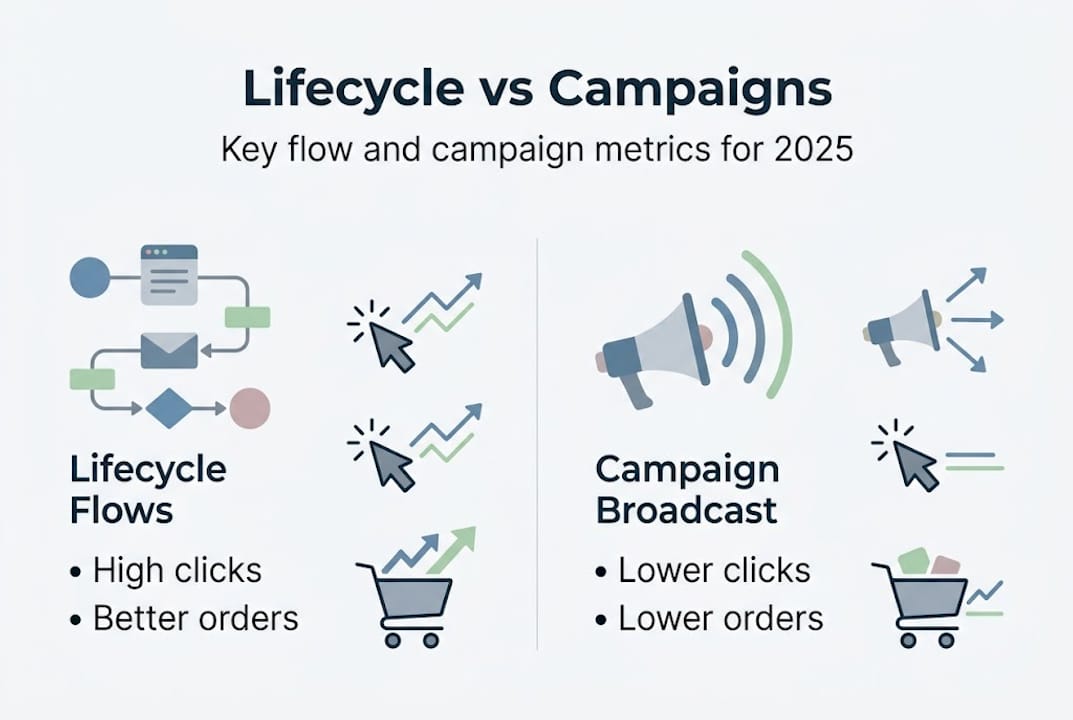
Here is how flows and campaigns compare across the core performance metrics:
| Metric | Lifecycle flows | Broadcast campaigns |
|---|---|---|
| Average click rate | ~3.8% | ~1.4% |
| Placed order rate | ~1.2% | ~0.3% |
| Revenue per send | High | Low |
| Audience relevance | High (behavior-triggered) | Low (broad list) |
The gap is consistent because relevance drives performance. A welcome flow nurtures someone who just discovered your brand. A browse abandonment flow re-engages someone who showed clear product interest. A post-purchase flow builds loyalty before the first order even arrives. Each of these sequences maps to real customer behavior, and that is something a scheduled campaign can never fully replicate.
According to Klaviyo’s best practices for ecommerce email in 2025, lifecycle retention built around segmentation and automated flows is the primary framework for sustainable revenue growth. Brands that treat flows as set-and-forget miss the point. The real advantage comes from continuously testing and refining each step in the sequence.
Explore the full picture of how Klaviyo lifecycle funnels work together to build compounding revenue. When you combine welcome, browse abandonment, abandoned cart, post-purchase, win-back, and cross-sell into one coordinated system, the combined revenue lift is significant, especially compared to brands relying on ad spend alone.
“Automation is not about removing the human touch. It is about delivering that touch at scale, at the exact moment a customer needs it.”
Pro Tip: Resist the urge to increase campaign frequency as a growth lever. Instead, audit your flow coverage first. If you are missing browse abandonment or a cross-sell sequence, plug those gaps before adding more one-off sends. Better ecommerce retention strategies are built on consistent behavioral touchpoints, not higher volume.
Segmentation: The engine behind personalized revenue growth
Once you have lifecycle flows running, segmentation becomes the multiplier. It determines which flows reach which customers, how aggressive the offer strategy gets, and whether your messages feel personal or generic. Without precise segmentation, even the best-written email is noise.
The core principle is simple: not every subscriber deserves the same message. A customer who just bought for the third time has completely different needs and intent compared to someone who signed up two weeks ago and has never clicked. Treating them identically is a missed opportunity every single time.
Here are the key segments every ecommerce brand should build and maintain:
- New signups (no purchase): Nurture sequence focused on brand story, social proof, and first-purchase incentive
- High-intent browsers: Visited product pages multiple times but have not added to cart yet
- Active cart abandoners: Added products but did not complete checkout
- Recent purchasers (1 to 30 days): Post-purchase sequence focused on onboarding, upsell, and review requests
- Repeat buyers: VIP treatment, early access, and loyalty rewards
- Lapsed customers (90 to 180 days): Win-back flows with compelling re-engagement offers
- Unengaged subscribers: Suppression candidates or last-chance reactivation campaigns
Each of these segments requires a different message tone, offer level, and send frequency. A high-intent browser who has visited a product page three times in one week is ready for a direct, benefit-led message. A lapsed customer who has not opened in 120 days needs a completely different angle.
Segmentation strategies that use both engagement data and purchase behavior create dynamic lists that update in real time. This is where Klaviyo’s native data layer becomes a competitive advantage. You can build rules based on purchase count, total order value, product category viewed, days since last order, and engagement score all at once.
The practical impact of this is powerful. Brands using behavioral segmentation see higher open rates because subscribers receive content that matches where they are in their journey. They also see fewer unsubscribes because the messaging feels relevant rather than intrusive. Understand the full segmentation benefits when you apply layered rules that combine intent signals with historical behavior.
Pro Tip: Avoid building static segments. Use dynamic filters in Klaviyo so your lists update automatically based on real behavior. A segment called “recently purchased” should pull in anyone who bought in the last 30 days without manual updates. Check out these list segmentation tips to set up your filters correctly from the start.
Segmentation is also what protects your sender reputation as you scale. Sending to your full list every time is a fast path to spam folders. Sending to tightly defined, engaged segments keeps your deliverability strong and your revenue per email climbing.
AI-powered personalization: The game changer for 2025 email engagement
Segmentation gets your message to the right person. AI-powered personalization makes sure that message says exactly the right thing. In 2025, the brands separating themselves from the competition are not just using AI to write subject lines. They are embedding AI-driven product recommendations directly into their lifecycle flows.
AI product recommendations are one of the most impactful trends for ecommerce personalization this year. The performance data supports the investment. Emails with AI-powered product recommendations achieve an average click rate of around 3.75%, with top-performing brands reaching 8.79%. Compare that to a standard campaign click rate around 1.4% and the case is clear.

Here is a practical comparison of how AI integration affects performance:
| Flow type | Click rate without AI | Click rate with AI | Order rate improvement |
|---|---|---|---|
| Post-purchase cross-sell | 2.1% | 4.3% | +105% |
| Browse abandonment | 3.0% | 5.8% | +93% |
| Win-back | 1.2% | 2.9% | +142% |
| Welcome series | 2.8% | 3.6% | +29% |
The biggest misconception about AI in email marketing is that it only helps with content generation. Writing subject lines with AI is useful but surface-level. The real leverage comes from operational maturity and connected workflows, where AI is embedded into automated sequences and tied directly to measurable outcomes.
Here is a four-step approach to getting started with AI-driven personalization in your flows:
- Connect your product catalog to your Klaviyo account so recommendations can pull from live inventory and pricing
- Define trigger points where product recommendations make the most sense (post-purchase cross-sell, browse abandonment follow-up, win-back reactivation)
- Set recommendation logic based on category affinity, purchase history, and viewed products rather than just bestsellers
- Test and iterate by running A/B tests on recommendation placement within the email and measuring click and order rate impact
The brands failing with AI personalization are the ones bolting it onto their existing setup without adjusting their trigger logic or offer strategy. The technology works best when it is part of an integrated system, not an afterthought. For broader context on how this fits into your overall content approach, explore these content marketing trends that align with personalized email execution.
Pro Tip: Do not default to showing top-selling products as your AI recommendation. Most customers have already seen those. Use affinity-based logic that matches what each individual has browsed or purchased before. This produces significantly better click-throughs and creates the experience of a brand that genuinely understands them.
Preparing for 2025 peak: Omnichannel orchestration and measurement
With core flows and personalized content in place, the next competitive advantage comes from synchronized omnichannel execution and disciplined measurement. Peak periods like Black Friday, Cyber Monday, and holiday season reward brands that plan early and coordinate across every owned channel.
Omnichannel planning for BFCM and holiday 2025 means treating email, SMS, and push notifications as one coordinated system rather than three separate channels. Klaviyo emphasizes acting on behavioral intent signals across all owned channels and orchestrating sequences so that each message builds on the last. A customer who clicks an email but does not purchase should receive an SMS follow-up, not a repeat of the same email.
Behavioral signals are the key to making omnichannel work without overwhelming subscribers. These signals include:
- Click activity: Shows intent and content interest
- Browse patterns: Reveals product and category preferences
- Cart actions: Strongest purchase intent signal available
- Purchase recency: Determines how aggressively to follow up
- Channel engagement: Tells you whether email or SMS drives more action for each segment
When you layer these signals across your peak-season sequence, you avoid the common mistake of blasting your entire list with every promotion. Instead, your highest-intent customers receive the most direct, urgent messaging. Customers who are less engaged get softer touchpoints that re-warm them before the main sale event.
“Open rate is no longer the metric that tells you if your email program is working. Clicks, conversions, and attributed revenue are the real scoreboard.”
This point matters especially in 2025. Open rates have become less reliable as a primary KPI due to privacy protections like Apple Mail Privacy. Brands that optimize for open rates often make the wrong decisions, such as choosing subject lines that generate curiosity but no clicks. Shifting your focus to click rate, conversion rate, and revenue per recipient gives you a much more accurate picture of what is actually working.
For peak-season measurement, here are the tactics that consistently produce results:
- Coordinate email and SMS sends so they complement each other rather than duplicate the same message
- Space your offers strategically with early access for VIP segments, followed by general sale sends
- Use intent-based triggers to send cart abandonment reminders at higher frequency during peak windows
- Measure revenue attributed to each flow and campaign separately so you know exactly where performance is coming from
You can find practical email marketing tips for peak-season execution that align with this omnichannel framework. For context on how these orchestration patterns are evolving beyond email into integrated retail workflows, the broader digital retail space is moving in the same direction.
Our take: What seasoned marketers miss about digital marketing trends in 2025
Here is what most trend articles will not say directly: the brands struggling in 2025 are not struggling because they lack access to AI tools. They are struggling because they are chasing tools without building the operational foundation that makes those tools work.
We see this constantly. A brand integrates an AI recommendation engine and sees zero lift because their product feed is incomplete. Another brand builds five new flows but never connects their SMS and email timing, so customers receive mixed signals. The technology is available to everyone. The discipline to connect it properly is not.
Operational maturity and connected workflows are what separate top performers from average ones. AI is an enabler. Your segmentation logic, your trigger setup, your measurement framework, and your team’s ability to act on data are the actual differentiators. Marketers who prioritize the system over the latest feature will outperform those who chase every new capability.
The uncomfortable truth is that a brand with basic flows, clean segmentation, and a strong measurement practice will beat a brand with advanced AI tools and messy execution every single time. Before you add another layer of technology, audit what you already have. Are your flows actually converting? Are your segments pulling the right people? Are you measuring the right KPIs? Start with marketing strategy insights that ground your decisions in data, not trend pressure.
Drive retention and revenue with expert email strategy
Understanding the trends is one thing. Building and running the systems that deliver results is where most teams hit a wall.
At Take Action, we specialize in exactly this: deploying winning lifecycle flows, building precise segmentation frameworks, and integrating AI-driven personalization into Klaviyo setups that actually perform. Whether you need a full audit of your current program, a managed service that handles ongoing execution, or a lifecycle playbook built specifically for your brand, our team brings the operational expertise and strategic depth to make it happen. Connect with our email marketing experts to discuss what your program needs most, or explore our full range of email strategy services to find the right engagement model for your growth stage.
Frequently asked questions
What are the most important lifecycle flows to set up in 2025?
The essential flows to prioritize are welcome, browse abandonment, abandoned cart, post-purchase, win-back, and cross-sell. According to Klaviyo’s best practices, these sequences form the core of lifecycle retention and collectively drive the most reliable automated revenue.
Is open rate still a meaningful email metric in 2025?
Open rates have become less reliable due to privacy changes like Apple Mail Privacy Protection. Clicks, conversions, and revenue are now the primary KPIs that accurately reflect how your email program is actually performing.
How does AI personalization really impact email results?
AI-powered product recommendations lift average email click rates to around 3.75%, with top performers exceeding 8.79%, by surfacing products directly relevant to each individual’s browsing and purchase behavior.
Why is omnichannel planning critical for BFCM and holiday 2025?
Omnichannel orchestration for BFCM ensures that email, SMS, and push messaging work together as a coordinated system, reaching shoppers across multiple touchpoints during the highest-revenue windows of the year and maximizing conversion from every intent signal.